Kelp Forests: Predicting Future Growth Areas With a Changing Climate

Jim Crocker
24th September, 2025

Kelp Forests: Predicting Future Growth Areas With a Changing Climate

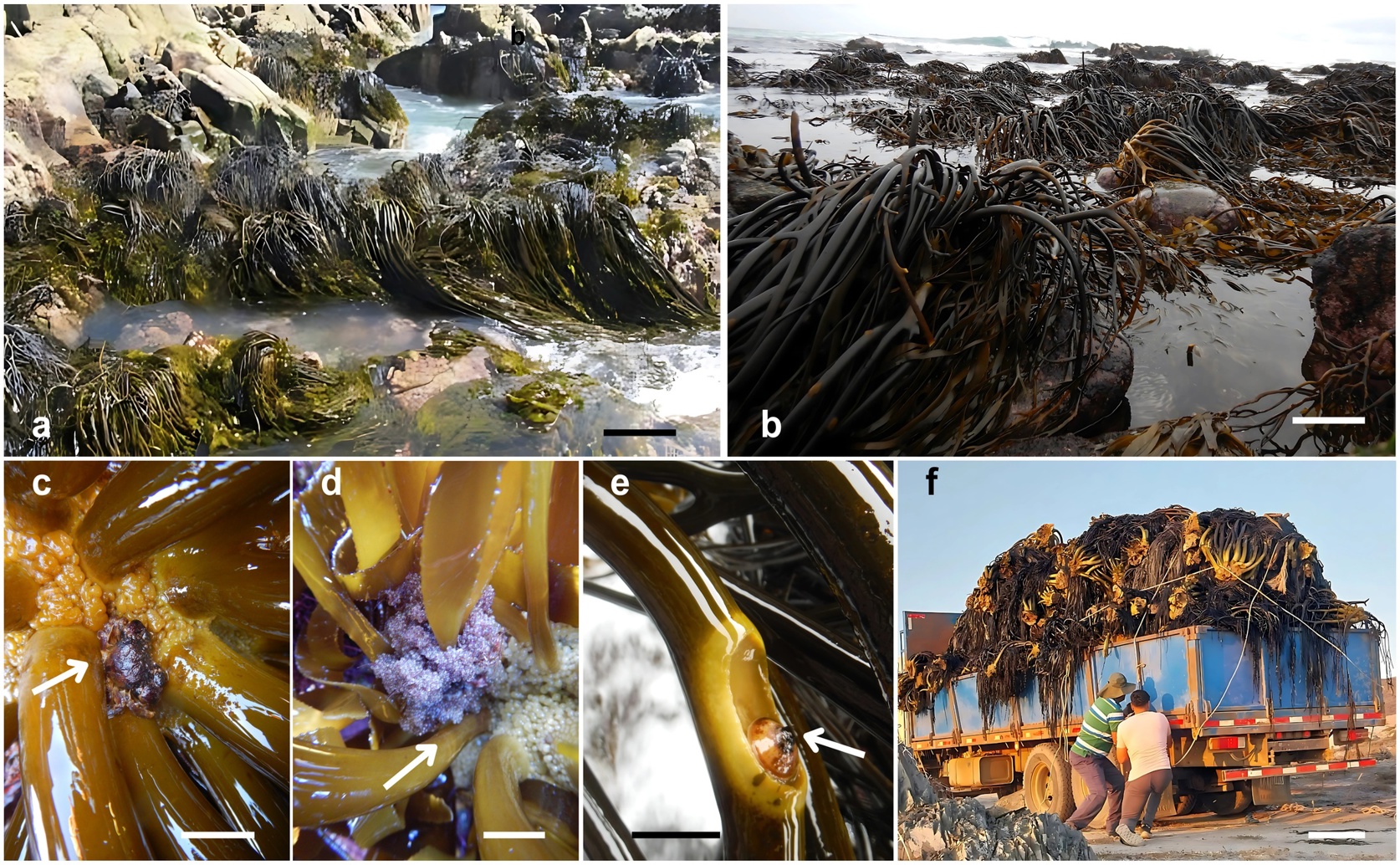
These field observations illustrate the critical role of Lessonia berteroana (a) and Lessonia spicata (b) as ecosystem engineers supporting diverse marine assemblages (c–e) and their significant socioeconomic value as harvested resources (f).

Image adapted from: Duarte et al. / CC BY (Source)

Key Findings

  • This study, focused on kelp species along the Pacific coast of South America, predicts significant habitat loss for both Lessonia berteroana and Lessonia spicata by 2050 due to climate change
  • L. berteroana is predicted to lose up to 60.6% of its current habitat, while L. spicata may lose 58.6%, with a particularly vulnerable zone between 14°S and 25°S
  • Salinity is the primary factor influencing L. berteroana's distribution, whereas surface water temperature is more important for L. spicata, suggesting tailored conservation strategies are needed
Kelp forests are underwater ecosystems formed by dense growths of kelp – large brown algae – and are among the most productive and biodiverse marine habitats on Earth. They provide shelter and food for a wide range of organisms, protect coastlines from erosion, and even absorb carbon dioxide from the atmosphere. However, these valuable ecosystems are under increasing threat from a combination of factors, including climate change and direct human activities like overharvesting. A recent study conducted by researchers at Universidad Austral de Chile, Universidad de Chile, Universidad Católica del Norte, CIDTA, Instituto Milenio SECOS, and MARE—Marine and Environmental Sciences Centre[1] focused on two species of kelp, Lessonia berteroana and Lessonia spicata, found along the Pacific coast of South America. These species are particularly important because they are heavily exploited by regional fisheries, making them vulnerable to overfishing. The study aimed to predict how the distribution of these kelps might change in the future under different climate change scenarios. Understanding how species distributions change is critical for conservation efforts. The distribution of any species is ultimately determined by the environmental conditions it can tolerate, and climate change is rapidly altering those conditions. To predict future distributions, researchers often use a technique called species distribution modelling (SDM). This involves identifying the environmental factors that currently limit where a species is found, and then using that information to project where the species might be able to survive in the future as those environmental conditions change. In this study, the researchers used SDMs to assess the potential distribution of L. berteroana and L. spicata under four different “representative concentration pathways” (RCPs). These pathways represent different possible future levels of greenhouse gas emissions, ranging from relatively low to very high. The models considered factors like salinity and sea surface temperature, which are known to influence kelp growth and survival. The results revealed a concerning trend: both L. berteroana and L. spicata are predicted to experience significant range contractions by 2050. For L. berteroana, the models suggest a potential loss of up to 60.6% of its current habitat, with only 31.6% of the current area expected to remain suitable. L. spicata faces a similar fate, with a predicted loss of 58.6% of its habitat and retention of only 58.2% of its current range. The models pinpointed a particularly vulnerable area between 14°S and 25°S, where both species are likely to disappear locally. These predictions align with broader observations of kelp forest decline worldwide[2]. While global declines are variable, with some regions even showing increases in kelp abundance, the study highlights that local stressors often play a dominant role in kelp dynamics. The findings also build upon research demonstrating the importance of physiological tolerance to environmental variables in determining species distributions[3]. Specifically, the study echoes the idea that the limits of a species’ range often correspond to the geographic extent of temperature regimes it can physiologically tolerate. Interestingly, the study identified different key environmental factors for each species. Salinity was the primary driver for L. berteroana, while surface water temperature was more important for L. spicata. This suggests that the two species respond differently to environmental change and may require tailored conservation strategies. The importance of sea surface temperature for L. spicata is consistent with other studies highlighting the sensitivity of kelp forests to warming ocean temperatures[4]. The predicted habitat loss has significant implications for the coastal ecosystems of South America. Kelp forests provide crucial ecosystem services, and their decline could lead to reduced biodiversity, increased coastal erosion, and impacts on fisheries. The research underscores the urgent need for effective management and conservation measures to protect these valuable ecosystems. This includes addressing overexploitation and mitigating the effects of climate change.

EnvironmentEcologyPlant Science

References

Main Study

1) Kelps on the move: Potential future distribution areas in the face of climate change, on the Pacific coast of South America

Published 23rd September, 2025

https://doi.org/10.1371/journal.pone.0332591


Related Studies

2) Global patterns of kelp forest change over the past half-century.

Journal: Proceedings of the National Academy of Sciences of the United States of America, Issue: Vol 113, Issue 48, Nov 2016


3) Temperature effects on gametophyte life-history traits and geographic distribution of two cryptic kelp species.

https://doi.org/10.1371/journal.pone.0039289


4) A species distribution model of the giant kelp Macrocystis pyrifera: Worldwide changes and a focus on the Southeast Pacific.

https://doi.org/10.1002/ece3.10901


Related Articles

An unhandled error has occurred. Reload 🗙