Dietary fiber could help protect the brain from Alzheimer's disease

Greg Howard
28th September, 2025

Dietary fiber could help protect the brain from Alzheimer's disease

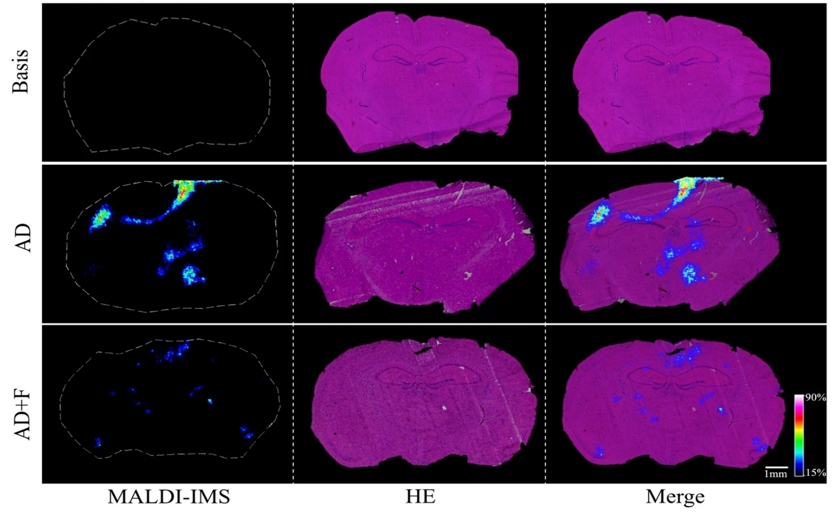
A high-fiber diet visibly reduces Alzheimer's plaques (bottom row / AD+F) compared to a standard diet (middle row / AD)

Image adapted from: Böswald et al. / CC BY (Source)

Key Findings

  • In 5xFAD mice, a diet supplemented with inulin fibre altered the gut microbiome composition
  • Inulin supplementation significantly increased short-chain fatty acid (SCFA) concentrations in the gut
  • Mice receiving inulin showed a noticeable reduction in amyloid-beta plaque build-up in the brain
Alzheimer’s disease is a devastating neurodegenerative condition affecting millions worldwide, characterized by progressive memory loss and cognitive decline. Currently, there is no cure, and treatment options are limited. Increasingly, research points to a complex interplay between the gut microbiome – the community of bacteria residing in the digestive system – and the brain, known as the microbiota-gut-brain axis, as a key factor in the development and progression of the disease[2]. However, the precise mechanisms involved are still being unravelled. Researchers at Ludwig-Maximilians-Universität München (LMU Munich) recently investigated whether dietary fibre supplementation could influence this axis and potentially mitigate Alzheimer’s disease pathology[1]. The study focused on a 5xFAD mouse model, a genetically engineered strain that develops characteristics of Alzheimer’s disease, including the build-up of amyloid-beta plaques in the brain. This model allows scientists to study the disease process in a controlled environment. The core of the study involved a feeding trial. Mice were divided into three groups: a control group (Basis) receiving a standard diet, an Alzheimer’s disease group (AD) also receiving a standard diet, and an Alzheimer’s disease group supplemented with inulin (AD+F). Inulin is a type of prebiotic fibre, meaning it’s not digested by the body but serves as food for beneficial bacteria in the gut. After seven weeks, researchers analyzed samples from the mice to assess the impact of the inulin supplement. These samples included gut contents from different parts of the digestive system and brain tissue. One of the key findings was a distinct difference in the composition of the gut microbiome between the AD and AD+F groups. The types and abundance of bacteria varied depending on whether the mice received inulin supplementation. This suggests that inulin is actively altering the gut microbial community. Crucially, the researchers also observed significantly higher concentrations of short-chain fatty acids (SCFAs) in the AD+F group compared to the AD and Basis groups. SCFAs are produced by gut bacteria when they ferment fibre and have known anti-inflammatory and neuroprotective properties. Perhaps the most significant result was the effect on amyloid-beta plaque load in the brain. Mice in the AD group exhibited a substantial increase in plaque build-up compared to the control group, as expected. However, the AD+F group showed a noticeable reduction in plaque load relative to the AD group. This indicates that inulin supplementation is having a protective effect against the hallmark pathology of Alzheimer’s disease. To further understand the mechanisms at play, the researchers performed a proteome analysis of brain tissue. The proteome refers to the complete set of proteins present in a cell or tissue, and analyzing it provides insights into the biological processes occurring. The proteome differed between the AD+F and AD groups, suggesting that inulin supplementation is influencing brain function beyond simply reducing plaque load. The study suggests that microbial acetate, a type of SCFA, may be partially responsible for these beneficial effects. These findings align with earlier research highlighting the role of lifestyle factors in Alzheimer’s disease[3]. While lifestyle factors don’t directly reverse the underlying disease pathology, they can contribute to positive outcomes in individuals at risk. The current study builds on this by identifying a specific dietary intervention – inulin supplementation – that appears to modulate the gut microbiome and subsequently impact brain health. It also supports the idea that diet can influence β-amyloid production and tau processing, and regulate inflammation, metabolism, and oxidative stress, plausibly via modulating gut microbiota[2]. The study also builds on the established understanding of bidirectional communication within the brain-gut-microbiome axis[4][5]. The research demonstrates that altering the gut microbiome through dietary means can have measurable effects on brain protein expression and amyloid-beta deposition. This supports the concept of circular communication loops between the brain, gut, and gut microbiome, where changes at one level can propagate throughout the system. The researchers emphasize that inulin is a common component of many human diets, making these findings potentially translatable to preventative and therapeutic strategies for Alzheimer’s disease. Further research, particularly well-designed clinical trials, is needed to confirm these results and determine the optimal dosage and duration of inulin supplementation for maximum benefit.

NutritionHealthMental Health

References

Main Study

1) Fibre supplementation alters the gastrointestinal microbiome, the microbial metabolites and indicators of neurodegeneration in a mouse model of Alzheimer´s disease

Published 24th September, 2025

https://doi.org/10.1038/s41598-025-20986-8


Related Studies

2) Diet-Microbiota-Brain Axis in Alzheimer's Disease.

https://doi.org/10.1159/000515700


5) The Brain-Gut-Microbiome Axis.

https://doi.org/10.1016/j.jcmgh.2018.04.003


Related Articles

An unhandled error has occurred. Reload 🗙