Differences in Local Food Options and Memory Loss in Older Adults

Jim Crocker
9th May, 2025

Differences in Local Food Options and Memory Loss in Older Adults

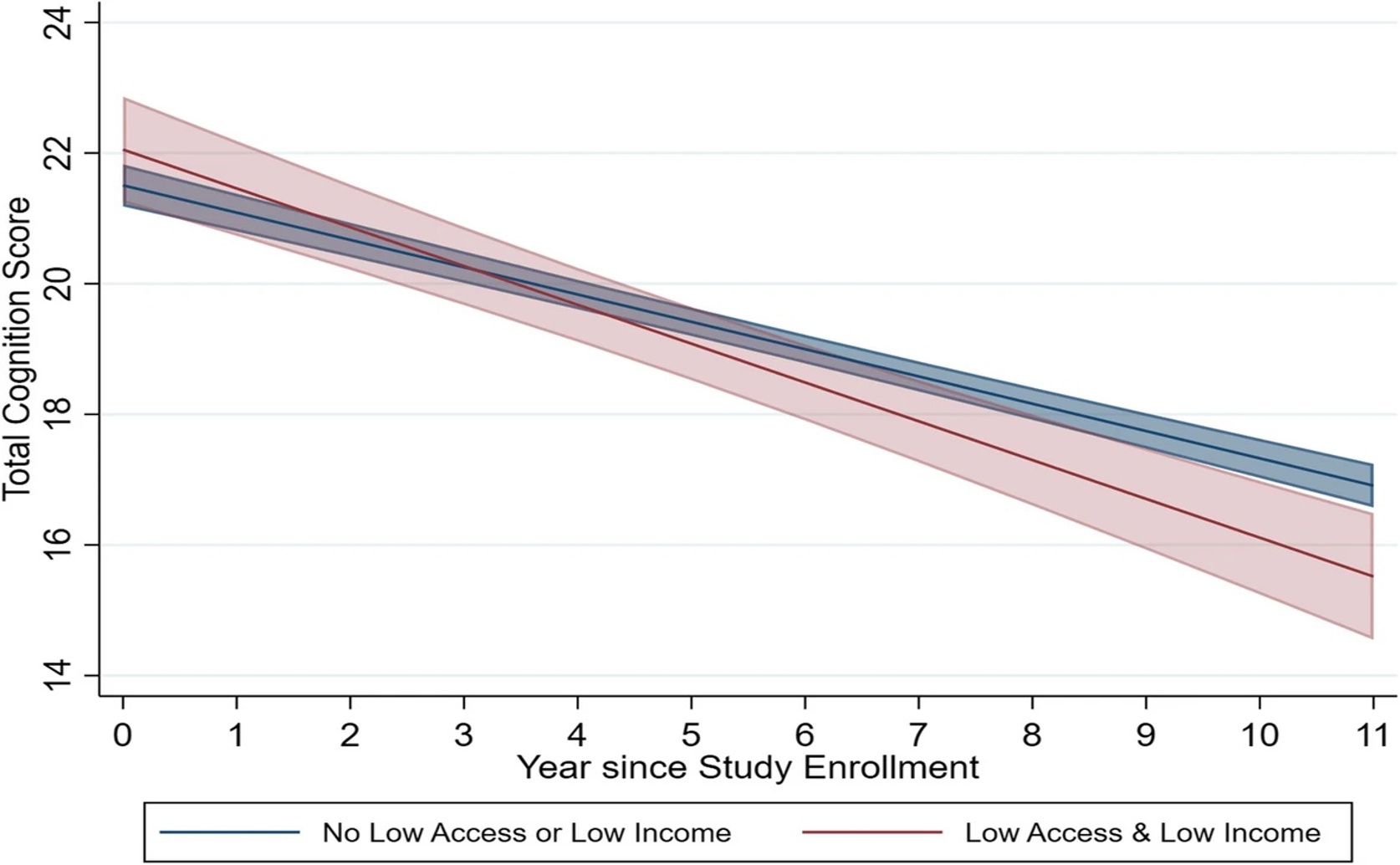
Older adults living in urban neighborhoods with both low food access and low income experience an accelerated rate of cognitive decline over time compared to their peers in neighborhoods without these combined disadvantages.

Image adapted from: Kim et al. / CC BY (Source)

Key Findings

  • In urban Iowa, older adults living in low-income areas with limited access to healthy food see their memory and thinking skills decline faster
  • Poor access to nutritious food combined with low income worsens cognitive health among seniors in these neighborhoods
  • Historical housing discrimination contributes to today's food shortages, deepening health inequalities for older residents
Access to healthy food is a critical component of overall health, particularly for older adults living in urban areas. Disparities in neighborhood food environments—where some communities have limited access to nutritious food while others do not—can have profound effects on residents' health outcomes. A recent study conducted by researchers at the University of Iowa[1] explores how living in low food access and low-income neighborhoods influences cognitive decline among older adults. The problem of unequal food access has been widely recognized in public health research. Food deserts, areas where residents have limited access to affordable and nutritious food, are often juxtaposed with food swamps, where unhealthy food options are plentiful. Previous studies have highlighted various dimensions of food access, including availability, accessibility, affordability, accommodation, and acceptability[2]. However, many of these studies primarily relied on Geographic Information Systems (GIS) to assess food access, which may not fully capture all the nuances of how food environments impact dietary choices and health[2]. The University of Iowa study leverages existing datasets to investigate the relationship between food environment and cognitive function in older adults. By linking the 2010 Food Access Research Atlas data with the 2011–2021 National Health and Aging Trends Study (NHATS), the researchers were able to analyze data from 4,768 urban-dwelling adults aged 65 and older. Cognitive function was measured through various tests assessing orientation, executive function, immediate memory, and delayed memory, providing a comprehensive overview of participants' cognitive health. One of the key findings of this study is that older adults living in neighborhoods characterized by both low access to healthy food stores and low income experience a faster rate of cognitive decline compared to their counterparts in more affluent and better-served areas. This decline was quantified using mixed-effects models, which accounted for both individual and area-level factors, ensuring that the results were robust and reliable. The study's findings build on previous research that has identified the multifaceted nature of food environments. For instance, policies aimed at improving food access, such as the South LA fast food ban, have often been too narrowly focused, failing to address the broader social, economic, and political challenges that contribute to unhealthy food environments[3]. The University of Iowa's research underscores the importance of a comprehensive approach that not only increases access to healthy foods but also addresses underlying issues like poverty and racial segregation. Historical factors, such as redlining—discriminatory housing practices from the 1930s that have long-term effects on neighborhood demographics and resources—continue to play a significant role in shaping current food environments[4]. The study highlights that neighborhoods historically subjected to redlining are more likely to have unhealthy food environments today, even when accounting for present-day economic and racial factors[4]. This structural discrimination has led to persistent inequalities in food access, which in turn contribute to health disparities, including cognitive decline among older adults. Furthermore, this research aligns with systematic reviews that emphasize the complexity of food access and the necessity of using diverse measures to assess it[5]. By incorporating both geographic and socioeconomic dimensions, the University of Iowa study provides a more nuanced understanding of how food environments affect cognitive health. This approach contrasts with earlier studies that may have focused predominantly on geographic access, missing critical aspects like affordability and the quality of available food[2][5]. The implications of these findings are significant for public health policy and urban planning. Addressing cognitive decline in older adults requires more than just improving the availability of healthy foods; it necessitates tackling the root causes of unhealthy food environments. Policies must consider the interconnectedness of economic, social, and political factors that influence food access. For example, improving transportation options to better food stores, increasing the affordability of healthy foods, and revitalizing economically distressed neighborhoods could collectively help mitigate cognitive decline among older residents. Moreover, the study highlights the need for ongoing research to explore the long-term effects of food environments on various aspects of health. As previous studies have shown, factors like affordability, accommodation, and acceptability of food options are crucial yet often overlooked[2]. Future research should continue to explore these dimensions to develop more effective interventions that promote both physical and cognitive health in aging populations. In conclusion, the University of Iowa's study provides valuable insights into the relationship between food environments and cognitive health in older adults. By demonstrating that low food access and low-income neighborhoods are associated with accelerated cognitive decline, the research underscores the urgent need for comprehensive policies that address both food access and the broader social determinants of health. Incorporating lessons from historical practices and previous research, this study paves the way for more holistic approaches to improving health outcomes in urban communities.

NutritionHealthMental Health

References

Main Study

1) Disparities in neighborhood food environment and cognitive decline among US older adults: a cohort study

Published 6th May, 2025

https://doi.org/10.1186/s12916-025-04091-1


Related Studies

2) The local food environment and diet: a systematic review.

https://doi.org/10.1016/j.healthplace.2012.05.006


3) The food environment is a complex social network.

https://doi.org/10.1016/j.socscimed.2015.03.058


4) Historical redlining and food environments: A study of 102 urban areas in the United States.

https://doi.org/10.1016/j.healthplace.2022.102775


5) Disparities and access to healthy food in the United States: A review of food deserts literature.

https://doi.org/10.1016/j.healthplace.2010.04.013


Related Articles

An unhandled error has occurred. Reload 🗙