Scrub Typhus in Nan Province: How Changing Landscapes Affect Disease Risk

Greg Howard
19th September, 2025

Scrub Typhus in Nan Province: How Changing Landscapes Affect Disease Risk

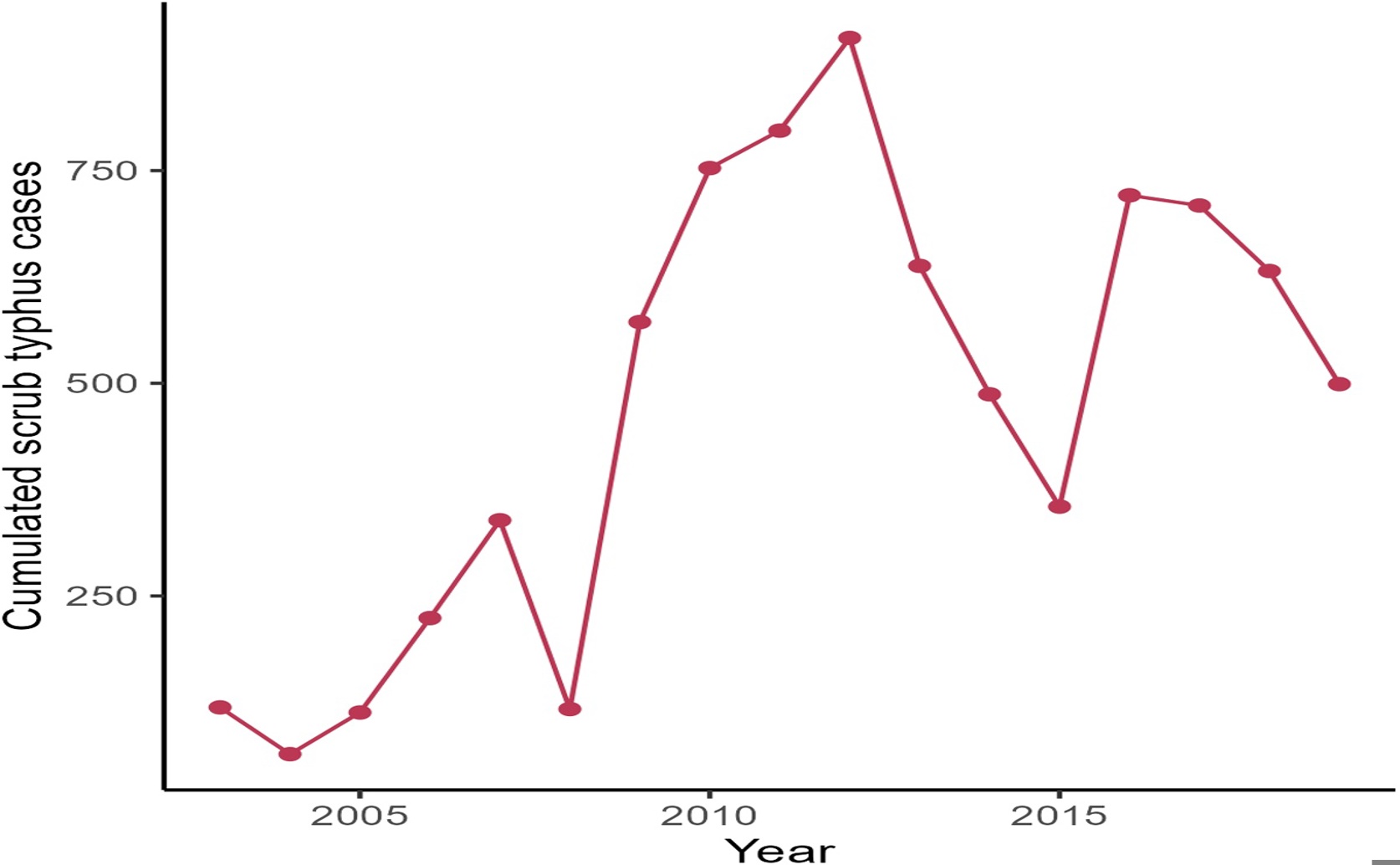
Description of scrub typhus human cases: trend of scrub typhus cases per year.

Image adapted from: Blache et al. / CC BY (Source)

Key Findings

  • In Nan Province, Thailand, scrub typhus cases increased between 2003 and 2019, peaking in 2012 and 2016, and were concentrated in mountainous areas
  • Shrubland and mosaic land areas were linked to higher scrub typhus cases, while broadleaf forest showed a complex relationship and needleleaf forest was associated with fewer cases
  • Changes in land cover, specifically transitions from shrubland to other types, and a male-dominated population were key drivers of scrub typhus transmission
Scrub typhus is a bacterial infection, caused by Orientia tsutsugamushi, transmitted by chigger mites, and is a significant public health concern throughout Asia[2]. Symptoms are often non-specific, making diagnosis difficult, and untreated infections can be fatal, with mortality rates varying considerably[2]. Early research indicated a potentially high mortality rate, but more recent studies suggest this may be lower than initially thought, although accurate estimation remains challenging due to limited surveillance and diagnostic capabilities[2]. The disease is re-emerging in some areas, including Japan[3], and affects an estimated one million people annually[2][3]. A recent study by researchers at Université Clermont Auvergne, Université de Lyon, CNRS – Kasetsart University – Mahidol University, and Tufts Medical Center[1] investigated the relationship between land cover changes and scrub typhus transmission in Nan Province, northern Thailand, between 2003 and 2019. Nan Province experiences a high incidence of scrub typhus, making it an ideal location to study the environmental factors influencing disease spread. The study aimed to determine if alterations to the landscape affected the ecology of the chigger mite vector and, consequently, the risk of infection. The researchers utilized publicly available land cover data from the European Spatial Agency Climate Change Initiative (ESA CCI) to quantify changes in land cover composition around villages in Nan Province. This data was then integrated with public health records of scrub typhus cases, alongside information on elevation, population density, and slope. Generalized Additive Models, a type of statistical analysis, were employed to assess the effects of these land cover changes on the annual number of scrub typhus cases. The study found a significant increase in scrub typhus cases over the 16-year period, with peaks in 2012 and 2016. Interestingly, cases were concentrated in mountainous areas, not the lower-lying Nan River valley. Specific land cover types were strongly associated with case numbers: shrubland, mosaic land (a mix of vegetation types), broadleaf forest, and needleleaf forest. Increased shrubland and mosaic land were linked to higher case numbers, while broadleaf forest showed a more complex, inverted U-shaped relationship – meaning cases increased up to a certain level of forest cover, then decreased. Conversely, needleleaf forest was associated with fewer cases. Several land cover change factors were identified as key drivers of transmission. Transitions from shrubland to other land types, population size, and interactions between geographic location and land cover were particularly important. The impact of reforestation – specifically the conversion of shrubland to broadleaf forest – also exhibited an inverted U-shaped relationship with cases, suggesting that a moderate increase in forest cover may be beneficial, but excessive reforestation could have unintended consequences. Stable broadleaf forest and the loss of shrubland to grassland were found to be less significant. A higher male population was also correlated with increased cases. These findings build upon previous epidemiological data from Thailand, which identified agricultural activity as a major risk factor[4]. The current study expands on this by demonstrating how landscape disturbance, specifically changes in land cover, can create conditions favorable for O. tsutsugamushi transmission. The association between shrubland and increased cases is particularly noteworthy, as this habitat provides suitable conditions for both the chigger mite vector and its rodent hosts. The study also highlights the importance of considering geographical factors, as the relationship between land cover and disease incidence varied across different regions of Nan Province. The research in also touches on the complexities of O. tsutsugamushi itself, which has evolved mechanisms to survive within its host cells[3]. Understanding these mechanisms, combined with the ecological insights provided by this study, is crucial for developing effective prevention and control strategies. The study's regional-scale exploration of land cover impacts on scrub typhus represents a novel approach to understanding disease transmission dynamics in Thailand.

EnvironmentHealthEcology

References

Main Study

1) Scrub typhus in Nan province (Thailand): Seventeen years of data to understand the impact of land cover change

Published 18th September, 2025

https://doi.org/10.1371/journal.pntd.0013552


Related Studies

2) A Systematic Review of Mortality from Untreated Scrub Typhus (Orientia tsutsugamushi).

https://doi.org/10.1371/journal.pntd.0003971


3) Scrub typhus and tropical rickettsioses.

Journal: Current opinion in infectious diseases, Issue: Vol 16, Issue 5, Oct 2003


4) The estimated burden of scrub typhus in Thailand from national surveillance data (2003-2018).

https://doi.org/10.1371/journal.pntd.0008233


Related Articles

An unhandled error has occurred. Reload 🗙