Searching Unusual Places for New Enzymes Using DNA Analysis

Greg Howard
9th September, 2025

Searching Unusual Places for New Enzymes Using DNA Analysis

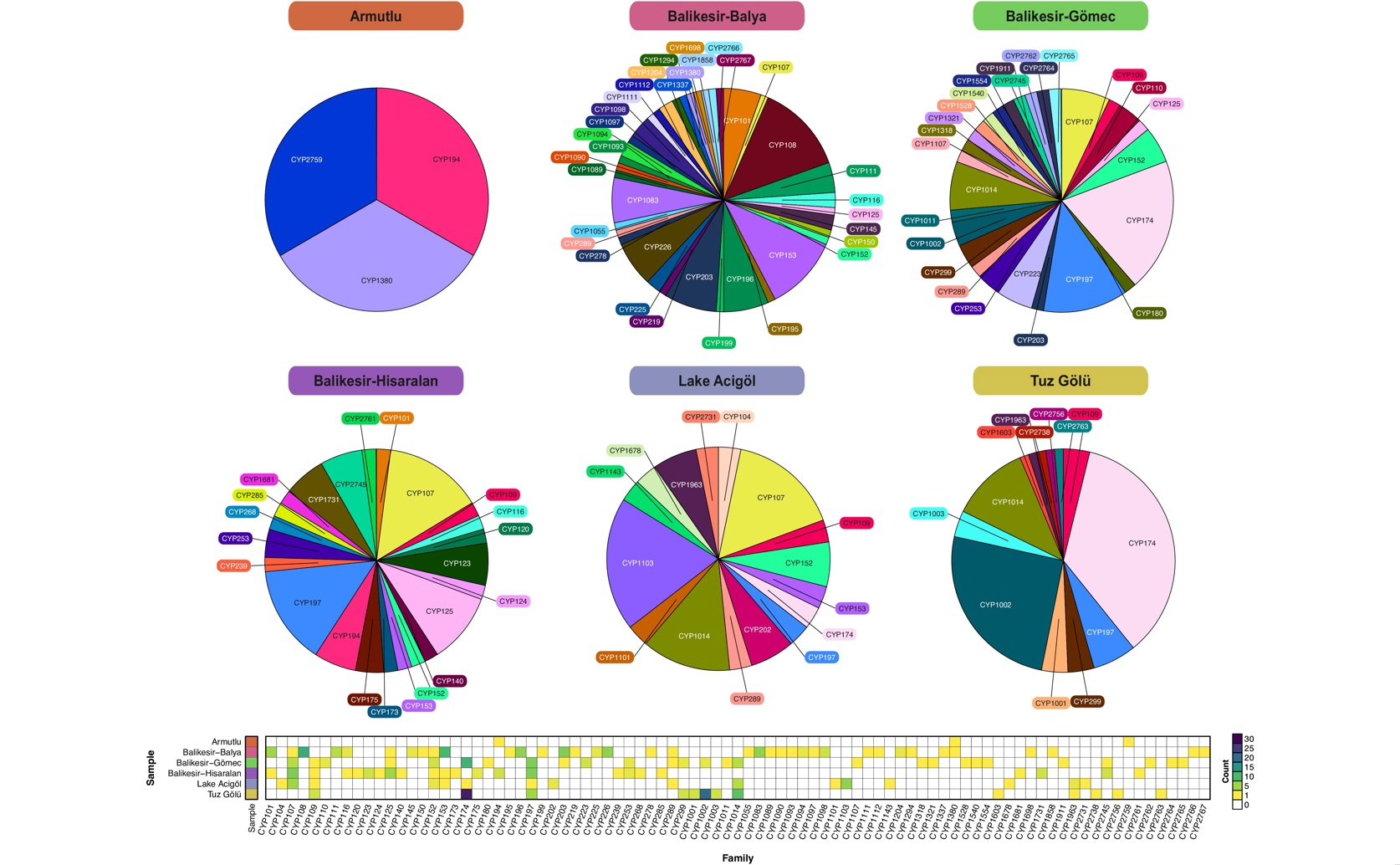
Pie-graphs and heatmap showing the distribution and counts of the P450 families identified across the six sites.

Image adapted from: Mumcu et al. / CC BY (Source)

Key Findings

  • This study explored microbial communities in Türkiye’s extreme environments—hot springs, salty lakes, and acid mine sites—to identify novel enzymes
  • Researchers identified 311 cytochrome P450 enzymes, including 8 entirely new families and 49 new subfamilies, using DNA sequencing
  • Specific microbial groups, like those from the Pseudomonadota and Actinomycetota phyla, were linked to diverse P450 enzymes, suggesting their environment shapes enzyme types
Cytochrome P450 enzymes (P450s) are a group of versatile proteins found in many organisms, known for their ability to modify chemical compounds. This capability makes them valuable tools in various industrial processes, including the production of pharmaceuticals and biofuels. However, identifying and harnessing new P450 enzymes remains a challenge, particularly those from organisms living in extreme environments. Traditionally, discovering new enzymes involved cultivating microbes in the laboratory, but many microorganisms are difficult or impossible to grow using standard methods[2]. This limitation hinders our ability to explore the full diversity of enzymes available in nature. Metagenomics, a technique that analyzes the genetic material directly from environmental samples, offers a solution to this problem[2][3]. It bypasses the need for cultivation, allowing researchers to identify genes – and therefore potential enzymes – from a wide range of organisms, even those that have never been cultured. Researchers at Istanbul Technical University, University of Queensland, University of Tennessee Health Science Center, and University of South Africa undertook a study[1] to identify novel P450 enzymes from extreme environments across Türkiye. These included hydrothermal springs (hot, mineral-rich water sources), hypersaline lakes (very salty lakes), and an acid-mine drainage site (water with a very low pH due to mining activity). The study focused on understanding the variety of P450 enzyme sequences present in these locations. The research team employed shotgun metagenomic analysis, a powerful technique where the entire genetic material from an environmental sample is broken down into small fragments, sequenced, and then computationally reassembled. This process, called de novo binning, allows for the grouping of genetic fragments originating from the same organism. They then used phylogenetic analysis – comparing the evolutionary relationships of the identified enzymes – and functional gene annotation – determining the potential roles of the enzymes – to classify the P450 sequences. The analysis revealed a significant diversity of P450 enzymes, with a total of 311 putative sequences identified, categorized into 87 families and 158 subfamilies. Notably, the study discovered 8 entirely new P450 families and 49 new subfamilies. These enzymes were found within 237 metagenomic bins, representing 138 distinct microbial genomes, including 45 high-quality reconstructions. The distribution of different P450 families varied between the sites. This variation suggests that the types of enzymes present are linked to the specific environmental conditions and the microbial communities living there. For example, microbes in the acid-mine drainage site might possess P450s involved in tolerating high acidity and processing specific pollutants, while those in hydrothermal springs may have enzymes adapted to high temperatures. The findings highlight the potential of Türkiye’s extreme habitats as a rich source of novel biocatalysts. As noted in previous research[2], metagenomics allows for a much more comprehensive understanding of microbial diversity, reaching up to 99% compared to traditional culture-based methods. The P450 enzymes identified in this study could have applications in various industrial processes, potentially leading to more efficient and sustainable production methods. Furthermore, the study suggests that P450s play a crucial role in helping microbes adapt to harsh environments. These enzymes may be involved in stress-responsive metabolic pathways, allowing organisms to survive and thrive under challenging conditions. The discovery of structurally resilient enzyme forms also offers insights into how enzymes can function effectively in extreme temperatures, salinity, and acidity, which is relevant to the broader understanding of enzyme stability and function. The work provides a solid foundation for future research focused on both the biotechnological applications and the ecological roles of these newly discovered P450 enzymes.

BiotechGeneticsEcology

References

Main Study

1) Exploring extreme environments in Türkiye for novel P450s through metagenomic analysis

Published 8th September, 2025

https://doi.org/10.1371/journal.pone.0330523


Related Studies

2) Shotgun metagenomics, from sampling to analysis.

https://doi.org/10.1038/nbt.3935


3) Metagenomic applications in exploration and development of novel enzymes from nature: a review.

https://doi.org/10.1186/s43141-020-00043-9


Related Articles

An unhandled error has occurred. Reload 🗙