Honeybee and Gilliamella Bacteria Boost Energy Production for Cold Tolerance

Jenn Hoskins
28th August, 2025

Honeybee and Gilliamella Bacteria Boost Energy Production for Cold Tolerance

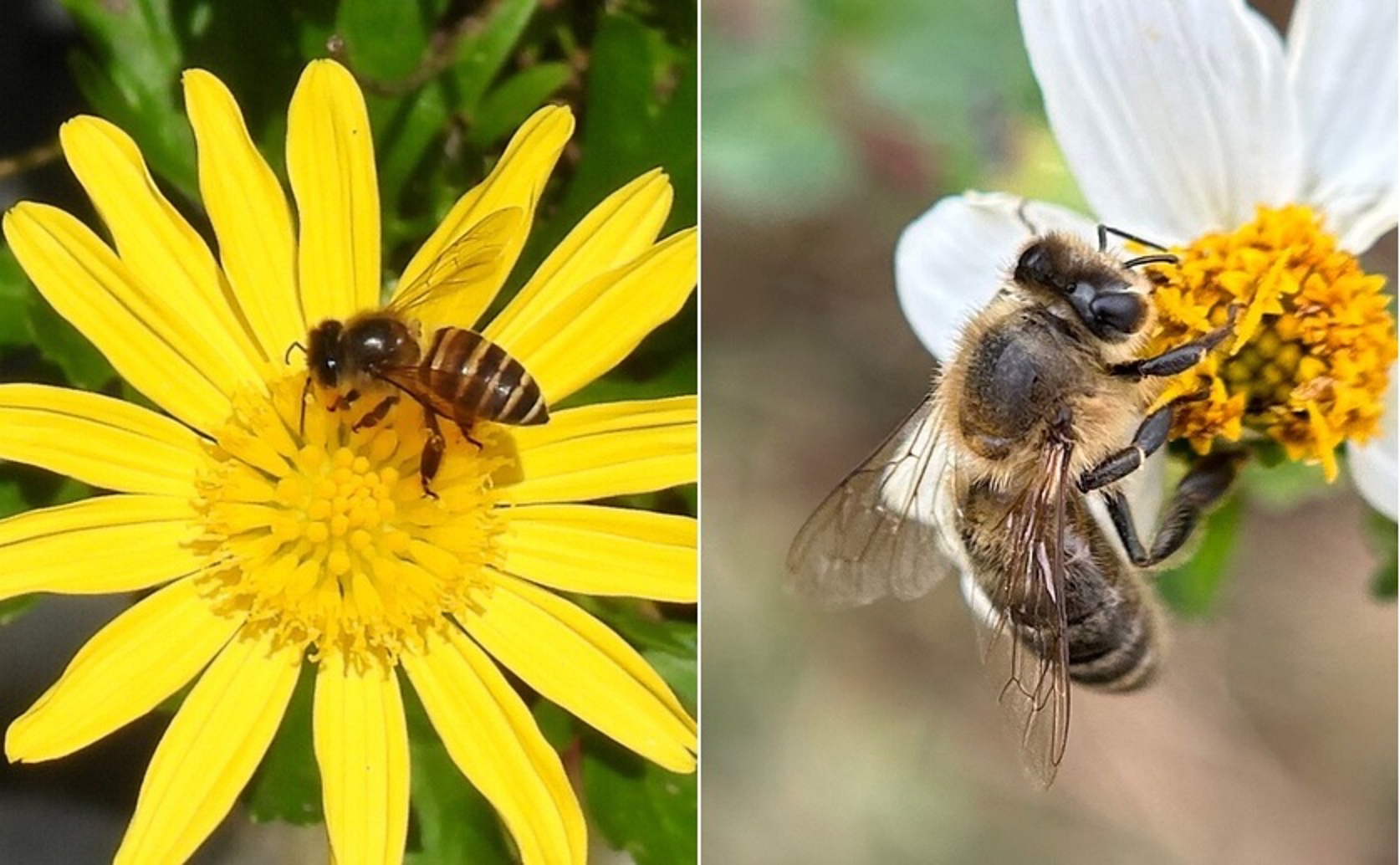
Asian Honey Bee (Apis cerana), right and Western Honey Bee (Apis mellifera), left.

Composite: Natural Science News / CC BY. [Sources]
Adapted from photos by:

Key Findings

  • Honeybees and their gut bacteria, specifically Gilliamella, were studied to understand adaptation to different climates in China
  • Cold-adapted honeybees have a greater ability to produce glucose, pyruvate, and lipids compared to tropical species
  • Introducing Gilliamella to germ-free bees increased their activity, body temperature, and fat storage in cold conditions, demonstrating a key role in cold adaptation
The ability of organisms to adapt to their environment is fundamental to survival, yet the precise mechanisms driving this adaptation, particularly the role played by symbiotic microorganisms, remain poorly understood. For decades, research has highlighted the importance of the gut microbiota – the community of bacteria, fungi, and other microbes living in the digestive tract – in host health and disease[2]. This understanding has moved beyond simply cataloging which microbes are present to investigating how they influence the host's metabolism and physiology. A key concept emerging from this research is the idea of the ‘holobiont’ – the host organism considered together with its microbiome, functioning as a single evolutionary unit[3]. This perspective emphasizes that adaptation isn't solely about changes in the host's genome, but also in the genomes of the microbes it harbors, and the interplay between the two. A recent study by researchers at China Agricultural University[1] investigated the relationship between honeybees and their gut bacteria, focusing on how this partnership contributes to adaptation in different climates. The team examined two honeybee species, Apis mellifera and Apis cerana, which occupy different climatic zones – cold-adapted and tropical, respectively – alongside their associated gut microbes. They found a clear difference in the genomic capabilities of bees from these different environments; cold-adapted species had a greater capacity for producing glucose, pyruvate, lipids, and glucuronate compared to their tropical counterparts. To identify which microbes were responsible for this difference, the researchers used metagenomics – a technique that allows them to study the genetic material of entire microbial communities. This revealed that the bacterium Gilliamella was significantly more abundant in the guts of cold-adapted bees. To test whether Gilliamella directly contributed to cold adaptation, the researchers created germ-free honeybees – bees raised without any gut microbes – and then inoculated them with Gilliamella from Apis cerana. The results were striking: bees colonized with Gilliamella showed increased activity, a higher body temperature, and greater fat storage when exposed to cold conditions. Further investigation into the metabolic processes occurring in the bees’ guts revealed higher levels of glucose in the hindgut of Gilliamella-colonized bees, and in Apis cerana compared to sympatric tropical species. While Gilliamella can break down β-glucan into glucose, laboratory experiments showed it preferentially degrades glucuronate into pyruvate. This finding suggested a complementary relationship between the bee and the bacterium; Gilliamella processes glucuronate, and the bee utilizes the resulting pyruvate. This aligns with the broader understanding that changes in either the host or microbiome genome can drive variations that are selected for or against[3]. The study also uncovered a fascinating detail about how Gilliamella acquires nutrients. The bacterium’s transporter genes – genes responsible for bringing molecules into the cell – are primarily focused on ascorbate, a derivative of glucuronate, which was found in higher concentrations in the guts of inoculated bees. Gilliamella then converts ascorbate into D-xylulose-5P, a molecule that promotes fat production. Interestingly, Gilliamella grew less effectively on glucuronate and ascorbate compared to glucose, suggesting it avoids competing with the host for this essential energy source. This research demonstrates a highly coordinated metabolic synergy between honeybees and Gilliamella, where the bacterium enhances the host's ability to acquire energy in cold environments. This supports the idea that the metagenome – the combined genetic material of the host and its microbiome – plays a crucial role in defining the characteristics of mammals, including adaptation to different climates[4]. The findings emphasize the importance of considering the microbiome when studying host physiology and evolution, and highlight the potential for manipulating microbial communities to improve host adaptation and resilience.

GeneticsEcologyAnimal Science

References

Main Study

1) Honeybee-Gilliamella synergy in carbohydrate metabolism enhances host thermogenesis in cold acclimation

Published 25th August, 2025

https://doi.org/10.1038/s41522-025-00798-4


Related Studies

2) Gut microbiota in human metabolic health and disease.

https://doi.org/10.1038/s41579-020-0433-9


3) The hologenome concept of evolution after 10 years.

https://doi.org/10.1186/s40168-018-0457-9


4) Accounting for reciprocal host-microbiome interactions in experimental science.

https://doi.org/10.1038/nature18285


Related Articles

An unhandled error has occurred. Reload 🗙