Honey Bees With Strong Hygiene Skills Resist Chalkbrood Disease

Jim Crocker
28th August, 2025

Honey Bees With Strong Hygiene Skills Resist Chalkbrood Disease

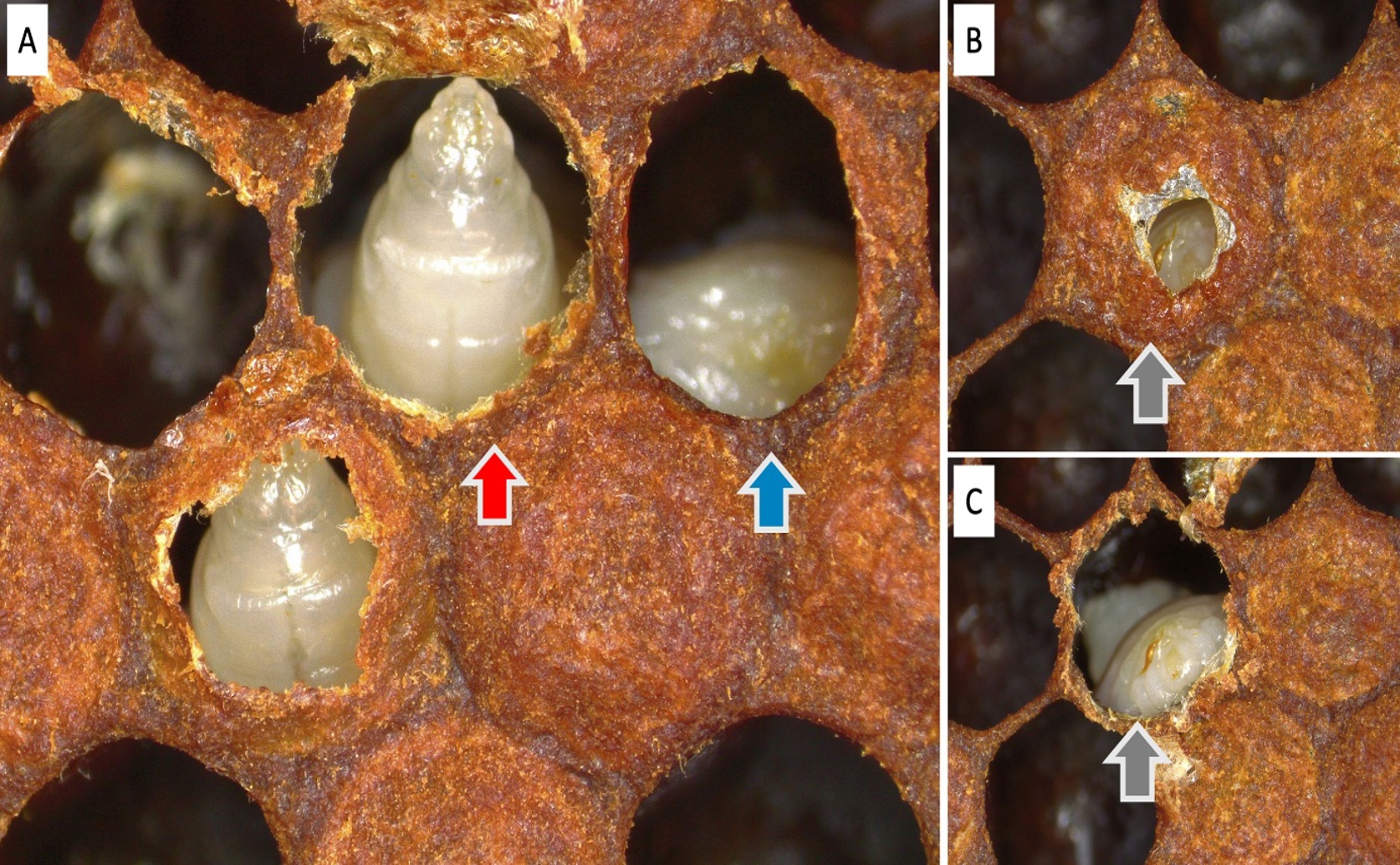
The detection of early, non-infectious signs of Ascosphaera apis infection, such as acuminate and amorphous pre-pupae (a, c), highlights the hygienic uncapping behavior (b) utilized by resistant honey bee (Apis mellifera) colonies to remove infected brood and interrupt disease transmission.

Image adapted from: Dyrbye-Wright et al. / CC0 1.0 (Source)

Key Findings

  • This study, conducted in Minnesota and Louisiana, found bees bred for Varroa mite resistance (Pol-line) were equally resistant to chalkbrood disease as commercially bred bees
  • Pol-line bees consistently showed lower Varroa mite levels in most trials, confirming their effectiveness in controlling mite populations without compromising disease resistance
  • The standard freeze-killed brood test didn’t reliably predict resistance to either mites or chalkbrood, suggesting it’s a useful screening tool but needs confirmation with real-world challenges
Honey bees are vital for agriculture, pollinating many crops. However, bee populations face numerous threats, including parasites like the Varroa mite and diseases such as chalkbrood. Beekeepers are increasingly focused on breeding bees that show resistance to these challenges, aiming to improve colony health and reduce losses. A key strategy involves selecting for specific traits, like Varroa Sensitive Hygiene (VSH), where bees detect and remove mite-infested brood – the cells containing developing bees. However, it’s been unclear whether bees bred for VSH also exhibit resistance to brood diseases, or if their resistance is limited to mites alone. Researchers at the University of Minnesota and the USDA-ARS lab in Baton Rouge, Louisiana, conducted a study[1] to address this question. The study compared colonies bred specifically for VSH (Pol-line) with commercially available colonies selected for general hygienic behavior. Hygienic behavior refers to a colony's ability to detect and remove diseased or otherwise abnormal brood cells. The commercial bees were assessed using a standard “freeze-killed brood” (FKB) assay, a method to measure their overall brood-cleaning capabilities. The study involved challenging both groups of colonies with Ascosphaera apis, the fungus responsible for chalkbrood disease. Chalkbrood is a fungal infection of bee larvae, leading to the development of mummified pupae within the brood cells. Researchers then carefully quantified the number of mites present in each colony, the extent of chalkbrood disease, and the level of hygienic behavior exhibited by the bees. The research was carried out over two years, in 2023 and 2024, to account for potential year-to-year variations. The results showed that bees from the Pol-line, bred for VSH, were as resistant to chalkbrood as the commercial bees bred for general hygienic behavior. This is significant because it demonstrates that selecting for VSH does not compromise resistance to diseases. Furthermore, the Pol-line colonies showed greater resistance to Varroa mites in two out of three trials, confirming their effectiveness in controlling mite populations. Importantly, both groups of bees displayed high levels of hygienic behavior overall. This study builds upon earlier work demonstrating the genetic basis of hygienic behavior in honey bees[2]. That research identified several quantitative trait loci (QTLs) – regions of the genome associated with specific traits – that influence hygienic behavior, and even pinpointed candidate genes involved in olfaction, learning, and social behavior. The current study adds to this knowledge by showing that the VSH trait, while potentially mediated by different genetic mechanisms, results in a similar behavioral outcome: effective removal of both diseased and mite-infested brood. The findings also align with research highlighting the ‘social immunity’ of honey bee colonies[3]. Social immunity refers to the collective defenses evolved by bee colonies against parasites and pathogens, involving cooperation between individual bees. This includes behavioral adaptations like hygienic behavior, physiological responses, and organizational strategies to prevent disease spread. The study demonstrates that VSH-selected bees are capable of activating these collective defenses against both mites and fungal diseases. Interestingly, a previous population genetics study[4] showed limited genetic differentiation between many commercially managed honey bee stocks, suggesting potential admixture – the mixing of genetic material – due to breeding practices. This highlights the importance of understanding the genetic profiles of different bee lines and the potential for unintended consequences of breeding programs. The study further supports this by indicating that breeding efforts to enhance parasite resistance may have created unique genetic profiles, warranting further investigation into the specific genes involved. The researchers emphasize the need for further comparative studies to clarify the genetic differences and underlying mechanisms driving VSH and general hygienic behavior. Specifically, they suggest investigating differences in olfactory sensitivity – the ability to detect odors – which may play a role in identifying diseased or infested brood. Ultimately, the study provides strong evidence that using bees selected for VSH in beekeeping operations can contribute to reduced colony losses, improved honey bee health, and decreased financial burdens associated with Varroa mites and diseases.

GeneticsEcologyAnimal Science

References

Main Study

1) Honey bees bred for Varroa sensitive hygiene trait demonstrate resistance to chalkbrood disease

Published 27th August, 2025

https://doi.org/10.1371/journal.pone.0329739


Related Studies

2) Six quantitative trait loci influence task thresholds for hygienic behaviour in honeybees (Apis mellifera).

https://doi.org/10.1111/j.1365-294X.2010.04569.x


3) Social immunity.

Journal: Current biology : CB, Issue: Vol 17, Issue 16, Aug 2007


4) Genome-wide patterns of differentiation within and among U.S. commercial honey bee stocks.

https://doi.org/10.1186/s12864-020-07111-x


Related Articles

An unhandled error has occurred. Reload 🗙