Gene Editing Creates Seedless Watermelon Through Pollen Control

Greg Howard
5th September, 2025

Gene Editing Creates Seedless Watermelon Through Pollen Control

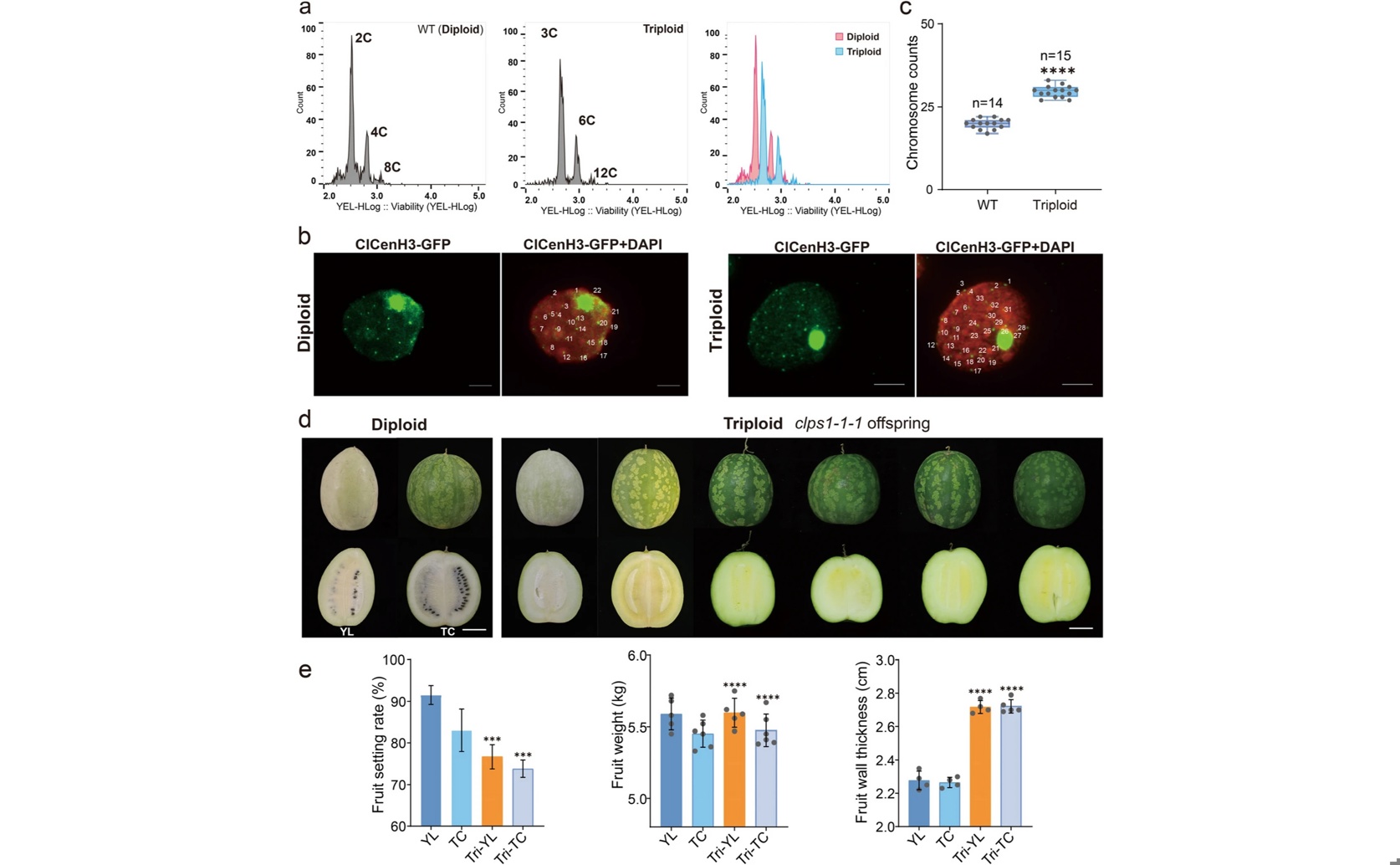
Morphological (a), cytological (b), and flow cytometric analyses (c) confirm that clps1 mutants successfully generate triploid watermelon (Citrullus lanatus) plants capable of producing seedless fruits (d) with agronomic traits consistent with triploidy (e).

Image adapted from: Pang et al. / CC BY (Source)

Key Findings

  • Researchers identified a gene, ClPS1, in watermelon that is crucial for producing the reproductive cells needed for breeding seedless varieties
  • Disrupting ClPS1 caused abnormal chromosome separation during pollen development, leading to the creation of diploid pollen grains
  • Using mutant plants with altered pollen, the study successfully produced a small percentage of triploid watermelons, demonstrating a new approach to seedless breeding
Seedless watermelons have become increasingly popular, offering convenience to consumers. However, creating new varieties of these triploid (having three sets of chromosomes) watermelons is a slow and difficult process, with many young plants failing to survive. Researchers at Northwest A&F University[1] have now identified a gene, called ClPS1, that plays a key role in producing the gametes (reproductive cells) needed for triploid watermelon breeding, offering a potential solution to these challenges. The problem lies in how triploid watermelons are made. They are created by crossing a diploid plant (two sets of chromosomes) with a tetraploid plant (four sets of chromosomes). The resulting seed produces a triploid fruit, but the seeds themselves are sterile and don’t develop further. Traditionally, breeders need to create and identify tetraploid plants, a lengthy and often unreliable process. A more efficient method would be to directly induce the production of gametes with an extra set of chromosomes – specifically, 2n gametes (gametes with twice the usual number of chromosomes). These 2n gametes, when combined with normal gametes, will produce triploid offspring. Previous research has highlighted the difficulty in studying reproductive development in plants, particularly in species like maize where reproductive cells are deeply embedded in plant tissues[2]. This makes direct observation of the process challenging. However, advances in staining techniques, such as those developed to visualize chromosomes within cells[2], have improved our ability to understand meiosis – the process of cell division that creates gametes. The study focused on ClPS1 because it showed high activity during meiosis and microsporogenesis, the development of male pollen cells. Using the CRISPR/Cas9 gene editing technology, the researchers created mutant watermelon plants where the ClPS1 gene was disrupted. They found that disrupting ClPS1 caused problems with chromosome segregation during the second division of meiosis (metaphase II) in the male pollen cells. This resulted in the production of diploid male spores – pollen cells with the normal number of chromosomes, rather than the reduced number needed for typical gamete formation. These diploid spores then divided abnormally, ultimately creating diploid pollen grains. Importantly, the female reproductive cells were unaffected by the mutation. When these mutant plants (with the altered pollen) were used as the paternal parent in crosses, the researchers observed a significant increase in the production of triploid watermelons. They also found some aneuploid watermelons – plants with an abnormal number of chromosomes. This indicates that while ClPS1 disruption successfully creates 2n gametes, it doesn’t always result in perfectly balanced chromosome numbers in the offspring. Interestingly, work in Arabidopsis[3] has demonstrated techniques for isolating specific cell types during male gametogenesis, allowing for detailed molecular analysis. While not directly applied in this watermelon study, these methods could be used in future research to further understand the role of ClPS1 and the mechanisms behind 2n gamete formation. Furthermore, understanding the genes involved in unreduced gamete production, as seen in Arabidopsis[4], is crucial for manipulating ploidy levels in crops. The discovery of ClPS1 in watermelon adds to this growing body of knowledge, providing a specific target for breeders to engineer the production of 2n gametes and improve triploid breeding efficiency. The research represents a significant step forward in polyploid breeding, offering new possibilities for crop improvement in watermelons and potentially other species within the Cucurbitaceae family.

AgricultureGeneticsPlant Science

References

Main Study

1) ClPS1 gene-mediated manipulation of 2n pollen formation enables the creation of triploid seedless watermelon

Published 2nd September, 2025

https://doi.org/10.1186/s43897-025-00170-2


Related Studies

2) Confocal microscopy of whole ovules for analysis of reproductive development: the elongate1 mutant affects meiosis II.

Journal: The Plant journal : for cell and molecular biology, Issue: Vol 43, Issue 2, Jul 2005


3) FACS-based purification of Arabidopsis microspores, sperm cells and vegetative nuclei.

https://doi.org/10.1186/1746-4811-8-44


4) Unreduced gamete formation in plants: mechanisms and prospects.

https://doi.org/10.1093/jxb/erq371


Related Articles

An unhandled error has occurred. Reload 🗙