New Wind Power Forecasts Using Advanced Data Analysis

Greg Howard
29th August, 2025

New Wind Power Forecasts Using Advanced Data Analysis

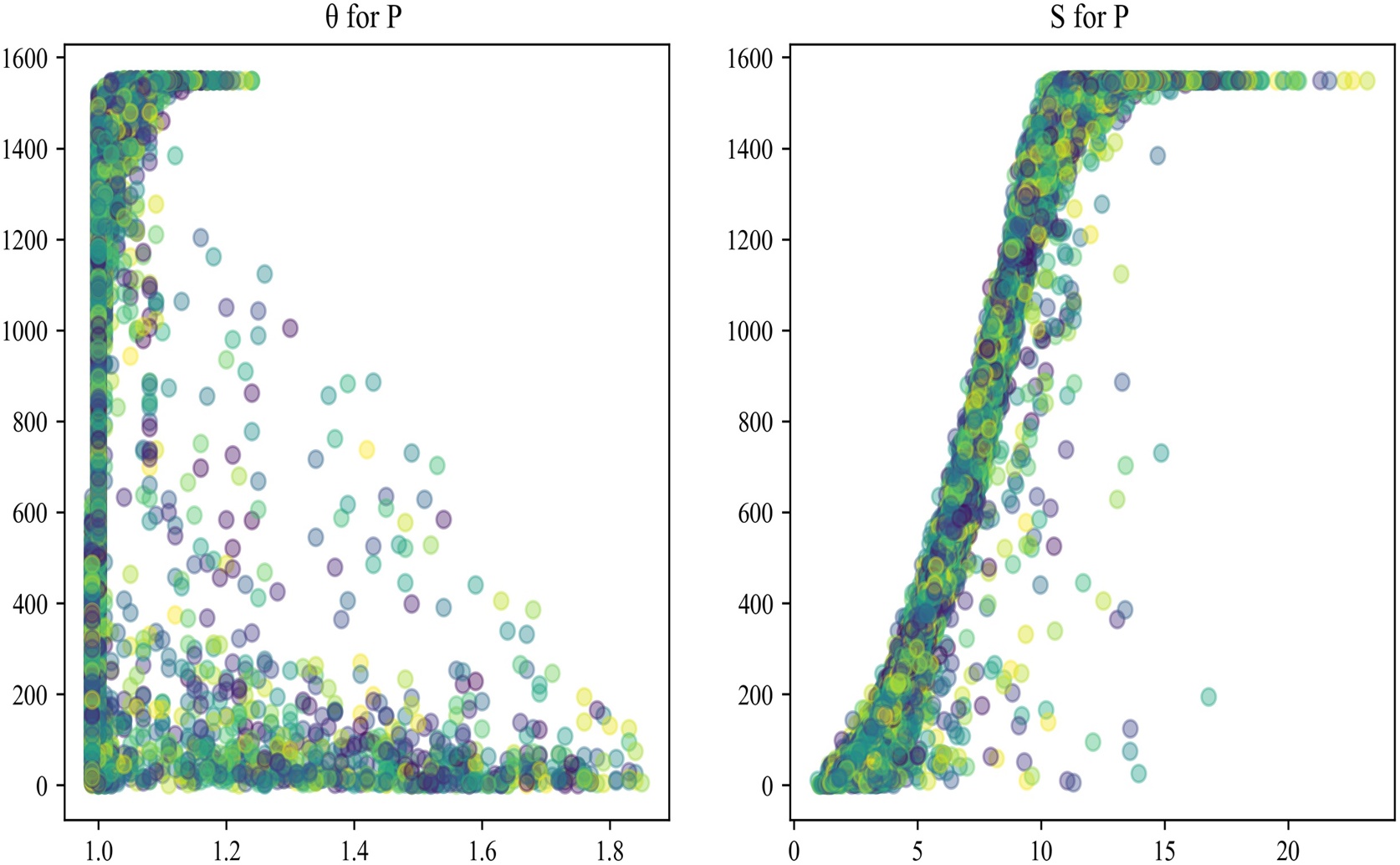
The scatter plot analysis confirms the strong dynamic correlations between wind speed, blade deflection angle, and power output, validating these variables as the essential multi-source features utilized to optimize the accuracy of the proposed MFIO-Informer prediction model.

Image adapted from: Zhou et al. / CC BY (Source)

Key Findings

  • This study, conducted by researchers from Hunan, Chongqing, and Amirkabir universities, aimed to improve wind power prediction accuracy and speed
  • A new model, MFIO-Informer, was developed by identifying key data points and assessing turbine health to better understand complex wind turbine operations
  • Testing on real-world datasets showed MFIO-Informer achieved approximately 20% higher prediction accuracy and was 54.85% faster than the standard Informer model
Wind power is becoming increasingly important for providing electricity, but its reliability depends on accurately predicting how much power wind turbines will generate. Fluctuations in wind speed and turbine performance can create instability in the electrical grid, so precise forecasting is essential. Traditional methods of prediction often struggle with the complexity of these factors.[1] Researchers from Hunan Institute of Engineering, Chongqing Jiangdong Machinery, and Amirkabir University of Technology have developed a new approach to improve wind power prediction using a type of artificial intelligence called the Informer model. The core of the problem lies in the interplay of numerous factors affecting wind turbine output. Simply feeding data into a standard neural network doesn’t always capture these relationships effectively, leading to inaccuracies and slow processing times. The new method, called MFIO-Informer (Multi-source Feature Interaction Optimization-Informer), aims to address these limitations. The study begins by identifying the most important data points from wind turbine operations. This involves using statistical methods – the Lasso algorithm and Pearson correlation coefficient – to determine which measurements have the strongest relationship with the amount of power being produced. This process is similar in concept to how researchers previously focused on identifying key indicators for predicting indoor air quality, utilizing data correlations to improve accuracy[2]. Both approaches highlight the importance of feature selection in complex prediction tasks. Next, the researchers focused on understanding how different aspects of the turbine’s operation work together. They used a fully-connected neural network (FNN) to model the relationship between wind speed, the angle of the turbine blades, and the power output. This resulted in a “Dynamic Synergistic Coefficient” (DSC), a value that reflects how well the turbine is performing. This is akin to monitoring equipment vibration to predict failures[3], where understanding the interplay of signals is crucial for accurate assessment. Crucially, the study also incorporates a “health assessment” of the wind turbine. By analyzing historical power data alongside the DSC, the researchers created a “health matrix” that indicates the turbine’s condition. This health matrix is then used to refine the way the Informer model processes information, improving its ability to make accurate predictions. The Informer model itself is a relatively recent development in neural networks, designed to handle long sequences of data efficiently – a key requirement for time-series forecasting like wind power prediction. The MFIO-Informer model was tested on two publicly available wind power datasets. The results showed a significant improvement over the standard Informer model. The new model achieved approximately 20% higher prediction accuracy and was 54.85% faster at making predictions. This improvement is due to the model’s ability to better understand the complex interactions between different data sources and to account for the turbine’s health status. The MFIO-Informer framework represents a step forward in wind power forecasting, offering a more accurate and efficient way to predict energy generation and maintain grid stability.

AgricultureEnvironmentSustainability

References

Main Study

1) A new design of wind power prediction method based on multi-interaction optimization informer model

Published 28th August, 2025

https://doi.org/10.1371/journal.pone.0330464


Related Studies

2) Revealing Long-Term Indoor Air Quality Prediction: An Intelligent Informer-Based Approach.

https://doi.org/10.3390/s23188003


3) A Deep Learning Model with Signal Decomposition and Informer Network for Equipment Vibration Trend Prediction.

https://doi.org/10.3390/s23135819


Related Articles

An unhandled error has occurred. Reload 🗙