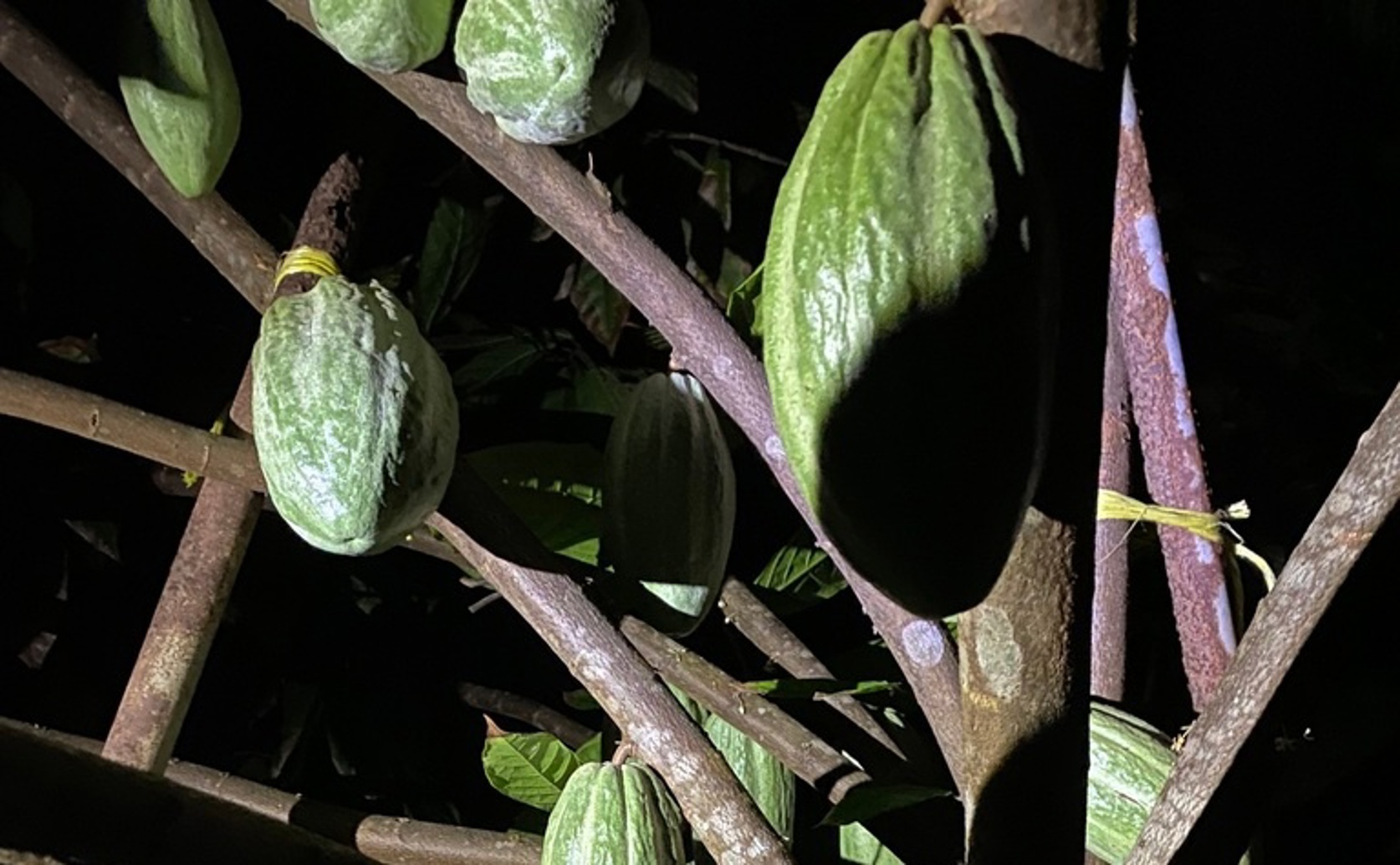
Overlooked Power: Natural Trees In Cocoa Fields Fight Climate Change

Jenn Hoskins
3rd August, 2025

Overlooked Power: Natural Trees In Cocoa Fields Fight Climate Change

Cacao tree (Theobroma cacao)

Photo adapted from: Barry Cottam / CC BY (Source)

Key Findings

  • In Côte d’Ivoire, a study found that large remnant trees store the most carbon in cocoa farms, while naturally grown trees accumulate carbon faster than planted ones over time
  • Overall carbon stored in cocoa farms increases with prior forest use and farmer knowledge, but decreases with higher cocoa plant density
  • Individual tree growth and carbon gain are boosted by clear land ownership and prior forest use, but hindered by dense cocoa planting and rising temperatures
Cocoa cultivation in West Africa has long been a significant driver of deforestation, leading to substantial releases of greenhouse gases into the atmosphere and threatening the very sustainability of cocoa production itself. Over two decades ago, the Guinean Rain Forest (GRF) of West Africa was identified as a global biodiversity hotspot, yet by the turn of the millennium, it had shrunk to just 18% of its original size. A primary cause of this decline has been the expansion of smallholder agriculture, with the area harvested for crops like cocoa, cassava, and oil palm in the GRF increasing dramatically between 1988 and 2007[2]. While previous research has suggested that intensifying crop yields through improved seed-fertilizer technologies could have significantly reduced deforestation and carbon emissions[2], another promising approach is agroforestry. This practice integrates trees into agricultural landscapes, potentially offering a sustainable way to enhance the amount of carbon stored in the ecosystem and improve the resilience of farms. Despite the recognized benefits of agroforestry, the specific contributions of different types of trees—those that are remnants of the original forest, those that grow spontaneously, and those that are intentionally planted—and the various social and environmental factors that influence their effectiveness in cocoa farms have remained poorly understood. A recent study[1] by researchers from Université Félix Houphouët-Boigny, INP Félix Houphouët-Boigny, UPR Forêts et Sociétés, CIRAD, Montpellier, France, Université Montpellier, CIRAD, and Universidad de la Amazonia, set out to address this gap. Their work involved a detailed examination of carbon dynamics across 150 cocoa fields in Côte d’Ivoire, analyzing over 11,500 trees across 15 different sites. The study aimed to quantify the carbon stored in these trees (known as carbon stocks) and the rate at which they accumulate more carbon (carbon gains), and to understand how socio-environmental factors influence this carbon balance within cocoa farms. To achieve this, the researchers employed Bayesian modeling, a statistical method that uses probability to update understanding as more data becomes available, allowing for robust conclusions from complex datasets. Their findings revealed significant differences in how carbon is stored and accumulated by trees of different origins. Remnant trees, which are typically large trees left over from the original forest, held the highest median carbon stocks, storing approximately 6.33 tonnes of carbon per hectare (Mg/ha). For context, a tonne is 1,000 kilograms. Spontaneous trees, those that grow naturally from seeds dispersed by wind or animals, stored less at 2.06 Mg/ha, while intentionally planted trees had the lowest median carbon stocks at 1.53 Mg/ha. Regarding carbon gains, or the rate at which trees accumulate new carbon through growth, the study found that planted and spontaneous trees had similar growth rates for the first seven years. However, after this period, spontaneous trees grew significantly faster, accumulating about 11.20 kilograms of carbon per year, compared to 3.96 kilograms per year for planted trees. This highlights the long-term potential of naturally regenerating trees in these systems. The study also identified several key factors influencing carbon levels. Carbon stocks generally increased in farms managed by well-informed farmers and in areas that were previously forested. Conversely, higher densities of cocoa plants were associated with lower carbon stocks. At the individual tree level, carbon gains were positively influenced by factors such as clear land ownership and the land’s previous use as forest. However, higher cocoa plant density and increased annual temperatures had negative effects on the rate of carbon accumulation by trees. This observation on temperature's negative effect on carbon gains in this specific agroforestry context adds nuance to broader studies on forest biomass accumulation, which have shown varying effects of temperature on above-ground biomass (AGB) accumulation rates depending on forest type[3]. The ability to accurately measure and map terrestrial carbon stocks is crucial for the success of climate change mitigation policies[4]. The measurements of carbon stocks and gains in this study rely on methods to estimate the above-ground biomass (AGB) of trees. AGB refers to the total mass of living organic matter above the ground, which is a key indicator of stored carbon. Accurate AGB estimation often uses allometric models, which are mathematical equations that predict a tree's biomass based on easily measurable dimensions like trunk diameter and height. Recent advancements in these models, including the development of pantropical models that account for wood specific gravity and bioclimatic stress, have significantly improved the accuracy of biomass assessments in tropical vegetation types[4], thus providing a stronger foundation for studies like this one. This research underscores the potential of cocoa agroforestry to address the deforestation crisis in West Africa, a problem highlighted by the extensive land conversion documented in the Guinean Rain Forest[2]. While earlier findings suggested that intensifying cocoa technology could have avoided significant deforestation and CO₂ emissions[2], this study provides a complementary solution by demonstrating how integrating diverse tree types within cocoa farms can also contribute to carbon sequestration. The findings emphasize that effective strategies for maximizing carbon storage and ensuring the sustainable management of these agroforestry systems should prioritize securing land tenure for farmers, enhancing their training in tree botany and management, and actively promoting the conservation of both remnant and spontaneously growing trees.

AgricultureEnvironmentSustainability

References

Main Study

1) Unsung climate guardians: The overlooked role of remnant and spontaneous trees in carbon stocks and gains from tree growth in West African cocoa fields

Published 1st August, 2025

https://doi.org/10.1371/journal.pone.0328763


Related Studies

2) Cocoa intensification scenarios and their predicted impact on CO₂ emissions, biodiversity conservation, and rural livelihoods in the Guinea rain forest of West Africa.

https://doi.org/10.1007/s00267-010-9602-3


3) Effects of climate and plant functional types on forest above-ground biomass accumulation.

https://doi.org/10.1186/s13021-023-00225-1


4) Improved allometric models to estimate the aboveground biomass of tropical trees.

https://doi.org/10.1111/gcb.12629


Related Articles

An unhandled error has occurred. Reload 🗙