Powerful AI Predicts Water Quality for Smart Agriculture

Greg Howard
24th July, 2025

Powerful AI Predicts Water Quality for Smart Agriculture

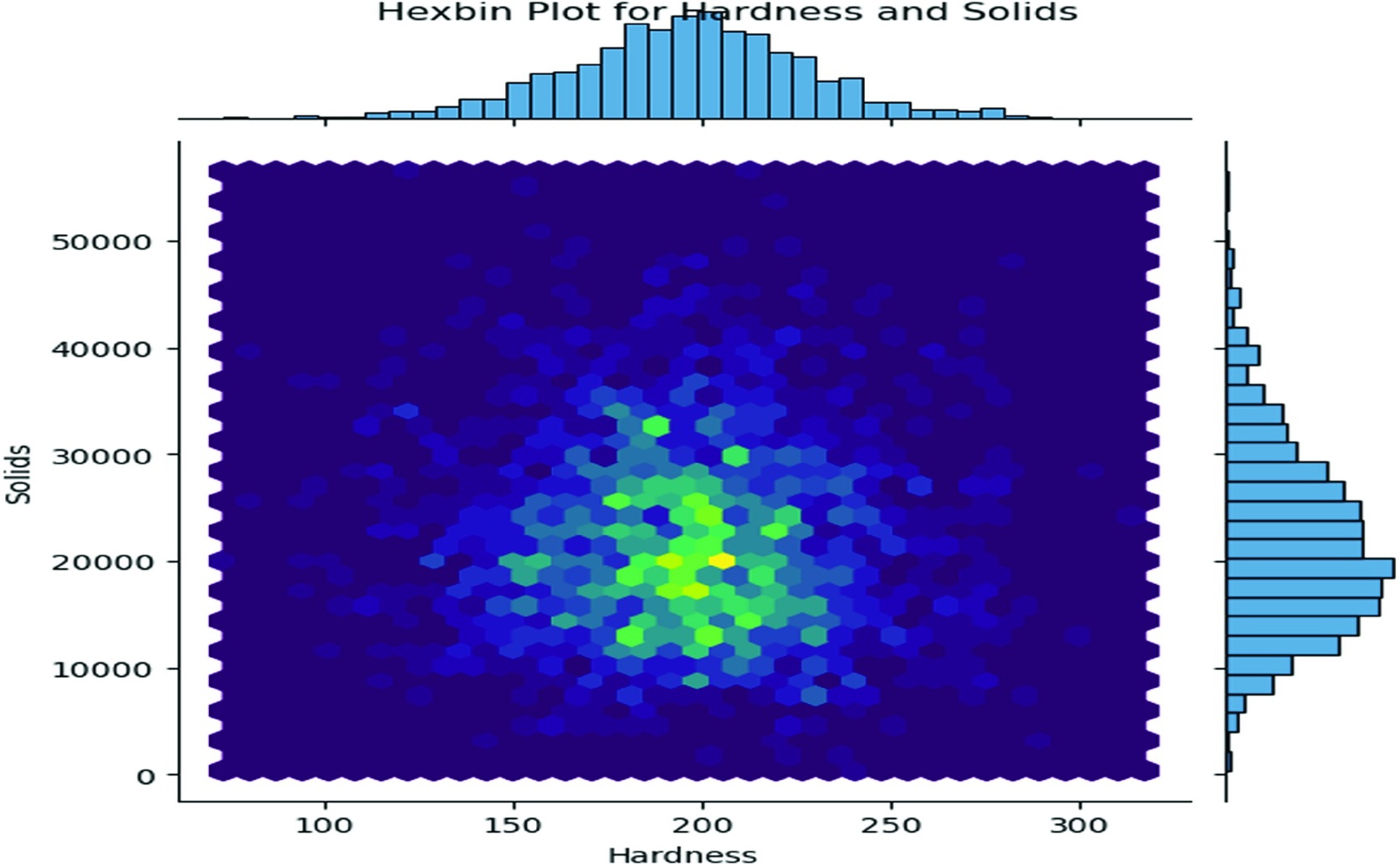
The hexbin visualization displays the joint distribution and density clustering of water hardness and solid content, providing insights into variable dependencies within the high-dimensional dataset used to train the proposed hybrid deep learning model for potato irrigation assessment.

Image adapted from: Alharbi et al. / CC BY (Source)

Key Findings

  • Researchers at Princess Nourah Bint Abdulrahman University developed a new AI system that accurately predicts water quality for potato irrigation, achieving 99.46% accuracy
  • This system uses a unique combination of two advanced AI techniques, inspired by bird foraging and mathematical patterns, to efficiently select key water features and optimize predictions
  • The highly accurate predictions help farmers make smarter irrigation decisions, leading to better crop yields and more efficient water use in areas with limited water
Modern agriculture faces a significant challenge: producing enough food for a growing global population while conserving precious resources like water. Crops such as potatoes require precise water management, not just in terms of quantity but also quality, to ensure healthy growth and high yields. In many agricultural regions, water availability is limited, and its quality can vary, making informed irrigation decisions crucial for farmers. Addressing this critical need, recent research from Princess Nourah Bint Abdulrahman University introduces a novel approach to predict water quality for smart irrigation systems[1]. This study developed a sophisticated framework designed to provide accurate and computationally efficient predictions, thereby supporting sustainable crop production and resource conservation, particularly in environments where water is scarce. The core of this new research lies in a hybrid metaheuristic framework. To understand this, consider that "metaheuristic" refers to a high-level strategy that guides a search process to find good solutions to complex problems, especially when an exact solution is difficult or impossible to compute directly. This framework combines two distinct algorithms: Dipper Throated Optimization (DTO) and Polar Rose Search (PRS). DTO is a bio-inspired algorithm, meaning its design is modeled on natural processes, specifically the foraging behavior of dipper-throated birds. PRS, on the other hand, is an optimization technique inspired by the mathematical concept of polar roses. By combining these two, the system creates a powerful tool for navigating complex data. This hybrid strategy is used to enhance deep learning models. Deep learning is a subset of machine learning that employs multi-layered artificial neural networks to learn from vast amounts of data, enabling them to recognize patterns and make predictions. Specifically, the study applied this framework to a Radial Basis Function Network (RBFN), a type of neural network particularly effective at classifying data based on similarities. The framework integrates two key processes: binary feature selection and metaheuristic optimization. Binary feature selection is a method where the system intelligently identifies and selects only the most relevant pieces of information (features) from a large dataset, discarding irrelevant data that could otherwise hinder accuracy. This process, combined with the metaheuristic optimization, allows the system to effectively balance "exploration" (searching new areas for potential solutions) and "exploitation" (refining known good solutions) when dealing with complex, high-dimensional datasets. The researchers validated their approach through extensive experiments, using statistical tests like ANOVA and Wilcoxon tests to confirm the performance improvements in both the feature selection and optimization phases. The results were highly promising: the optimized model achieved an impressive classification accuracy of 99.46%. This significantly outperformed both traditional machine learning methods and unoptimized deep learning models, demonstrating the framework's capability to deliver highly accurate, understandable, and efficient predictions. These findings directly support the broader goals of sustainable agriculture. Previous research has consistently highlighted the importance of optimizing inputs like water and nitrogen for crops such as potatoes. For instance, a study on potato production found that while full irrigation combined with a specific nitrogen level (300 kg N ha-1) produced the highest total tuber yield, a lower irrigation level (66% of field capacity) consistently resulted in the highest water use efficiency[2]. This earlier work emphasized the delicate balance between maximizing yield and conserving water, noting that full irrigation could even negatively impact tuber quality. The predictive water quality assessment from the current study provides farmers with the precise information needed to make informed decisions, allowing them to adjust irrigation strategies to achieve optimal yields while improving water use efficiency, aligning perfectly with the recommendations from[2]. Furthermore, the integration of advanced technologies for precision agriculture is a growing trend. Modern irrigation tools, like the NutriBalance system evaluated in a grapefruit orchard, have shown significant potential in boosting fertigation efficiency and sustainability, especially when dealing with varying water qualities[3]. That system computes optimal fertilizer doses based on specific data, including the quality of irrigation water. The highly accurate water quality predictions provided by the new framework can serve as a crucial input for such advanced fertigation tools, enabling them to operate with even greater precision and effectiveness, potentially leading to increased fertilizer savings and overall resource optimization. This research also ties into the broader advancements in precision water and fertilizer application technologies, which are recognized as crucial innovations for sustainable agriculture[4]. A comprehensive review of these technologies highlighted the integration of advanced sensors, remote sensing, and machine learning algorithms in optimizing irrigation and nutrient management. The framework developed by Princess Nourah Bint Abdulrahman University directly contributes to this field by offering a sophisticated predictive model that enables real-time monitoring and adaptive management of water resources. This aligns with the review's emphasis on using data analytics and predictive models to enhance resource use efficiency and reduce environmental pollution. By providing accurate insights into water quality, the new study empowers farmers to implement targeted interventions tailored to specific field conditions, a key aspect of advanced precision agriculture discussed in[4]. In essence, the research from Princess Nourah Bint Abdulrahman University offers a powerful new tool for smart irrigation decision-making. By accurately predicting water quality, it enables farmers to optimize their water use, conserve resources, and contribute to more sustainable and efficient agricultural practices, ultimately supporting global food security in water-limited environments.

AgricultureEnvironmentSustainability

References

Main Study

1) Hybrid deep learning optimization for smart agriculture: Dipper throated optimization and polar rose search applied to water quality prediction

Published 21st July, 2025

https://doi.org/10.1371/journal.pone.0327230


Related Studies

2) Responses of yield, quality and water use efficiency of potato grown under different drip irrigation and nitrogen levels.

https://doi.org/10.1038/s41598-023-36934-3


3) Evaluation of an autonomous smart system for optimal management of fertigation with variable sources of irrigation water.

https://doi.org/10.3389/fpls.2023.1149956


4) Precise application of water and fertilizer to crops: challenges and opportunities.

https://doi.org/10.3389/fpls.2024.1444560


Related Articles

An unhandled error has occurred. Reload 🗙