How Irrigation Changes Rural Areas and Boosts Income

Jenn Hoskins
21st June, 2025

How Irrigation Changes Rural Areas and Boosts Income

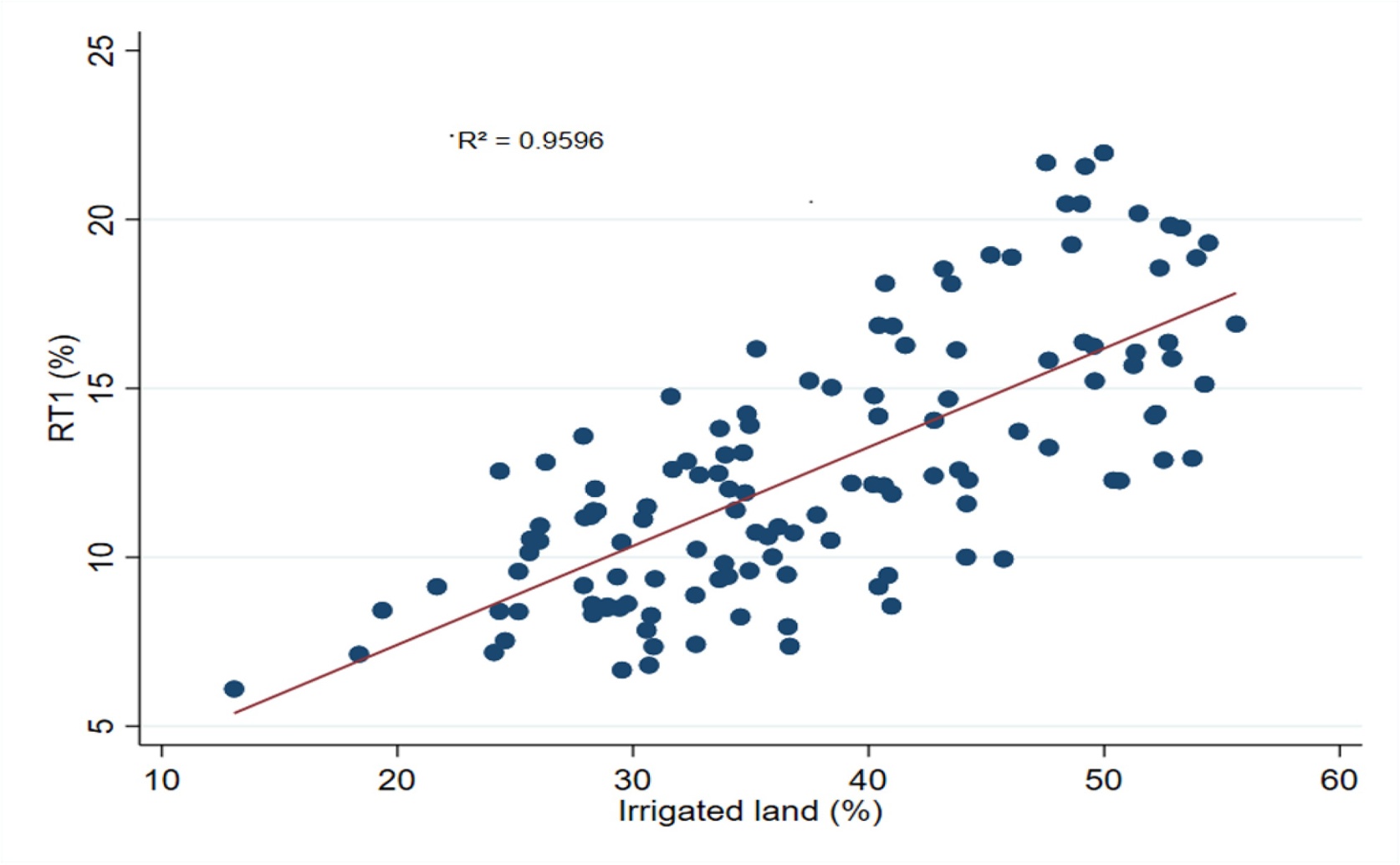
A strong positive correlation between the share of irrigated land and the proportion of high-value agricultural commodities in Bangladesh (2000–2016) demonstrates that irrigation investment is a significant driver of this key component of rural transformation.

Image adapted from: Saha et al. / CC BY (Source)

Key Findings

  • In Bangladesh, increased investment in irrigation infrastructure significantly boosts rural development by promoting high-value farming and creating more non-farm jobs
  • This irrigation also directly raises overall rural income, though its specific impact on non-farm jobs and income varies across different stages of rural development
Rural areas in many developing countries face significant challenges in improving livelihoods, increasing income, and providing stable employment opportunities. A key strategy for addressing these issues often involves transforming traditional agricultural practices and diversifying economic activities. Understanding how specific investments can drive this transformation is crucial for effective policy-making aimed at uplifting rural communities. Recent research from Bangladesh Agricultural University[1] has investigated the impact of investment in irrigation infrastructure on rural transformation and income levels in Bangladesh. The study utilized extensive data collected over 16 years, from 2000 to 2016, through nationally representative Household Income and Expenditure Surveys. Researchers analyzed the relationship between the proportion of irrigated land, which serves as a clear indicator of irrigation investment, and key aspects of rural development. The findings indicate that increased irrigation significantly contributes to rural transformation. Specifically, it positively influences the shift towards high-value agricultural products and expands opportunities for rural non-farm employment. High-value agriculture refers to crops or farming practices that yield higher economic returns compared to traditional staple crops, such as certain vegetables, fruits, or aquaculture. Rural non-farm employment encompasses jobs outside direct agricultural production, like small businesses, services, or manufacturing activities in rural areas. The study also found a direct positive effect of irrigation on overall rural income. To arrive at these conclusions, the researchers employed sophisticated statistical techniques including ordinary least squares (OLS) and fixed effects regression models. OLS is a common method used to estimate the relationship between variables, while fixed effects regression is a more advanced approach particularly useful with panel data – data collected from the same households or districts over multiple time periods. This latter method helps to control for unobserved factors specific to each location or household that might otherwise skew the results, providing a more accurate picture of cause and effect. The study further explored how the benefits of irrigation unfold across different stages of rural transformation. It observed that irrigation's positive effect remains consistent throughout all stages, particularly in boosting high-value agricultural commodities. However, its impact on the growth of rural non-farm employment and overall rural income appeared less conclusive when examined at various specific stages of transformation. These findings resonate with and expand upon earlier research concerning rural development. For instance, a previous study also conducted in Bangladesh[2] highlighted that rural transformation, indicated by the share of high-value agricultural outputs and rural non-farm employment, plays a crucial role in enhancing income and employment prospects for the rural labor force. That study, which used the Gini coefficient – a statistical measure of income distribution where a higher value indicates greater inequality – to measure rural income inequality, found that while income inequality initially increases with rural transformation, it tends to decrease in the long run, showing an inverted U-shaped relationship. It also noted that government social safety net programs had a significant negative correlation with income inequality. The current research provides a vital missing piece by demonstrating how investment in irrigation directly drives these very indicators of rural transformation – high-value agriculture and non-farm employment – which are known to influence income and inequality as explored in[2]. This suggests that irrigation, by fostering these transformative elements, can indirectly contribute to the long-term reduction of income inequality, aligning with the broader trajectory observed in[2]. Furthermore, the importance of non-farm employment, a key component of rural transformation identified in the Bangladesh Agricultural University study, is reinforced by research from China[3]. That study emphasized that the non-farm employment of farmers significantly increases their income and reduces poverty. It specifically found that rural land transfer, a policy allowing farmers to lease out their land, greatly increased participation in non-farm employment. While the mechanisms differ (irrigation in versus land transfer in[3]), both studies underscore the critical role of facilitating non-farm employment opportunities for rural populations to improve livelihoods and narrow economic disparities. The Bangladesh Agricultural University study thus identifies irrigation as a powerful tool for promoting this vital shift in employment. Overall, the results from Bangladesh Agricultural University strongly emphasize the strategic importance of investing in irrigation infrastructure. The findings suggest that both government initiatives and private sector involvement in constructing and improving irrigation systems are critical. Such investments not only enhance agricultural productivity by enabling the cultivation of more profitable crops but also catalyze broader rural economic diversification by fostering non-farm employment opportunities. This integrated approach to rural development, driven by foundational investments like irrigation, holds significant potential for sustainable income growth and improved living standards in rural Bangladesh.

AgricultureEnvironmentSustainability

References

Main Study

1) Effect of irrigation on rural transformation and income at the district level in Bangladesh

Published 18th June, 2025

https://doi.org/10.1371/journal.pone.0326504


Related Studies

2) Does rural transformation affect rural income inequality? Insights from cross-district panel data analysis in Bangladesh.

https://doi.org/10.1016/j.heliyon.2024.e30562


3) Research on the Impact of Rural Land Transfer on Non-Farm Employment of Farm Households: Evidence from Hubei Province, China.

https://doi.org/10.3390/ijerph192315587


Related Articles

An unhandled error has occurred. Reload 🗙