Organic vs Chemical Fertilizer: Effects on Soil Carbon Pools in Rice Fields

Greg Howard
3rd June, 2025

Organic vs Chemical Fertilizer: Effects on Soil Carbon Pools in Rice Fields

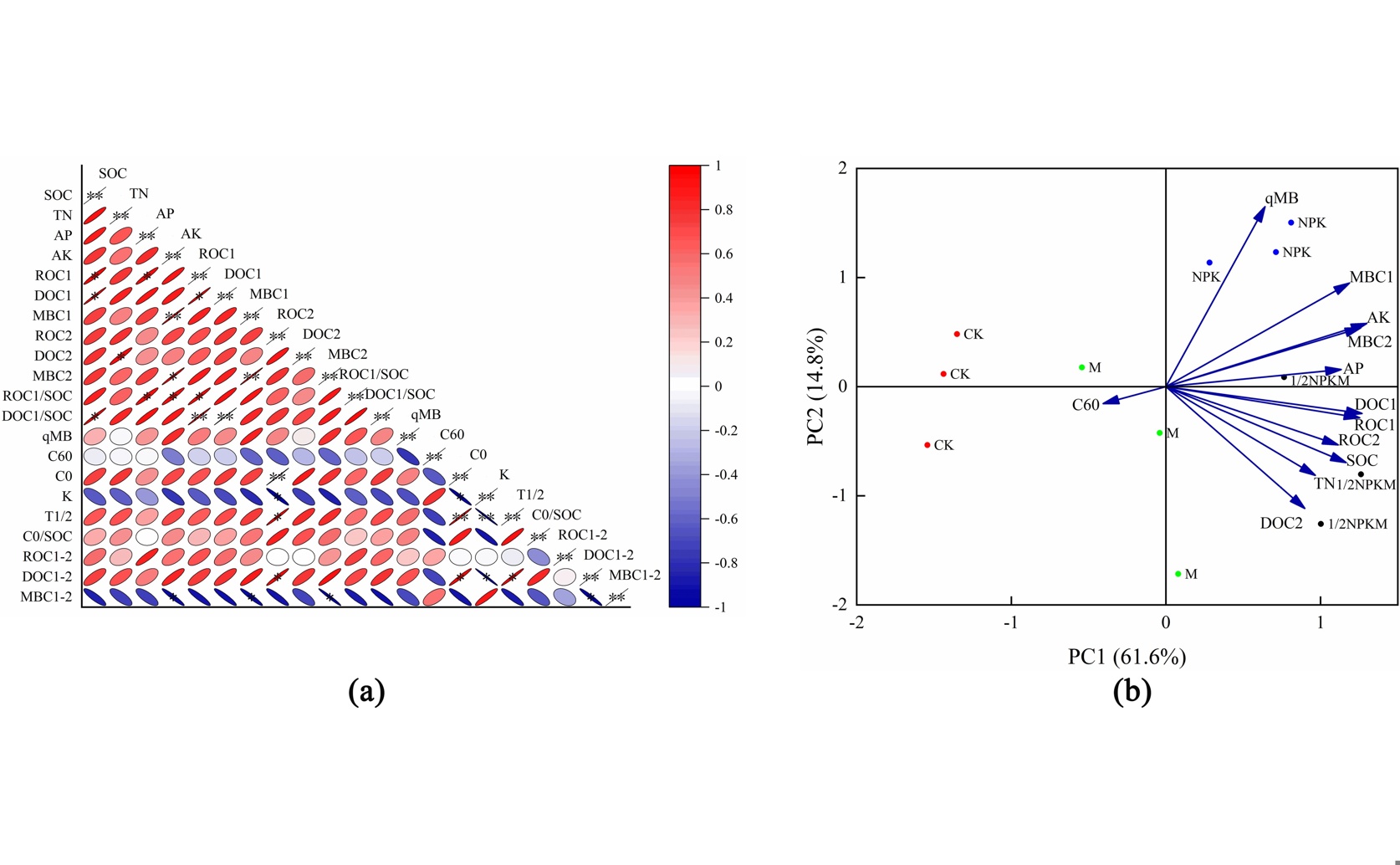
Correlation analysis indicated that soil organic carbon mineralization rates were negatively associated with active carbon fractions particularly microbial biomass carbon (a), while principal component analysis demonstrated that the substitution of 50% chemical fertilizer with organic fertilizer distinctively enhanced soil carbon pools and inhibited mineralization compared to the control and single fertilization treatments (b).

Image adapted from: Wei et al. / CC BY (Source)

Key Findings

  • In Guizhou, China, using a mix of 50% organic fertilizer with chemical fertilizer boosted soil organic carbon and key nutrients in yellow paddy soils
  • This fertilizer mix slowed down microbial carbon breakdown, helping the soil store more carbon and potentially reducing greenhouse gas emissions
[1] Researchers from Guizhou University and the University of Minnesota recently investigated methods to reduce chemical fertilizer use while boosting soil carbon sequestration in yellow paddy soils. The study focused on replacing half of the chemical nitrogen fertilizer with organic fertilizer to assess its impact on soil organic carbon dynamics, particularly the mineralization process. Soil organic carbon mineralization is essentially the breakdown of organic carbon by soil microbes, a process that releases carbon dioxide. Ideally, reducing excessive mineralization helps in sequestering more carbon within the soil, thereby mitigating climate change and enhancing soil fertility. The experiment involved four treatments: no fertilization, conventional fertilization (using chemical fertilizer alone), a combination of 50% organic fertilization and 50% chemical nitrogen fertilization, and a treatment with organic fertilization replacing chemical nitrogen addition. Measurements included soil organic carbon (SOC), total nitrogen, available phosphorus, and available potassium levels. In addition, key active organic carbon fractions such as readily oxidizable carbon (ROC), dissolved organic carbon (DOC), and microbial biomass carbon (MBC) were tracked both before and after mineralization. ROC represents carbon that is easily decomposed by microorganisms, DOC is the water‐soluble carbon portion, and MBC quantifies carbon contained within soil microorganisms. Results demonstrated that soils receiving the organic fertilizer treatment had markedly higher contents of SOC, total nitrogen, available phosphorus, and available potassium compared to the unfertilized control. Notably, when comparing the combined treatment (50% organic fertilization) with the chemical-only approach, researchers observed a significant increase in soil pH and a decrease in available potassium content. Over the course of the incubation period, cumulative carbon mineralization rates in all treatments decreased. However, the treatments with organic amendments showed increased levels of ROC, DOC, and MBC. For the 50% organic substitution treatment, these active carbon fractions increased by around 10–56% compared to the chemical fertilizer treatment after mineralization. The study also noted that the decrease in ROC was the most pronounced among the measured variables. Statistical analysis further revealed that higher SOC and active carbon fractions were negatively correlated with the rate of carbon mineralization, meaning that soils richer in these active compounds tended to lose carbon at a slower rate. In contrast, SOC itself was positively correlated with active carbon fractions, suggesting that an increase in easily available carbon forms helps maintain overall organic carbon levels. These findings have important implications. By inhibiting rapid organic carbon mineralization through a partial replacement of chemical fertilizer with organic alternatives, the soil can retain more carbon over time. This not only improves soil fertility but also contributes to carbon sequestration, lessening the greenhouse gas emissions associated with soil respiration. The study underlines ROC and MBC as the main sources of the mineralized organic carbon, highlighting their crucial role in the carbon cycle within soil ecosystems. Earlier studies provide relevant context for these findings. For example, research on long-term fertilization in yellow paddy soils[2] found that applying organic fertilizers led to notable improvements in soil microbial properties and enhanced carbon mineralization rates compared to chemical fertilization alone. Similarly, work examining the long-term replacement of chemical fertilizer with organic inputs in wheat–maize rotation systems[3] demonstrated that organic amendments raise the quality of soil humus and boost enzyme activities crucial for nutrient cycling. The current study builds on these observations by showing that even a 50% substitution can effectively control carbon loss in paddy soils. Other investigations have emphasized the structural benefits of organic amendments. A four-year study on Vertisol soils[4] revealed that combining organic manure with chemical fertilizers improved soil structure through enhanced macroaggregate stability and increased the activities of carbon cycle enzymes within soil aggregates. This link between soil structure and carbon retention reinforces the idea that organic matter improvements brought about by organic fertilizers can support longer-term carbon storage. In addition, a study focusing on maize rhizosphere soils[5] noted that organic fertilizer not only improved nutrient content and enzyme activity but also increased soil aggregate stability, which is vital for reducing carbon mineralization. Overall, the main study demonstrates that partial substitution of chemical fertilizer with organic fertilizer can result in higher levels of active organic carbon fractions while simultaneously mitigating the loss of soil organic carbon through mineralization. This approach represents a promising strategy for sustainable agriculture by reducing dependency on chemical inputs and fostering better soil health. The combined evidence from earlier research and the current findings provides a compelling case for integrated fertilizer management practices that not only sustain crop yields but also support environmental goals such as carbon sequestration.

AgricultureEnvironmentSustainability

References

Main Study

1) Effects of organic fertilizer replacing chemical fertilizer on organic carbon mineralization and active carbon fractions in yellow paddy soil of Guizhou Province

Published 2nd June, 2025

https://doi.org/10.1371/journal.pone.0323801


Related Studies

2) Effects of long-term fertilization on soil organic carbon mineralization and microbial community structure.

https://doi.org/10.1371/journal.pone.0211163


3) Impacts of Partial Substitution of Chemical Fertilizer with Organic Fertilizer on Soil Organic Carbon Composition, Enzyme Activity, and Grain Yield in Wheat-Maize Rotation.

https://doi.org/10.3390/life13091929


4) Effect of compost and inorganic fertilizer on organic carbon and activities of carbon cycle enzymes in aggregates of an intensively cultivated Vertisol.

https://doi.org/10.1371/journal.pone.0229644


5) Mineralization mechanism of organic carbon in maize rhizosphere soil of soft rock and sand mixed soil under different fertilization modes.

https://doi.org/10.3389/fpls.2023.1278122


Related Articles

An unhandled error has occurred. Reload 🗙