How Workers' Status Affects Farmland Transfers

Jim Crocker
16th May, 2025

How Workers' Status Affects Farmland Transfers

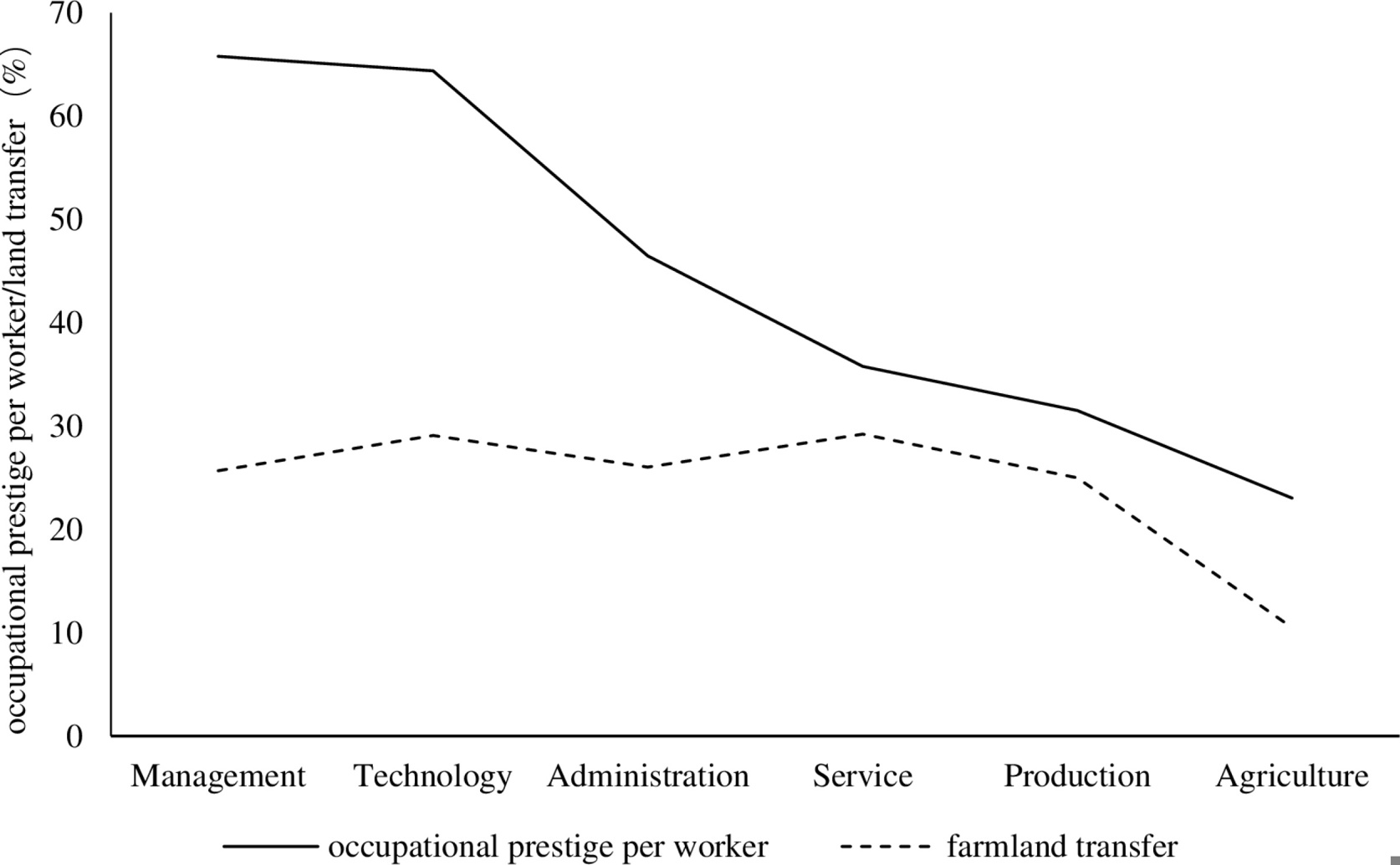
Consistent with the study's conclusion that occupational prestige positively influences land rental behavior, the data demonstrates that occupational categories with higher prestige scores—such as administrative affairs and commercial services—are associated with a significantly higher probability of farmland transfer compared to the agricultural sector.

Image adapted from: Wang et al. / CC BY (Source)

Key Findings

  • In China, farmers with higher job status are more likely to transfer their farmland
  • This is because they better understand land policies and depend less on land for income
  • The trend is stronger among farmers with financial constraints, lower incomes, and those in central-west regions
Farmland transfer plays a crucial role in China's rural development, influencing agricultural productivity and the livelihoods of millions. As urbanization accelerates, understanding the factors that drive farmers to transfer their land is essential for formulating effective rural policies. A recent study conducted by researchers from Zhejiang University of Finance and Economics, Southwestern University of Finance and Economics, and Sichuan Agricultural University[1] sheds light on how occupational prestige affects farmland transfer, building on earlier research in this area. Previous studies have highlighted the impact of migration on farmland use. For instance, a study found that characteristics such as trailing migration, the duration of migration, and the proportion of co-migrants significantly influence whether rural households abandon or transfer their farmland[2]. It was observed that in western and middle regions of China, and among households with smaller land areas, there is a higher tendency to abandon farmland. Conversely, in eastern regions and major cities, households are more likely to transfer their land. These patterns are linked to household earnings, which increase as families gain more income from non-agricultural employment, leading them to either give up cultivation or transfer their land[2]. The consolidation of arable land and the establishment of effective farmland transfer mechanisms were recommended as key strategies, especially in economically underdeveloped areas[2]. Building on this foundation, the main study explores a relatively under-examined factor: occupational prestige. Occupational prestige refers to the social status associated with one's job, which reflects a person's socioeconomic standing. The researchers utilized data from the China Family Panel Studies (CFPS) conducted in 2018 and 2020 to examine how occupational prestige influences farmers' decisions to transfer their land. The study found that farmers with higher occupational prestige are more likely to engage in farmland transfer. This relationship held true even when using an instrumental variable (IV)-Probit model, which strengthens the reliability of the findings by addressing potential biases. The researchers attributed this trend to several key mechanisms. Higher occupational prestige enhances farmers' awareness of land ownership rights and relevant policies, making them more informed and confident in transferring their land. Additionally, these farmers tend to have lower expectations of land security, meaning they are less reliant on land as a stable source of income and more open to transferring it for economic opportunities elsewhere. Moreover, the study identified that credit-constrained farmers, those with lower income levels, and those located in central-western regions of China are more inclined to transfer their land. Credit constraints limit farmers' access to financial resources, making farmland transfer an attractive option to alleviate financial pressures. Lower-income farmers may also see land transfer as a way to diversify their income sources, while regional economic disparities influence the decision based on local opportunities and market conditions. These findings complement and extend the earlier research[2] by highlighting the role of socioeconomic status, specifically occupational prestige, in farmland transfer decisions. While the previous study emphasized the effects of migration and household earnings, the current research adds a new dimension by showing how social status and awareness influence land transfer behaviors. This integration of social and economic factors provides a more comprehensive understanding of the dynamics at play in China's rural land market. The implications of this study are significant for policymakers and stakeholders involved in rural development and land management. By recognizing that occupational prestige influences farmland transfer, efforts can be made to support farmers in gaining higher social status through education and access to better employment opportunities. Additionally, fostering inclusive urban employment initiatives can provide upward mobility for rural workers, reducing the need to rely solely on agricultural income. This aligns with the study's recommendation for promoting inclusive urban employment and providing upward mobility opportunities as critical steps for developing China's rural land rental market. Furthermore, the findings suggest that enhancing farmers' awareness of land rights and policies is essential. Educational programs and information campaigns can empower farmers to make informed decisions about land transfer, ensuring that they are aware of their rights and the benefits of transferring land under favorable conditions. Addressing credit constraints by improving access to financial services for farmers can also encourage more efficient land transfer practices, particularly among those with lower incomes and in less economically developed regions. In summary, the study from Zhejiang University of Finance and Economics and its collaborating institutions provides valuable insights into the factors influencing farmland transfer in China. By focusing on occupational prestige, it adds a critical layer of understanding to the existing body of research[2], highlighting the interplay between social status, economic opportunities, and land use decisions. These insights are vital for shaping policies that support sustainable rural development, optimize land use, and improve the livelihoods of rural populations in China.

AgricultureEnvironmentSustainability

References

Main Study

1) How does occupational prestige of migrant workers affect farmland transfer in China?

Published 15th May, 2025

https://doi.org/10.1371/journal.pone.0319468


Related Studies

2) The impact of migration characteristics on rural migrant households' farmland use arrangements in China.

https://doi.org/10.1371/journal.pone.0273624


Related Articles

An unhandled error has occurred. Reload 🗙