Soil Organic Carbon: Trends and Drivers in Black Soils

Jenn Hoskins
5th June, 2025

Soil Organic Carbon: Trends and Drivers in Black Soils

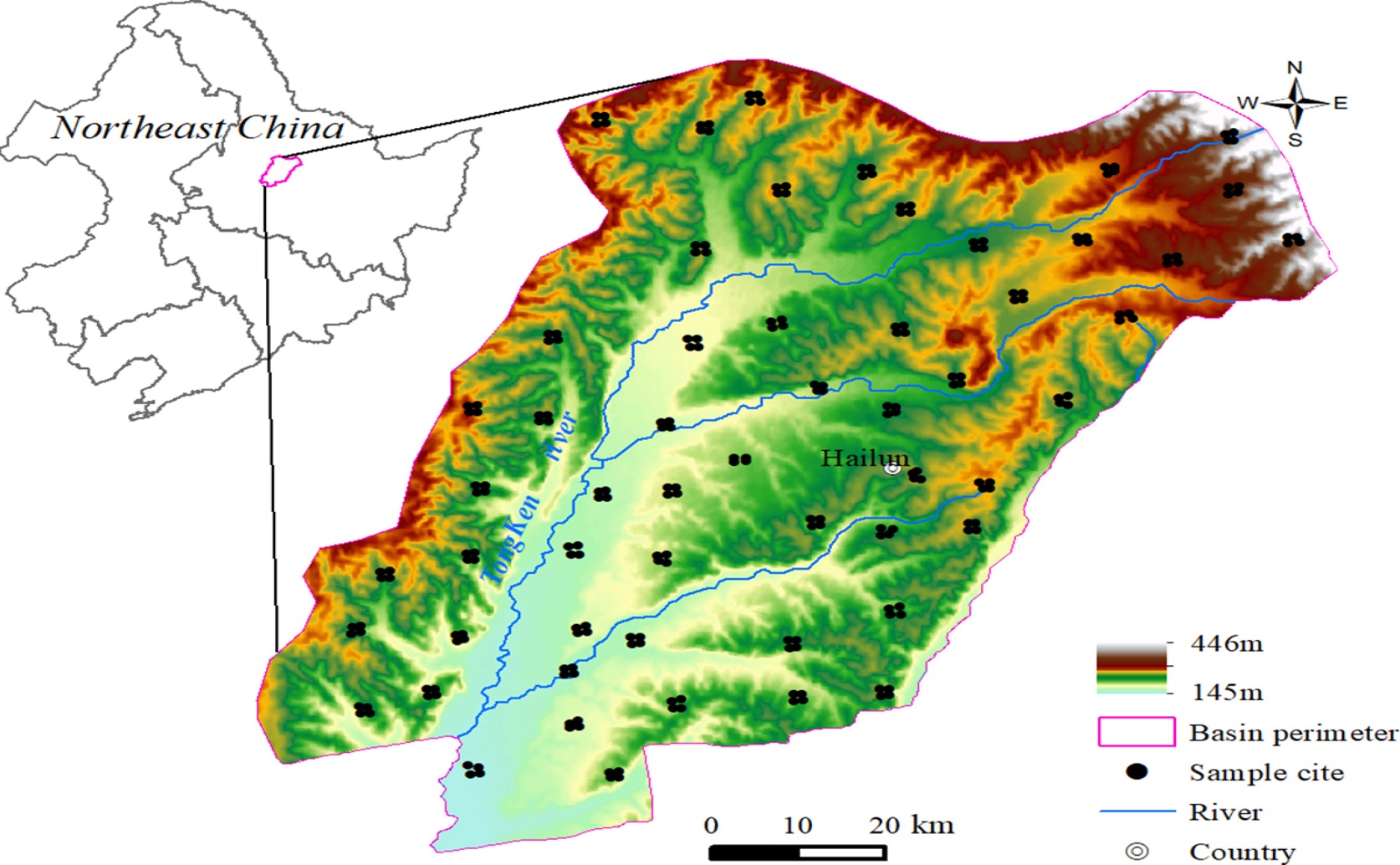
This map depicts the elevation and distribution of sampling sites within the Tongken River Basin, providing the geographical framework used to identify precipitation and land management as key drivers of the observed increase in soil organic carbon (SOC).

Image adapted from: Liu et al. / CC BY (Source)

Key Findings

  • In Northeast China's Tongken River Basin, soil organic carbon increased over 10 years, showing improved soil health from climate-smart practices and rising rainfall
  • Advanced analysis revealed that increased rainfall drove most of the carbon gains, while warmer temperatures slightly reduced the benefits
[1] Researchers from the Ministry of Natural Resources, China Geological Survey, Shenyang Pengde Environmental Technology Co., Ltd, and Zhejiang Agriculture and Forestry University recently completed a study focused on understanding how Soil Organic Carbon (SOC) has changed over a decade (2013–2023) in the Tongken River Basin of Northeast China. SOC is a fundamental component of soil health, agricultural productivity, and climate regulation because it influences soil structure, nutrient availability, and the capacity of soils to act as carbon sinks. At its core, the study examined both temporal (over time) and spatial (across the region) variations in SOC. The researchers used advanced machine learning techniques and sophisticated spatial mapping to quantify changes in SOC density and content. They found that average SOC content increased from 2.99% to 3.25% over the study period, while SOC density rose from 7.08 kg/m² to 7.72 kg/m². Among the key drivers analyzed, precipitation emerged as the strongest positive factor, while temperature and soil management practices also played significant roles. These findings are particularly vital considering the interconnected challenges of soil degradation and climate change. Healthy soils contribute to sustainable agriculture and environmental resilience by storing carbon that might otherwise contribute to greenhouse gas accumulation in the atmosphere. The study’s results suggest that climate-smart land-use practices can effectively enhance SOC storage, thereby improving soil quality and contributing to broader climate adaptation efforts. The research builds on a body of earlier studies that have explored the dynamics of SOC under various environmental and management conditions. For example, earlier work has highlighted that soils are the largest carbon reservoir on Earth, often containing more carbon than is found in the atmosphere. However, there has long been a debate about how climate change will influence the balance of soil carbon dynamics, including whether warming accelerates carbon release or whether increased carbon inputs from plant residues can offset any such effects[2]. The current study provides data from a critical agricultural region, thus offering insight into how such processes might unfold in a climate context that is dominated by increased precipitation and rising temperatures. In studies focusing on regions of North and Northeast China, changes in land use—such as the conversion of forests or grasslands to croplands—were shown to markedly influence SOC dynamics[3]. The recent study in the Tongken River Basin echoes this sentiment by demonstrating how different soil management strategies correlate with increases in SOC. Unlike some earlier work that noted reductions of SOC in areas under intensive conversion, the new study highlights an encouraging trend: under climate-smart management and favorable precipitation conditions, SOC can be enhanced even within cultivated landscapes. Methodologically, the study employed machine learning to analyze large datasets collected over the ten-year period. This approach allowed the researchers to identify complex interactions between climate variables (such as temperature and rainfall) and management practices. Advanced spatial mapping techniques ensured that variations across different parts of the Tongken River Basin were captured, allowing for more localized insights. The use of such techniques is in line with recent applications in other countries. For instance, studies in the United States have demonstrated that climate-smart practices, including optimized crop rotations and reduced tillage, have supported increases in SOC stocks in croplands[4]. Similarly, research in Europe has assessed targets for annual SOC increases, reinforcing the idea that strategic interventions are critical to achieving desired outcomes[5]. The present study stands out by not only documenting positive trends but also by quantifying the magnitude of change in SOC. Machine learning provided clarity on which factors had the greatest impact, with increased precipitation identified as the most powerful driver in boosting SOC. This suggests that in regions where rainfall increases, enhanced SOC storage may naturally occur as part of broader shifts in regional climate. However, the impact of temperature changes must not be overlooked. Slight increases in temperature can influence decomposition rates of soil organic matter, a phenomenon discussed in earlier literature where the temperature sensitivity of decomposition remains a contested issue[2]. The research demonstrates that even as temperatures rise, the net effect on SOC can be beneficial if proper soil management and favorable climatic conditions, particularly moisture availability, are maintained. Overall, the study offers valuable the insights that sustainable soil management practices, when designed in a climate-smart framework, have the capacity to improve SOC stocks. This is promising for efforts aimed at enhancing soil health, boosting agricultural productivity, and mitigating the effects of climate change. It brings together the lessons from earlier studies—whether regarding the delicate balance of soil carbon storage in various land uses[3], or the potential for management practices to secure carbon storage in agricultural soils[4][5]—and applies them to a real-world context with encouraging results. These findings contribute a significant piece to the complex puzzle of soil carbon dynamics and highlight the importance of tailored land management strategies in addressing environmental challenges.

AgricultureEnvironmentSustainability

References

Main Study

1) Spatiotemporal patterns and drivers of soil organic carbon in black soil landscapes of Northeast China

Published 2nd June, 2025

https://doi.org/10.1371/journal.pone.0320784


Related Studies

2) Temperature sensitivity of soil carbon decomposition and feedbacks to climate change.

Journal: Nature, Issue: Vol 440, Issue 7081, Mar 2006


3) Land use and climate change effects on soil organic carbon in North and Northeast China.

https://doi.org/10.1016/j.scitotenv.2018.08.016


4) Counterfactual scenarios reveal historical impact of cropland management on soil organic carbon stocks in the United States.

https://doi.org/10.1038/s41598-023-41307-x


5) European croplands under climate change: Carbon input changes required to increase projected soil organic carbon stocks.

https://doi.org/10.1016/j.scitotenv.2024.176525


Related Articles

An unhandled error has occurred. Reload 🗙