Making Salty Soil Stronger With Plastic Fibers

Jenn Hoskins
15th August, 2025

Making Salty Soil Stronger With Plastic Fibers

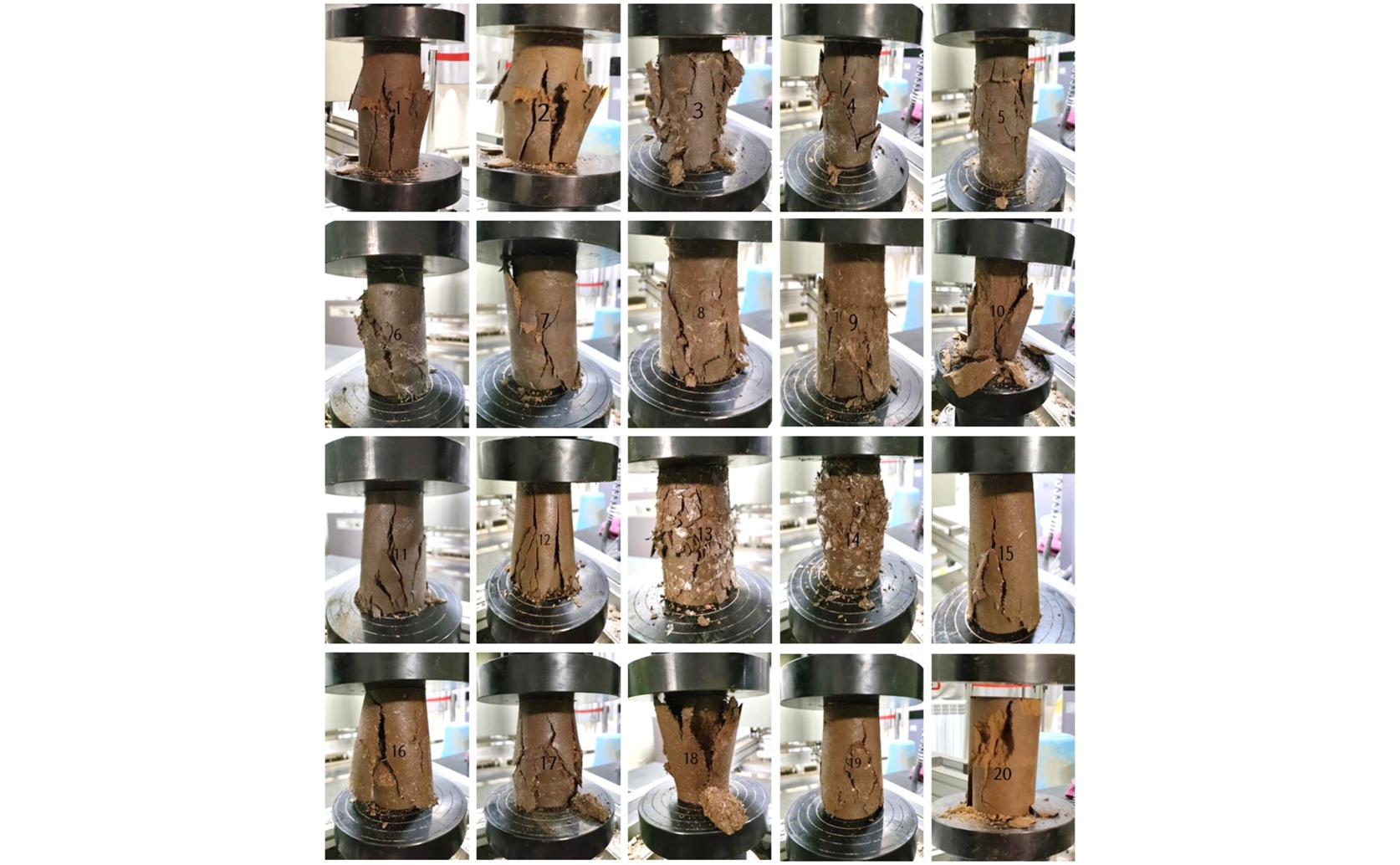
The comparison of failure modes reveals that while untreated saline soil exhibits brittle vertical fracturing (20), the inclusion of synthetic fibers transforms the soil's behavior into a more ductile shear failure (1–19), demonstrating significantly enhanced structural integrity and deformation resistance.

Image adapted from: Liu et al. / CC BY (Source)

Key Findings

  • A study in Kashi, China, found that adding synthetic fibers significantly improves the strength and stability of problematic salt-affected soils
  • These fibers increased soil density and strength, with glass fibers being most effective at reducing salt dissolution and enhancing overall stability
Soils affected by high salt content present a significant challenge in civil engineering, particularly in regions like Kashi, Xinjiang, China. These soils can be unstable, prone to swelling and shrinking, and lose strength, posing risks to roads, buildings, and other infrastructure. This instability necessitates costly and complex engineering solutions to ensure the longevity and safety of constructions built upon them. Finding effective, practical, and potentially sustainable ways to improve these challenging soil conditions is crucial for development in such areas. Addressing this problem, recent research conducted by the University of Shanghai for Science and Technology, Kashi University, and the University of Sharjah[1] has explored an innovative approach: reinforcing salt-affected soil with various types of synthetic fibers. The study aimed to understand how different fiber types and quantities could enhance the mechanical properties and microscopic structure of these challenging soils. The researchers at the University of Shanghai for Science and Technology, Kashi University, and the University of Sharjah investigated the impact of adding polypropylene, polyester, and glass fibers to sulfate-affected soil samples from Kashi. They varied the fiber content to determine optimal concentrations. To assess the improvements, they performed several tests. Key among these were the unconfined compressive strength and shear strength tests. Unconfined compressive strength measures how much pressure a soil sample can withstand before it fails when it's not supported on its sides – essentially, how much weight a column of soil can bear. Shear strength, on the other hand, describes a soil's ability to resist forces that cause it to slide or deform. This property is composed of two factors: cohesion, which refers to the attractive forces between soil particles that make them stick together, and the internal friction angle, which quantifies the resistance particles offer when they try to slide past one another. The study also measured the maximum dry density, which is the densest state a soil can achieve when compacted, indicating better stability. Furthermore, they examined the dissolution coefficient, a measure of how easily salts in the soil dissolve and are washed away, which can weaken the soil structure over time. To gain a deeper understanding of how the fibers interacted with the soil, select samples were analyzed using advanced microscopic techniques. Scanning Electron Microscope (SEM) provided highly magnified images of the soil-fiber blends, revealing their detailed surface structure. Nuclear Magnetic Resonance (NMR) microanalysis was employed to investigate the material properties at a molecular level, particularly to understand porosity and the subtle ways fibers integrated with soil particles. The team also subjected the most promising soil-fiber blends to dry-wet cycling and dissolution tests to simulate real-world conditions and assess long-term stability. The findings from the University of Shanghai for Science and Technology, Kashi University, and the University of Sharjah demonstrated that the addition of polypropylene, polyester, and glass fibers significantly improved the salt-affected soil. All three fiber types were found to increase the maximum dry density of the soil, indicating a more compact and stable material. Notably, soil reinforced with 1% polyester fiber and 8% silica fume exhibited the highest unconfined compressive strength, nearly doubling the strength of the original soil. Even without silica fume, 1% polyester fiber alone increased the soil's strength by 43%. Glass fibers also performed well, with 5% and 7% concentrations increasing strength by over 50%. While the original soil had the highest cohesion, the internal friction angle was significantly improved, especially with 6% glass fiber reinforcement, suggesting better resistance to sliding forces. A critical finding was that synthetic fibers, particularly glass fibers, considerably reduced the dissolution coefficient of the salt-affected soil. This means the fibers help to stabilize the soil by making the embedded salts less prone to dissolving and leaching away, which is a common cause of soil degradation in saline environments. The microscopic analyses using SEM and NMR provided insights into these improvements. They revealed that the fibers create a "clamping action" with the soil particles, holding them together more effectively. Some fibers even formed tight bonds with the soil, leading to a reduction in the soil's overall porosity, which contributes to increased strength and reduced water permeability. This research aligns with broader efforts in civil engineering to enhance material properties through the incorporation of various additives. For instance, a separate study[2] explored using shredded face masks (SFM) with recycled concrete aggregate (RCA) for road base and subbase applications. That research found that adding 1%, 2%, or 3% SFM to RCA improved the strength and stiffness of the material, enhancing its ductility and flexibility. Interestingly, the study[2] also noted that while 1% SFM yielded the highest strength and stiffness, increasing the SFM beyond 2% led to a decrease in these properties. This mirrors the current study's exploration of optimal fiber percentages, where too much or too little of an additive can affect performance. Both studies underscore the importance of finding the right balance and concentration of reinforcing materials to achieve desired mechanical properties, whether it's synthetic fibers in salt-affected soil or recycled masks in concrete aggregate, contributing to more sustainable and resilient construction practices.

AgricultureEnvironmentSustainability

References

Main Study

1) Investigation of mechanical properties and micromechanisms of saline soil modified with synthetic fibers

Published 14th August, 2025

https://doi.org/10.1371/journal.pone.0329941


Related Studies

2) Repurposing of COVID-19 single-use face masks for pavements base/subbase.

https://doi.org/10.1016/j.scitotenv.2021.145527


Related Articles

An unhandled error has occurred. Reload 🗙