Fungal Disease Found in Wild Mammals

Jim Crocker
28th August, 2025

Fungal Disease Found in Wild Mammals

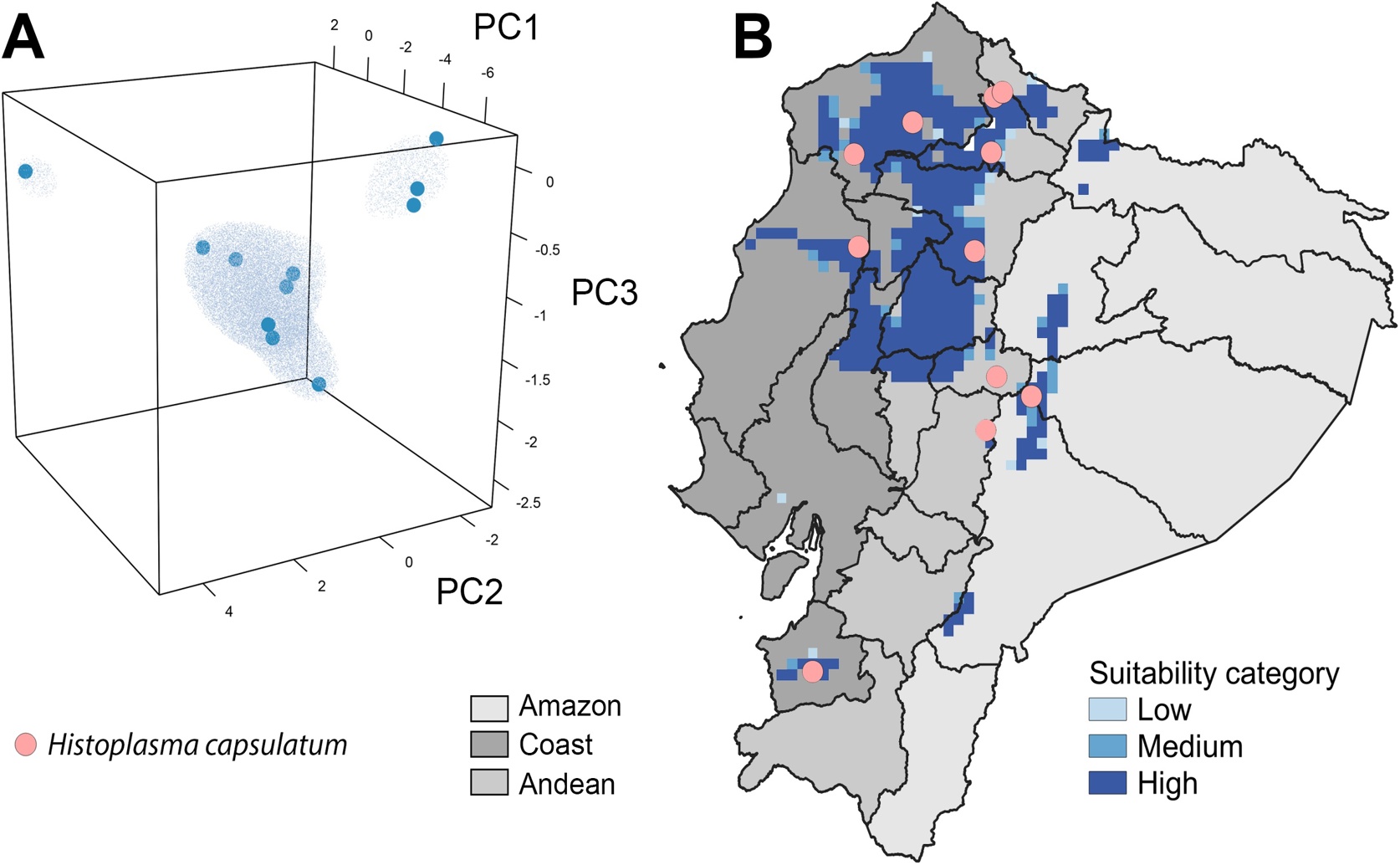
Ecological niche modeling based on environmental clustering (A) projects that the northern Coast and Andean regions of Ecuador offer the highest environmental suitability for Histoplasma capsulatum, consistent with the study's detection of the pathogen in wild mammals within these areas (B).

Image adapted from: Hernández-Alomía et al. / CC BY (Source)

Key Findings

  • In Ecuador, a study across three regions found Histoplasma capsulatum in 14% of wild mammal samples
  • Bats were the most common hosts, identified in 80% of positive samples, suggesting they are key reservoirs
  • The Coast region of Ecuador appears to have the most favorable environments for the fungus, posing a higher infection risk
Histoplasmosis is a fungal infection caused by the fungus Histoplasma capsulatum, acquired through breathing in airborne spores. While it can affect anyone, it’s particularly concerning for individuals with weakened immune systems, potentially leading to severe lung or systemic (whole-body) illness. The fungus thrives in environments rich in nitrogen, often associated with bird and bat droppings, and is spread by these animals[2]. Understanding where the fungus exists and which animals carry it is crucial for public health, as it helps identify risk areas and potential sources of infection. A recent study conducted by researchers at INABIO, Pontificia Universidad Católica del Ecuador, Universidad de las Américas, Universidad Internacional SEK (UISEK), Universidad Espíritu Santo, and Universidad de Antioquia[1] investigated the presence of H. capsulatum in wild small mammals across different regions of Ecuador – the Coast, Andes, and Amazon. The researchers examined tissue samples from 324 mammals, representing 106 different species, collected between 2022 and 2023. They used a technique called nested PCR, which detects the fungal DNA by amplifying a specific gene (the 100-kDa protein-encoding gene). Samples that tested positive were then sequenced to identify the fungal strain. The results revealed that H. capsulatum was found in 14% of the samples, across 30 of the 106 species studied. Notably, bats (Chiroptera) were the most common hosts, found in 80% of the positive samples. Rodents (Rodentia) accounted for 15% and opossums (Didelphimorphia) for 4%. This broad host range highlights the fungus’s ability to infect a variety of mammals, suggesting a complex network of potential reservoirs. To understand where the fungus might be thriving, the researchers used ecological niche modeling. This technique identifies environmental conditions suitable for the fungus’s survival. The modeling indicated that the Coast region of Ecuador provided the most favorable environments, with isolated suitable areas also found in the Andean and Amazon regions. This suggests that the fungus isn't uniformly distributed, and certain geographical areas pose a higher risk of infection. These findings build upon previous research that has documented histoplasmosis in animals across Europe[3]. That study, analyzing cases from 1968 to 2022, found a prevalence in cats and badgers in Central Europe, and highlighted the importance of molecular typing to understand the fungus’s spread. The Ecuadorian study expands on this by demonstrating a wider geographical distribution and a broader range of host species. Furthermore, the Ecuadorian research supports the idea that bats play a crucial role in the dispersal of H. capsulatum[2]. Previous studies have indicated that bats are major natural reservoirs for the fungus, and their movements can contribute to its spread across continents. The identification of cryptic species within the Histoplasma complex[4] adds another layer of complexity, suggesting that different genetic groups of the fungus may be adapted to specific environments or hosts. The study by[4] identified at least six new phylogenetic species, which could be driven by host or environmental adaptation, meaning that the fungus isn't a single entity, but a collection of closely related species. The Ecuadorian study reinforces the concerns about the zoonotic potential of histoplasmosis, meaning the fungus can be transmitted from animals to humans. The detection of H. capsulatum across diverse mammals and ecosystems emphasizes the importance of continuous wildlife surveillance to better understand fungal pathogen reservoirs and identify geographical hotspots. This information is vital for developing effective prevention and control strategies.

WildlifeEcologyMycology

References

Main Study

1) Histoplasma capsulatum in wild mammals from Ecuador

Published 25th August, 2025

https://doi.org/10.1371/journal.pntd.0013410


Related Studies

2) Considerations about the Geographic Distribution of Histoplasma Species.

https://doi.org/10.1128/aem.02010-21


3) Animal Histoplasmosis in Europe: Review of the Literature and Molecular Typing of the Etiological Agents.

https://doi.org/10.3390/jof8080833


4) Worldwide Phylogenetic Distributions and Population Dynamics of the Genus Histoplasma.

https://doi.org/10.1371/journal.pntd.0004732


Related Articles

An unhandled error has occurred. Reload 🗙