How Ecology Impacts Virus Risk: Mosquito and People Interactions in Wetlands

Jenn Hoskins
27th August, 2025

How Ecology Impacts Virus Risk: Mosquito and People Interactions in Wetlands

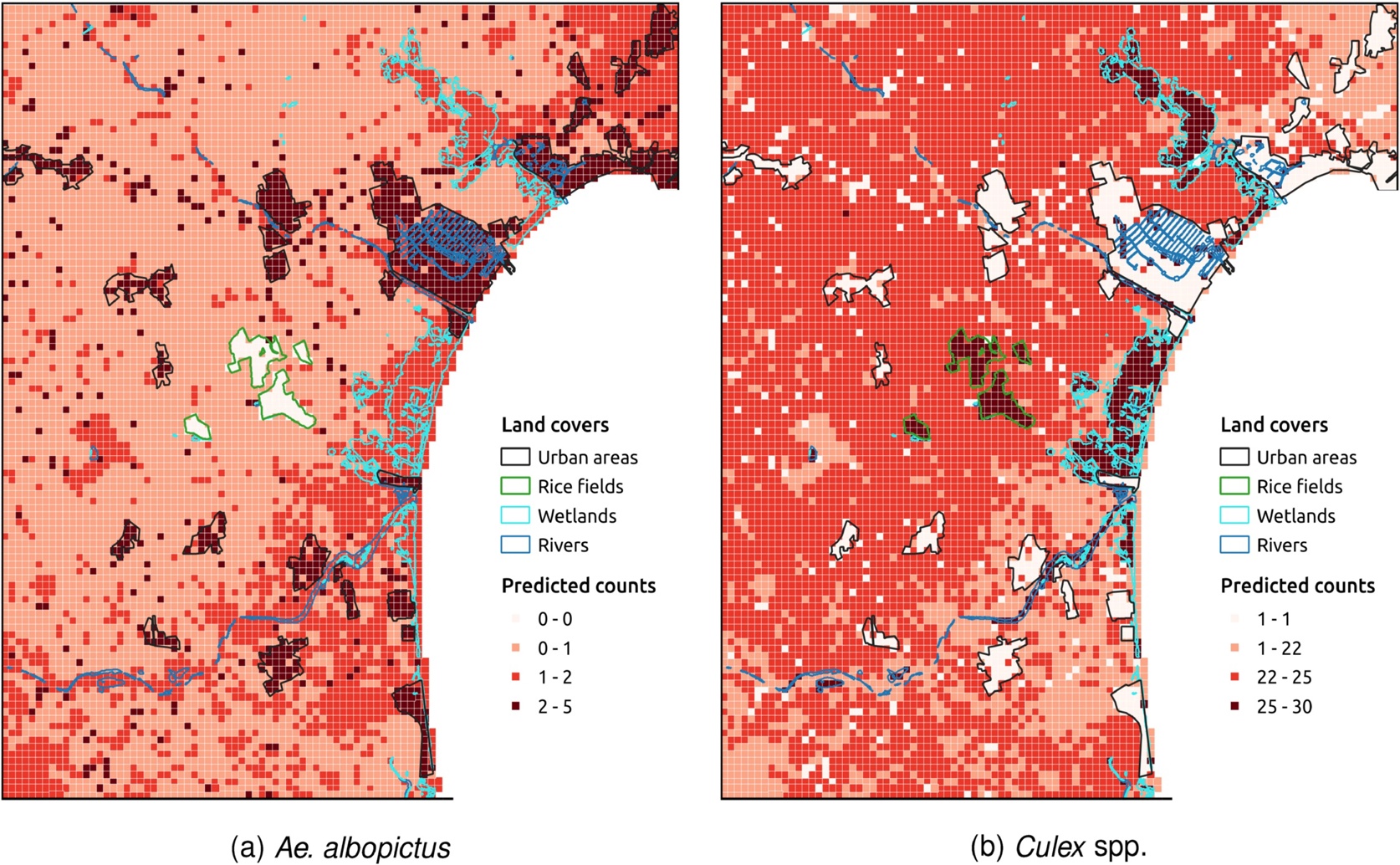
Predicted spatial distributions reveal distinct ecological niches, with Aedes albopictus concentrated in urban environments (a) and Culex spp. predominantly inhabiting natural and rural areas such as wetlands and rice fields (b).

Image adapted from: Froxán-Grabalosa et al. / CC BY (Source)

Key Findings

  • This study, conducted in northeastern Spain, investigated the risk of West Nile virus, dengue, Zika, and chikungunya transmission by analyzing mosquito populations, bird hosts, and human cases
  • Mosquito activity peaks between June and October, with Aedes albopictus common in urban areas and Culex species prevalent in rural settings, influencing disease spread
  • Areas near urban edges, especially those adjacent to rice fields and wetlands, show the highest risk for West Nile virus transmission due to overlapping mosquito and bird host populations
Arboviral diseases – illnesses transmitted by arthropods like mosquitoes – are an increasing global health concern. While historically considered relatively minor threats[2], diseases such as dengue, Zika, and chikungunya are now causing widespread epidemics, fueled by factors like urbanisation and increased international travel. Understanding how these diseases spread at a local level is crucial for effective prevention and control. The challenge lies in the complex interplay between mosquito vectors, animal hosts, and the surrounding environment. A recent study by researchers at CSIC & ICREA, in collaboration with the CDC (Puerto Rico), investigated pathogen transmission risk in a Mediterranean wetland in Northeastern Spain[1]. The research aimed to identify areas and times of highest risk for West Nile virus (WNV), dengue, Zika, and chikungunya, focusing on the specific ecological factors at play. This is particularly relevant given that over 80% of the global population is at risk of vector-borne diseases, with mosquitoes being the primary culprits[3]. The study involved analyzing historical data from multiple sources to build a detailed picture of mosquito populations, bird hosts for WNV, and human cases of dengue, Zika, and chikungunya. Mosquito activity was found to be highest between June and October. Importantly, the study identified a clear pattern in mosquito distribution: Aedes albopictus, a key vector for dengue, Zika, and chikungunya, was most common in urban areas, while Culex species, important for WNV transmission, were more prevalent in rural and natural settings. The research didn’t stop at simply identifying which mosquitoes were where. It also examined the role of bird populations in WNV transmission. Certain bird species act as reservoirs for the virus, amplifying its spread, while others have a limited ability to carry the virus, effectively diluting it. The relative abundance of passeriform (perching birds) and columbiform (pigeons and doves) bird species was shown to influence the potential for WNV amplification and dilution within the ecosystem. To translate these findings into practical risk assessment, the researchers developed a spatial risk index for WNV transmission. This index integrated data on vector abundance and avian community composition to pinpoint high-risk areas. The results revealed that areas near the edges of urban areas were particularly vulnerable, especially those adjacent to rice fields and wetlands – locations where mosquitoes and reservoir hosts frequently overlapped. For dengue, Zika, and chikungunya, the highest transmission risk was observed in late summer. This coincided with the peak activity of Aedes albopictus and the timing of imported cases from regions where these diseases are already endemic. This highlights the importance of surveillance and control efforts during periods of peak mosquito activity and when travelers are returning from affected areas. This study builds upon previous research emphasizing the need to move beyond solely focusing on climate change as the primary driver of mosquito-borne disease dynamics[3]. While climate does play a role, the researchers demonstrate the critical importance of considering other global change processes, such as land-use changes, and their impact on vector and host populations. In fact, previous work has shown that anthropogenic landscape transformation significantly affects pathogen transmission, with urbanization having a complex effect on mosquito communities[4]. The current study adds to this understanding by showing how these landscape characteristics relate to mosquito abundance and species composition, providing valuable information for targeted public and animal health management. The research from CSIC & ICREA and the CDC underscores the value of using fine-scale ecological data to guide mosquito surveillance and control strategies. By focusing efforts on high-risk areas and times, public health officials can more effectively reduce the risk of arboviral transmission in vulnerable regions. The findings also support the idea that a combined intervention approach, targeting multiple aspects of disease transmission, is likely to be the most sustainable and cost-effective strategy[2].

EnvironmentWildlifeEcology

References

Main Study

1) Ecological drivers of arboviral disease risk: Vector-host interfaces in a Mediterranean wetland of Northeastern Spain

Published 26th August, 2025

https://doi.org/10.1371/journal.pntd.0013447


Related Studies

2) Epidemic arboviral diseases: priorities for research and public health.

https://doi.org/10.1016/S1473-3099(16)30518-7


3) The effect of global change on mosquito-borne disease.

https://doi.org/10.1016/S1473-3099(19)30161-6


4) Effects of landscape anthropization on mosquito community composition and abundance.

https://doi.org/10.1038/srep29002


Related Articles

An unhandled error has occurred. Reload 🗙