Wind Farm Noise Disrupts Communication in Dry Forests

Greg Howard
20th March, 2025

Wind Farm Noise Disrupts Communication in Dry Forests

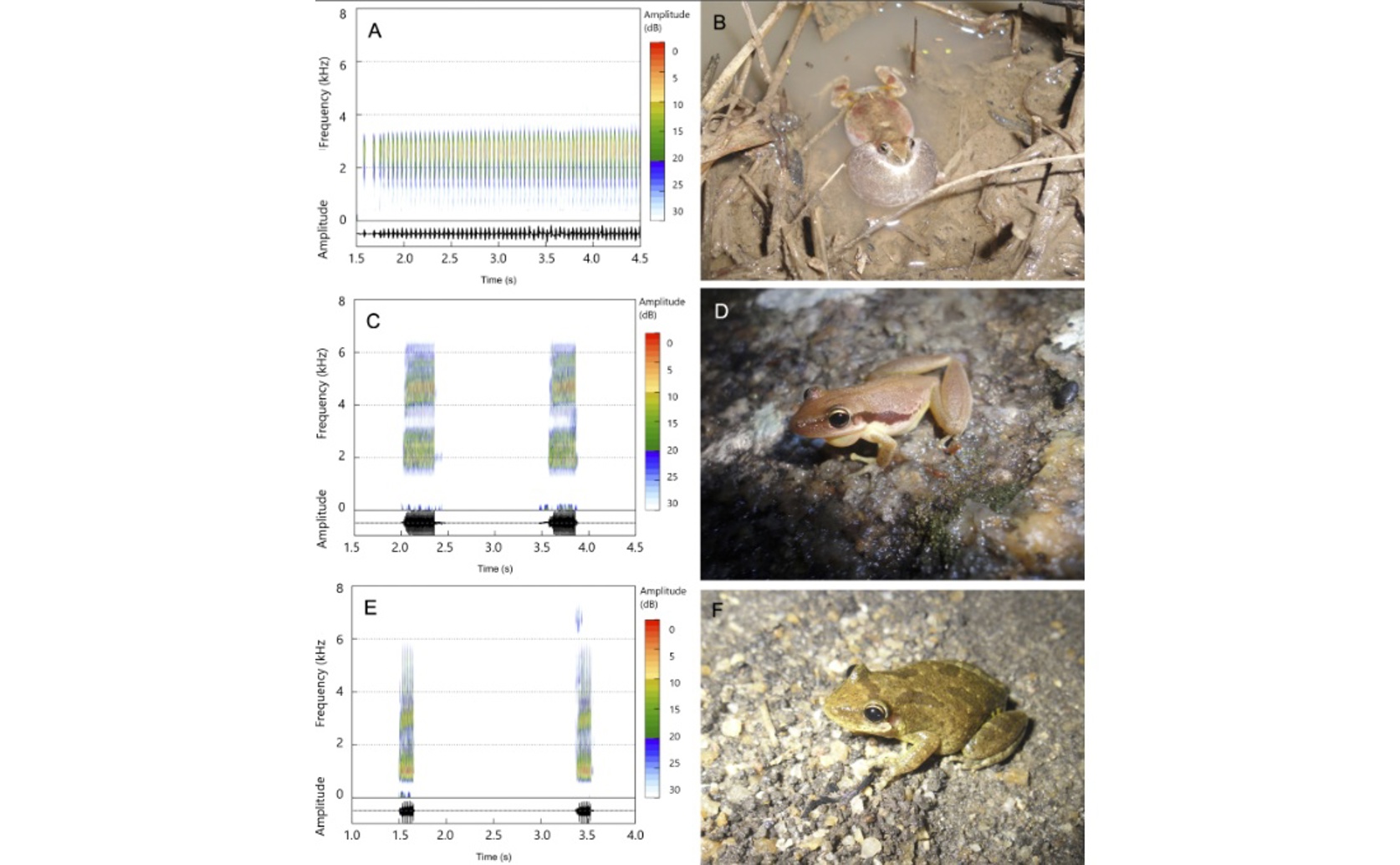
Oscillograms and spectrograms illustrate the distinct acoustic profiles of the three frog species studied—Physalaemus cicada (a, b), Scinax pachycrus (c, d), and Scinax x-signatus (e, f)—whose advertisement calls were differentially altered by wind farm noise in Caatinga dry forests.

Image adapted from: Oliveira et al. / CC BY (Source)

Key Findings

  • In Brazil’s Caatinga region, wind turbine noise disrupts the mating calls of frogs and toads
  • The noise changes the pitch and timing of their calls, making it harder for males to attract females
  • These disruptions may lead to fewer successful matings and negatively impact frog populations
Acoustic communication is vital for anurans, such as frogs and toads, particularly during mating seasons when males call to attract females. However, the proliferation of wind farms in sensitive ecosystems like the Caatinga in Brazil raises concerns about how the noise generated by these turbines might interfere with these essential vocalizations. A recent study by researchers at the Universidade Federal Rural de Pernambuco, Recife, Brazil[1] investigates this issue by examining the impact of wind turbine noise on the communication of three anuran species: Scinax pachycrus, Scinax x-signatus, and Physalaemus cicada. The Caatinga ecosystem is a unique and biodiverse region, making it a priority area for conservation. As wind power generation expands in this region, understanding its effects on local wildlife becomes crucial. Previous studies have highlighted various ways in which wind turbines can affect animals. For instance, badgers living near wind farms exhibited significantly higher stress hormone levels[2], and toads showed reduced calling activity in response to vibrations caused by wind turbines and road traffic[3]. Additionally, Japanese tree frogs exposed to wind turbine noise demonstrated altered calling behaviors and decreased immunity[4]. These findings collectively suggest that wind turbine noise can have profound physiological and behavioral impacts on wildlife. In the main study, researchers focused on how wind turbine noise affects the acoustic parameters of anuran calls. They recorded the advertisement calls of 181 adult males from the three species across 19 temporary ponds situated within two wind farms. These ponds were chosen because they had similar vegetation structures, allowing the study to isolate the effects of noise rather than other environmental variables. The researchers categorized the ponds based on noise gradients, ranging from areas with high wind turbine noise to quieter locations farther away from the turbines. The analysis revealed that wind turbine noise significantly altered both the spectral (frequency-related) and temporal (time-related) aspects of the anurans' calls. Specifically, Scinax pachycrus experienced a decrease in dominant frequency and frequency range in noisier ponds. This alteration could make their calls less attractive to females, potentially reducing their chances of successful mating. Similarly, Scinax x-signatus exhibited a decrease in call amplitude and the number of call pulses, which are crucial for attracting mates and deterring rivals. On the other hand, Physalaemus cicada responded by reducing call duration and the number of call pulses while increasing call rate. This adjustment appears to be an attempt to maintain communication effectiveness in the presence of noise but may still lead to reduced reproductive success. These behavioral changes are concerning because effective communication is essential for anuran reproduction. Males rely on their calls not only to attract females but also to establish territories and ward off competitors. Disruptions in these vocalizations can lead to lower mating success and, consequently, affect population dynamics. The findings of this study align with previous research showing that anthropogenic noise can lead to physiological stress and altered behaviors in wildlife[2][3][4]. For example, badgers near wind farms showed elevated cortisol levels, indicating chronic stress[2], while toads reduced their call rates in response to vibrations[3]. Similarly, Japanese tree frogs not only changed their call patterns but also experienced decreased immunity, making them more susceptible to diseases[4]. The methodology of the main study involved recording the calls in natural settings to ensure that the data accurately reflected the animals' responses to real-world noise levels. By focusing on multiple species, the researchers could assess whether the impact of wind turbine noise was consistent across different types of anurans or if certain species were more vulnerable than others. This comprehensive approach provides a broader understanding of how wind farms might affect amphibian communities as a whole. The implications of these findings are significant for both conservation efforts and the planning of wind energy projects. As wind power is promoted as a green alternative to fossil fuels, it's essential to balance energy needs with the preservation of biodiversity. The Caatinga region, being a hotspot for unique species, could face long-term ecological consequences if wind turbine noise continues to disrupt anuran communication and reproduction. Mitigation strategies, such as designing quieter turbines or establishing buffer zones where wind farms are not installed, could help reduce the negative impacts on local wildlife. Furthermore, this study highlights the need for ongoing research into the ecological effects of renewable energy infrastructure. While wind farms contribute to reducing carbon emissions, their installation must be carefully managed to minimize harm to ecosystems. Future studies could explore the cumulative effects of noise pollution on different animal groups and investigate potential adaptive behaviors that could mitigate these impacts. In conclusion, the research conducted by the Universidade Federal Rural de Pernambuco underscores the complex relationship between renewable energy development and wildlife conservation. Wind turbine noise poses a tangible threat to the acoustic communication of anurans in the Caatinga, potentially affecting their reproductive success and overall population health. Addressing these challenges requires a multidisciplinary approach, integrating ecological research with sustainable energy planning to ensure that the pursuit of green energy does not come at the expense of biodiversity.

EnvironmentWildlifeEcology

References

Main Study

1) Wind farm noise negatively impacts the calling behavior of three frogs in Caatinga dry forests

Published 19th March, 2025

https://doi.org/10.1371/journal.pone.0318517


Related Studies

2) WIND TURBINES CAUSE CHRONIC STRESS IN BADGERS (MELES MELES) IN GREAT BRITAIN.

https://doi.org/10.7589/2015-09-231


3) Anthropogenic substrate-borne vibrations impact anuran calling.

https://doi.org/10.1038/s41598-019-55639-0


4) Wind Turbine Noise Behaviorally and Physiologically Changes Male Frogs.

https://doi.org/10.3390/biology11040516


Related Articles

An unhandled error has occurred. Reload 🗙