How The Land Shaped Sumer

Greg Howard
21st August, 2025

How The Land Shaped Sumer

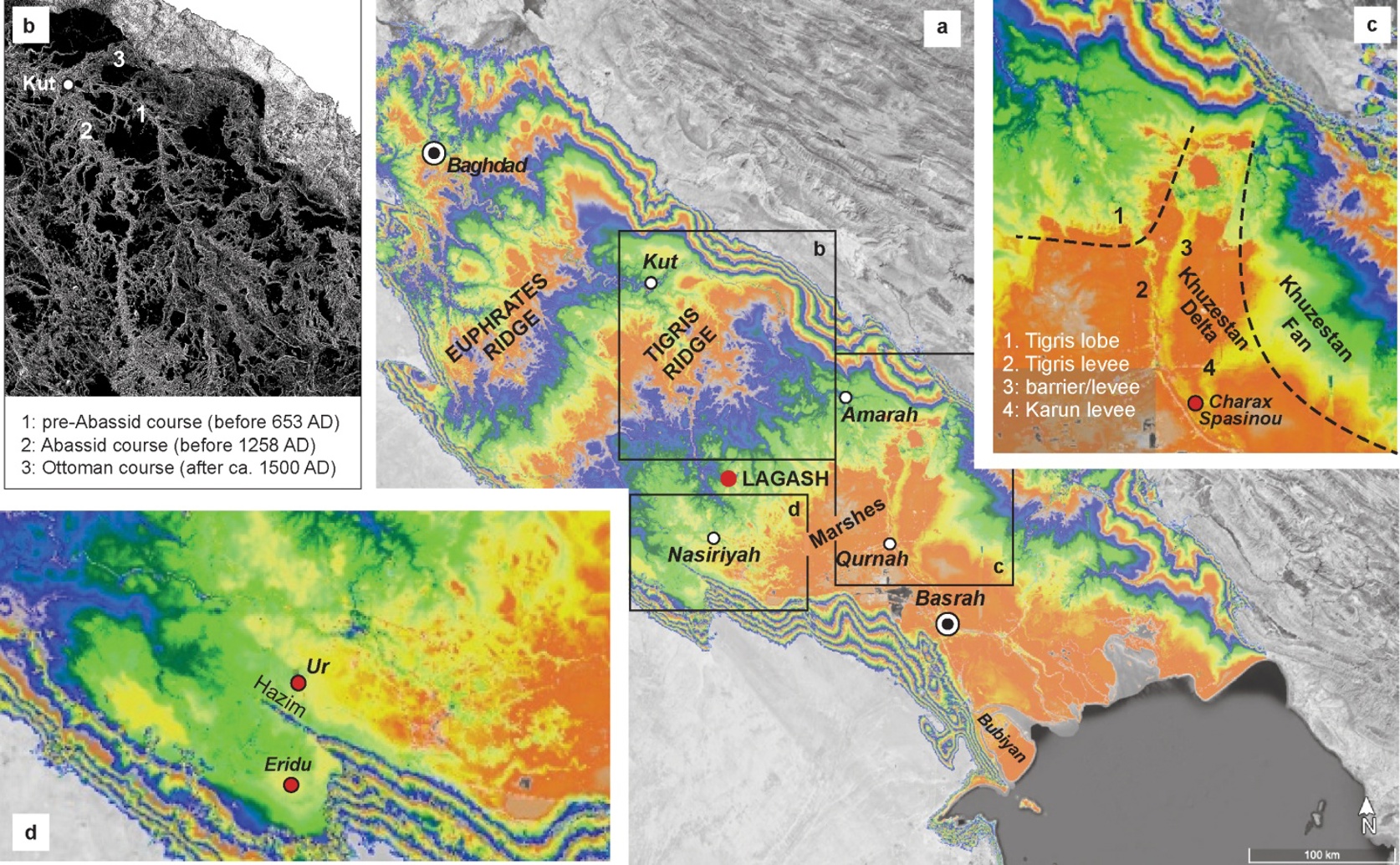
Satellite-derived topography reveals the preservation of distinct large-scale geomorphological zones across the Mesopotamian Plain (a), specifically distinguishing between upstream fluvial avulsion nodes (b) and downstream deltaic or coastal basin features (c, d) that conditioned the evolving hydrological environment of ancient Sumer.

Image adapted from: Giosan et al. / CC BY (Source)

Key Findings

  • A study in ancient Mesopotamia reveals that early Sumerian cities thrived due to natural tidal irrigation, where river water pushed inland by tides fertilized fields
  • This natural system provided abundant water and nutrients without complex canals, jumpstarting agriculture during a period of stable sea levels
  • As the delta grew, tidal access diminished, forcing Sumerians to develop large-scale river irrigation, which shaped their urban society
The emergence of ancient Sumer, one of the world's earliest urban civilizations in Mesopotamia (modern-day Iraq), has long puzzled historians and archaeologists. How did such a complex society, characterized by large cities and advanced social structures, develop significant agricultural surpluses without the extensive irrigation systems that became common later? Traditional explanations have pointed to pastoralism, trade, or diverse resource use, but the scale of agricultural output needed to sustain early urbanization remains difficult to explain. A recent study[1] by a collaborative team of researchers from Woods Hole Oceanographic Institution, Babeș-Bolyai University, University of Bucharest, Clemson University, University of Pennsylvania, New York University, and Ariel University, ISRAEL, proposes a compelling new answer: tidal irrigation. This research suggests that natural tidal forces provided a crucial "jumpstarting mechanism" for high-yield, diversified agriculture, thereby fueling the initial growth of Sumerian cities during the Uruk period, approximately 6,000 to 5,200 years before present (y BP). The study posits that the early Sumerian landscape was significantly different from today. Instead of relying on complex, human-engineered canals, early agriculture benefited from the natural ebb and flow of tides. Tidal irrigation occurs when coastal areas, particularly low-lying deltas and estuaries, are regularly inundated by freshwater from rivers during high tides. This natural flooding brings not only water but also nutrient-rich sediments, creating fertile ground for crops without the need for extensive human labor or sophisticated water management systems. To reconstruct this ancient environment, the researchers employed a multi-faceted approach. They utilized high-resolution satellite-based topography, which provides detailed elevation data of the landscape, allowing them to map ancient waterways and landforms. This was combined with paleoenvironmental proxies from a new drill core extracted at Lagash/Tell Al Hiba, a significant archaeological site. Paleoenvironmental proxies are clues preserved in the geological record, such as sediment layers, pollen, or microscopic organisms, that provide information about past environmental conditions like water salinity, vegetation, and climate. By analyzing these proxies alongside existing geological and archaeological data, the team could reconstruct the morphodynamic evolution of the coastal Sumerian region. Morphodynamic evolution refers to how the shape and form of a landscape, in this case, the coastline and river delta, change over time due to natural processes like water flow and sediment deposition. The findings indicate that the Uruk period coincided with a time when global sea levels were relatively stable. Earlier research on global sea level changes during and after the last ice age[2] shows that after a period of significant deglaciation from about 16.5 to 8.2 thousand years before present (ka BP), the rate of sea level rise progressively decreased from 8.2 ka BP to about 2.5 ka BP. Subsequently, ocean volumes remained nearly constant until very recently. The Uruk period, falling within this interval of decreasing and then stable sea levels, would have provided a more predictable coastal environment for tidal irrigation to thrive. However, even within this period of general sea level stability, the study highlights that the delta was actively building up and tides were shifting with the advancing coastline, indicating a dynamic environment where natural processes were constantly at play. The study's emphasis on "coastal morphodynamics" and the intricate interplay of natural systems and human activity aligns with broader understandings of coastal environments. As highlighted by research on sea level rise impacts in estuaries[3], assessing these impacts requires moving beyond static "bathtub" models, which simply assume water rises uniformly. Instead, it necessitates considering complex hydrodynamic effects, such as how tidal waves amplify, dampen, or reflect within estuarine systems. The Sumerian study's detailed reconstruction of ancient tidal regimes and deltaic changes exemplifies this sophisticated, interdisciplinary approach, underscoring the vital connections between physical processes, geology, and human societal development. This approach directly addresses the call for more integrated studies of estuaries, which are crucial for understanding complex environmental responses to changes like sea level fluctuations[3]. The researchers propose that this natural tidal irrigation provided the initial impetus for urbanization. However, this system was not static. As the delta continued to build up due to sediment deposition from the rivers, access to the sea became increasingly restricted, and the tidal influence on inland areas diminished. This shifting coastal environment meant that the natural tidal irrigation became less reliable. Consequently, the Sumerian communities had to adapt, gradually intensifying their reliance on the more mercurial river regimes. This eventual shift likely led to the development of the expansive, human-engineered fluvial (river-based) irrigation networks characteristic of later Early Dynastic city-states. By positioning the dynamic evolution of the coastline as a pivotal factor in the emergence of urbanization and political structures, this research underscores the profound and intricate interconnections between naturally evolving environmental systems and the collective actions and adaptations of human societies. It offers a plausible explanation for the early agricultural success of Sumer, demonstrating how environmental opportunities, even transient ones, can shape the course of human history.

Environment

References

Main Study

1) Morphodynamic Foundations of Sumer

Published 20th August, 2025

https://doi.org/10.1371/journal.pone.0329084


Related Studies

2) Sea level and global ice volumes from the Last Glacial Maximum to the Holocene.

https://doi.org/10.1073/pnas.1411762111


3) Sea level rise impacts on estuarine dynamics: A review.

https://doi.org/10.1016/j.scitotenv.2021.146470


Related Articles

An unhandled error has occurred. Reload 🗙