Spotting Plant Leaf Diseases With Explaining AI

Greg Howard
18th August, 2025

Spotting Plant Leaf Diseases With Explaining AI

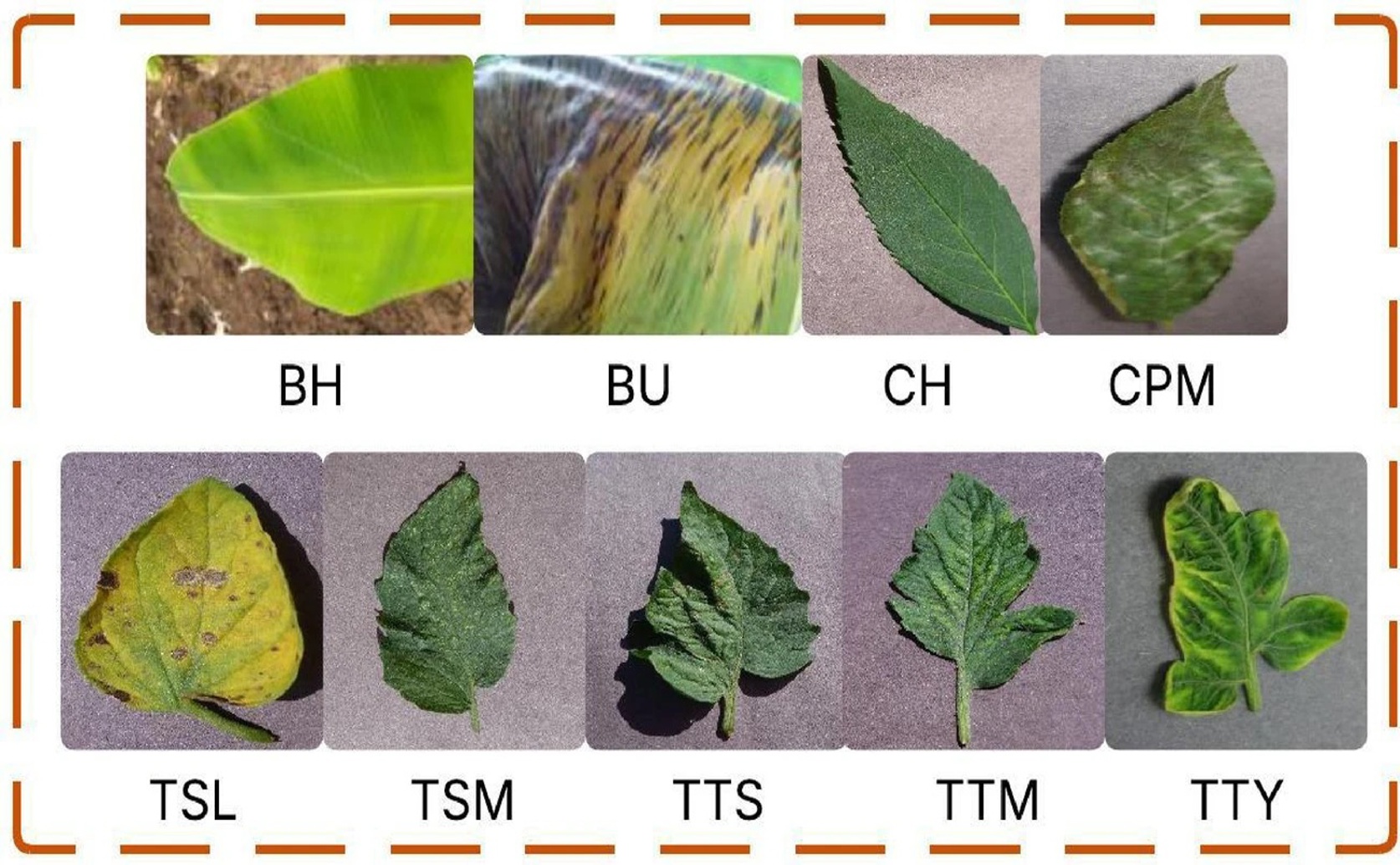
Sample dataset images of all diseases.

Image adapted from: Murugesan et al. / CC BY (Source)

Key Findings

  • Researchers at Vel Tech Rangarajan Dr. Sagunthala R&D Institute developed a new AI model to accurately detect diseases in banana, cherry, and tomato leaves
  • This new hybrid model achieved an impressive 99.29% accuracy in identifying plant diseases, outperforming other advanced AI systems
  • The model's success comes from combining two AI techniques, allowing it to recognize both small disease details and the overall leaf condition
Agriculture forms the backbone of many economies, and crop health is paramount for food security and farmer livelihoods. Diseases, particularly those affecting leaves, pose a significant threat to yields, leading to substantial economic losses. For instance, the Indian economy is heavily reliant on its banana industry, making the early detection of banana plant diseases crucial to safeguard production[2][3]. Similarly, tomato crops, valued for their nutritional and economic contribution, are frequently impacted by diseases that can severely reduce quality and yield[4][5]. The challenge lies in accurately identifying these diseases early, often complicated by factors like varying lighting, leaf overlap, and the small size of early lesions in natural environments[4][5]. Traditional manual inspection is time-consuming, labor-intensive, and prone to human error, highlighting the urgent need for more efficient and precise detection methods. Addressing this critical need, recent research from Vel Tech Rangarajan Dr. Sagunthala R&D Institute has introduced a new deep learning framework designed for effective and accurate detection and classification of diseases in banana, cherry, and tomato leaves[1]. Deep learning (DL) is a subset of machine learning that uses multi-layered artificial neural networks to learn from vast amounts of data, often excelling at tasks like image recognition. This study aimed to develop a highly effective system by comparing the performance of several established deep learning models against a novel approach. Previous efforts have shown the promise of automated systems integrating machine learning and deep learning algorithms for disease prediction[2]. Convolutional Neural Networks (ConvNets or CNNs), a type of deep learning model, have demonstrated impressive accuracy in many image-based tasks due to their ability to learn local patterns and features, such as edges and textures, from images. However, a known limitation of traditional CNNs is their lack of built-in invariance to scale and rotation, meaning they might struggle to recognize the same disease if the leaf image is taken from a different angle or distance[2]. This can be a significant hurdle in real-world agricultural settings where image conditions vary widely. Furthermore, while hybrid CNN models have shown high accuracy, like one achieving 99% accuracy for banana disease detection by combining different CNN elements[3], there's always room for improvement and broader applicability. Earlier studies on tomato diseases also highlighted challenges with environmental interference and the need for enhanced feature extraction and fusion to pinpoint small lesions[4][5]. The researchers in the study tackled these challenges by proposing a new Hybrid ConvNet-Vision Transformer (ViT) model. A Vision Transformer is another type of deep learning model that, unlike ConvNets, processes images by dividing them into patches and then analyzing the relationships between these patches using a mechanism called "self-attention." This allows ViTs to understand global contexts and long-range dependencies within an image, similar to how attention mechanisms have been successfully integrated into other models for improving feature extraction in complex backgrounds[4][5]. The core innovation of the study's Hybrid ConvNet-ViT model lies in its ability to combine the strengths of both architectures. It leverages ConvNet layers for efficient extraction of local, fine-grained features, such as the specific patterns of a lesion. Simultaneously, it incorporates ViT layers to capture the broader, global context of the leaf and its surroundings. This fusion helps overcome the scale and rotation invariance issues of pure ConvNets by providing a more comprehensive understanding of the image. To test their model, the researchers used a publicly available dataset containing images of healthy and diseased leaves from banana, cherry, and tomato plants. The data was carefully prepared and split into training, validation, and test sets to ensure unbiased evaluation. They compared their Hybrid ConvNet-ViT model against several state-of-the-art pre-trained models, including EfficientNetV2, ConvNeXt, Swin Transformer, and a pure ViT. To further ensure the robustness of their findings and prevent overfitting (where a model performs well on training data but poorly on new data), they employed a technique called 5-fold cross-validation. This involves dividing the dataset into five parts, training the model five times using a different part for testing each time, and then averaging the results. The experimental results demonstrated the effectiveness of this hybrid approach. The proposed Hybrid ConvNet-ViT model achieved an impressive testing classification accuracy of 99.29%, outperforming all other compared pre-trained models. This high accuracy indicates that fusing the local feature learning capabilities of ConvNets with the global representation power of Vision Transformers is indeed beneficial for improving disease classification performance in image-based agricultural applications. This advancement positions the Hybrid ConvNet-ViT model as a robust solution for practical use by farmers, potentially enabling more timely and accurate disease management and ultimately contributing to higher yields and reduced economic losses.

AgricultureBiotechPlant Science

References

Main Study

1) Robust multiclass classification of crop leaf diseases using hybrid deep learning and Grad-CAM interpretability

Published 15th August, 2025

Journal: Scientific Reports

Issue: Vol 15, Issue 17, 8 2025


Related Studies

2) Analysis of banana plant health using machine learning techniques.

https://doi.org/10.1038/s41598-024-63930-y


3) Banana Plant Disease Classification Using Hybrid Convolutional Neural Network.

https://doi.org/10.1155/2022/9153699


4) Tomato leaf disease detection based on attention mechanism and multi-scale feature fusion.

https://doi.org/10.3389/fpls.2024.1382802


5) An efficient deep learning model for tomato disease detection.

https://doi.org/10.1186/s13007-024-01188-1


Related Articles

An unhandled error has occurred. Reload 🗙