Sugar Beet Leaf Spot: How a Helpful Bacteria Beats Fungus and Boosts Growth

Greg Howard
31st May, 2025

Sugar Beet Leaf Spot: How a Helpful Bacteria Beats Fungus and Boosts Growth

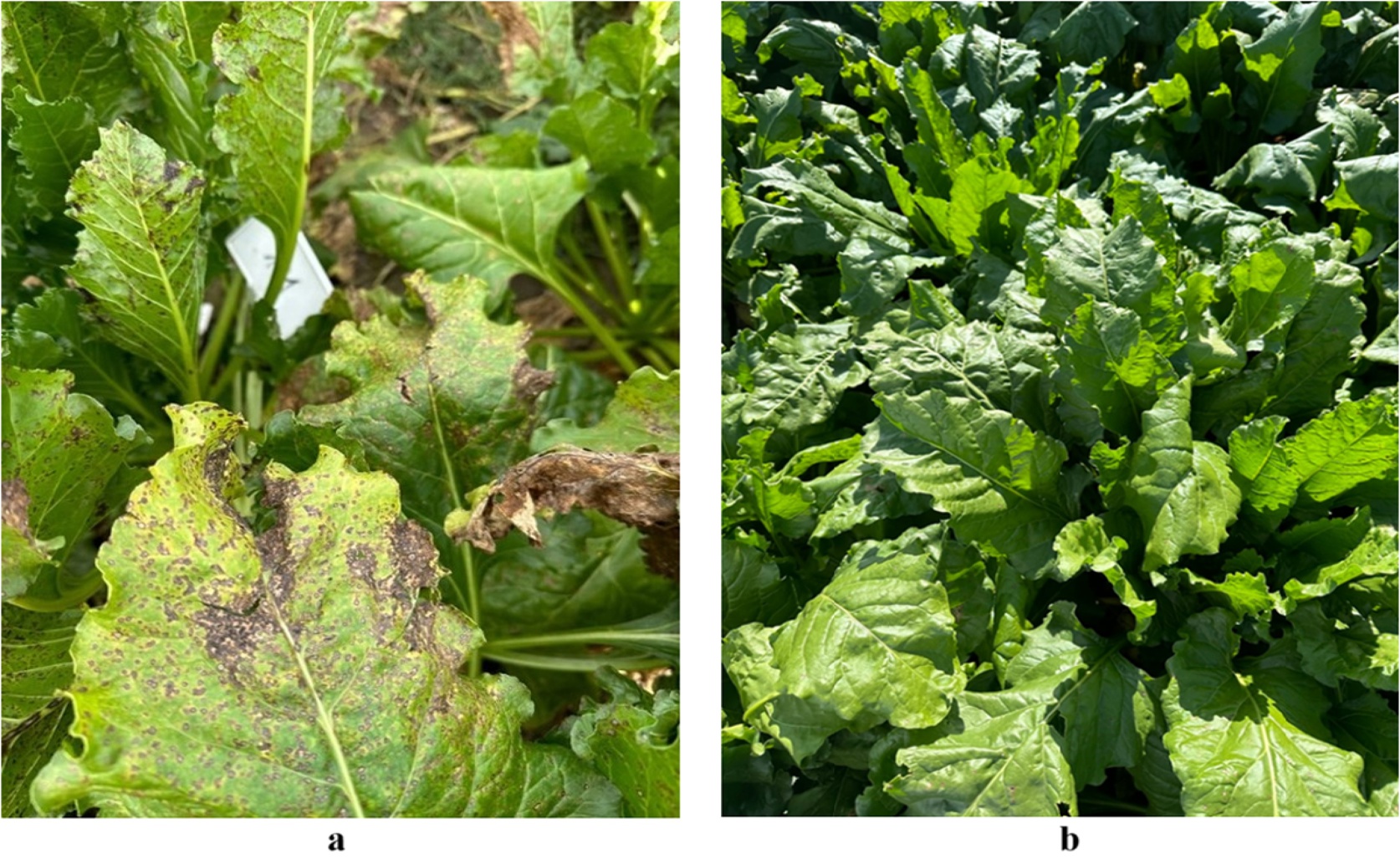
Field assessments confirm the high biocontrol efficacy of the formulation, as sugar beet (Beta vulgaris) leaves treated with Bacillus velezensis KT27 induced by Rhizoctonia cerealis (b) exhibited significantly reduced Cercospora leaf spot symptoms compared to the untreated control (a).

Image adapted from: Wita et al. / CC BY (Source)

Key Findings

  • In a study conducted in Poland and Puebla, Bacillus velezensis KT27 reduced sugar beet leaf spot by 60% while making key plant nutrients more available
  • Adding heat-killed fungal cells, especially from R. cerealis, boosted the bacterium’s effects nearly to the level of chemical fungicides and increased sugar beet yields by up to 15%
[1] A recent study from Poznań University of Life Sciences and Benemérita Universidad Autónoma de Puebla presents new evidence that a naturally occurring bacterium, Bacillus velezensis KT27, may offer an effective and environmentally friendly solution to combat several damaging crop diseases. The study focused on the management of Cercospora leaf spot (CLS), a serious disease caused by the fungus Cercospora beticola that significantly reduces yields in sugar beet and other crops. Along with CLS, the research also tested the bacterium's activity against Rhizoctonia cerealis and Fusarium oxysporum. Crop diseases lead to substantial economic losses, and farmers have long relied on chemical fungicides to control them. However, challenges such as increasing resistance of pathogens to these chemicals and the resultant environmental pollution have urged researchers to explore alternative solutions. The study addresses this critical issue by investigating a biocontrol agent that can both suppress pathogens and promote plant growth. This approach aligns with earlier work showing that plants benefit from associations with beneficial microorganisms, leading them to become Enhanced Plant Holobionts (EPHs) that exhibit improved resistance to various stresses[2]. In the laboratory portion of the study, researchers conducted in vitro assays to determine the antagonistic activity of B. velezensis KT27 against the target fungal pathogens. They observed that the bacterium inhibited the growth of C. beticola by 60.2%, a significant level of suppression compared to its effects on R. cerealis (22.5%) and F. oxysporum (15.5%). These differences suggest that while B. velezensis KT27 produces compounds active against a range of fungi, the efficacy varies by pathogen. The study further explored how the bacterium achieves its antifungal effects. Researchers noted that B. velezensis KT27 produces lipopeptides such as surfactin, iturin, and fengycin. Lipopeptides are small molecules known in previous research to have strong antimicrobial properties and to stimulate plant defense responses[3]. Additionally, the bacterium was found to solubilize important nutrients like phosphorus, potassium, and zinc, making these nutrients more available to plants. This dual function of disease suppression and nutrient mobilization suggests that B. velezensis KT27 not only protects plants but also contributes directly to plant health and growth. An interesting aspect of the study was the influence of direct interaction between the bacterial cells and the fungi. When researchers removed the bacterial biomass and used only the sterile supernatant of the bacterial cultures, the antifungal activity dropped by more than 3.5 times. This finding implies that physical presence and direct interactions between B. velezensis KT27 and the fungal pathogens are crucial for optimal biocontrol efficacy. Moreover, supplementing bacterial cultures with thermally inactivated fungal biomass, especially from R. cerealis, amplified the antagonistic effect. This indicates that components of the fungal cells might act as signals that further stimulate the bacterium to produce antifungal compounds. Field experiments further validated laboratory findings. When sugar beet plants were treated with B. velezensis KT27, particularly in combination with inactivated R. cerealis biomass, the level of protection against CLS came close to that achieved using a mix of three chemical fungicides—the difference being only 9.1%. Not only did this treatment control disease effectively, but it also promoted plant growth, resulting in an increase in root yield of up to 15.2% compared to untreated controls. This outcome resonates with previous studies where beneficial microbes were observed to promote plant growth and resistance to both biotic and abiotic stresses[2]. The current study adds to a growing body of literature that supports the use of biological control agents as sustainable alternatives to chemical pesticides[4]. In contrast to chemical fungicides, biocontrol methods using bacteria like B. velezensis KT27 offer a reduced environmental impact and potentially lower risks to human health. By naturally inhibiting fungal pathogens and promoting nutrient availability, this biocontrol strategy represents a promising tool for modern sustainable agriculture. The integration of these findings with earlier research refines our understanding of how beneficial microbes interact with plants and pests. While previous work has emphasized the role of microbial communities in enhancing plant resilience[2] and the development challenges facing biopesticides[4], the new study demonstrates a practical application where B. velezensis KT27 performs both disease suppression and growth promotion. Additionally, the study reinforces earlier genomic insights[3] regarding the importance of secondary metabolite production in Bacillus species, establishing a direct connection between these compounds and effective biocontrol.

AgricultureBiotechPlant Science

References

Main Study

1) Biocontrol of Cercospora leaf spot in sugar beet by a novel Bacillus velezensis KT27 strain: Enhanced antifungal activity and growth promotion in laboratory and field conditions

Published 30th May, 2025

https://doi.org/10.1371/journal.pone.0323889


Related Studies

2) Benefits to Plant Health and Productivity From Enhancing Plant Microbial Symbionts.

https://doi.org/10.3389/fpls.2020.610065


3) Bacillus velezensis: A Valuable Member of Bioactive Molecules within Plant Microbiomes.

https://doi.org/10.3390/molecules24061046


4) Biological Control of Plant Pathogens: A Global Perspective.

https://doi.org/10.3390/microorganisms10030596


Related Articles

An unhandled error has occurred. Reload 🗙