Optimizing Reinforced Composites Made from Coconut and Pineapple Fibers

Greg Howard
16th January, 2025

Optimizing Reinforced Composites Made from Coconut and Pineapple Fibers

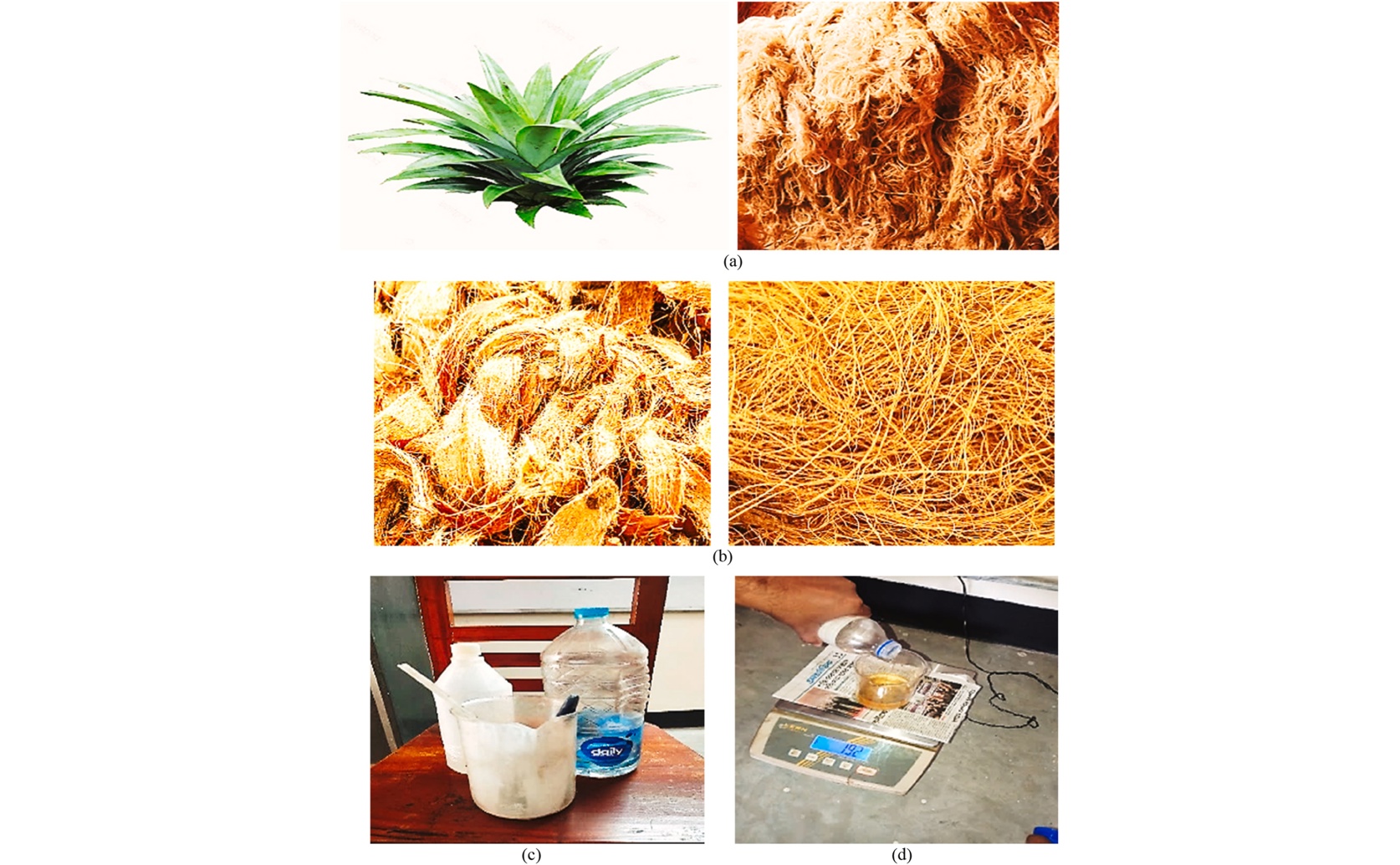
The novel composite material central to this study's findings was fabricated using natural pineapple leaf fiber (a) and coir fiber (b) as reinforcements, combined with an epoxy resin (c) and hardener (d) to form the binding matrix.

Image adapted from: Kabir et al. / CC BY (Source)

Key Findings

  • Researchers at BAUST developed a new composite using coir and pineapple leaf fibers, aiming to improve mechanical and physical properties
  • The study found that the highest impact strength was 53.93 J/cm², tensile strength was 31.94 MPa, flexural strength was 46.365 MPa, Rockwell hardness was 77, and water absorption rate was 3.62%
  • The angle of fiber orientation significantly affected flexural strength and water absorption, while the type of mat used influenced tensile strength and hardness
Composite materials are increasingly being favored over traditional wood and metallic materials due to their superior properties. A recent study conducted by the Bangladesh Army University of Science and Technology (BAUST)[1] focuses on developing a new natural fiber reinforced composite using coir and pineapple leaf fiber. This study aims to enhance the mechanical and physical properties of these composites by varying fiber orientation. The researchers employed the Taguchi method, a statistical approach used to optimize processes and improve quality, to investigate the effects of different control factors such as fiber ratios, angles of orientation, and mat types on the properties of the composites. The testing adhered to ASTM standards, ensuring the reliability of the results. The study found that the highest mean impact strength of the composite was 53.93 J/cm², tensile strength was 31.94 MPa, flexural strength was 46.365 MPa, Rockwell hardness number was 77, and the water absorption rate was only 3.62%. These results were validated through various statistical analyses, including Taguchi orthogonal array analysis, confirmation tests, regression analysis, and analysis of variance (ANOVA). The margin of errors for impact, tensile, and flexural strength, Rockwell hardness, and water absorption tests were found to be 4.84%, 2.59%, 2.35%, 6.62%, and 2.334%, respectively. The ANOVA analysis revealed that the angle of orientation of fibers had a significant impact on flexural strength and water absorption rate, contributing 72.30% and 70.89%, respectively. The type of mat used significantly affected tensile strength and Rockwell hardness, with contributions of 46.47% and 50.67%, respectively. The impact strength was most significantly influenced by the weight percentage of fibers, which accounted for approximately 50.32%. This study builds on previous research, such as the work on Bitter Albizia (BA) tree skin fibers[2], which highlighted the potential of natural fibers in composite materials due to their high cellulose content, thermal stability, and tensile strength. The current study's findings align with this earlier research by demonstrating the effectiveness of natural fibers in enhancing the mechanical properties of composites. Another relevant study focused on hybrid bio-composites using green epoxy with hemp and sisal fiber mats[3]. This study examined the static properties of the composites and found that the stacking sequence of the fibers influenced the tensile and compressive strengths. The current study by BAUST expands on this by exploring the effects of fiber orientation and mat types, providing a more comprehensive understanding of how these factors impact the overall performance of natural fiber composites. In summary, the research conducted by BAUST demonstrates that natural fiber reinforced composites, particularly those using coir and pineapple leaf fibers, can achieve impressive mechanical and physical properties. By optimizing factors such as fiber orientation and mat types, these composites can serve as viable alternatives to synthetic fiber-based products, offering both environmental and performance benefits.

AgricultureBiotechPlant Science

References

Main Study

1) A Taguchi-based study on the control factors of reinforced composites with the fiber of coir and pineapple leaves.

Published 15th January, 2025

https://doi.org/10.1016/j.heliyon.2024.e40947


Related Studies

2) Characterization of new cellulose fiber extracted from second generation Bitter Albizia tree.

https://doi.org/10.1038/s41598-024-51719-y


3) Investigation into mechanical, absorption and swelling behaviour of hemp/sisal fibre reinforced bioepoxy hybrid composites: Effects of stacking sequences.

https://doi.org/10.1016/j.ijbiomac.2019.08.166


Related Articles

An unhandled error has occurred. Reload 🗙