Predicting Nutrient Interactions in Crop Plant Soil Using Metabolic Models

Jenn Hoskins
18th October, 2024

Predicting Nutrient Interactions in Crop Plant Soil Using Metabolic Models

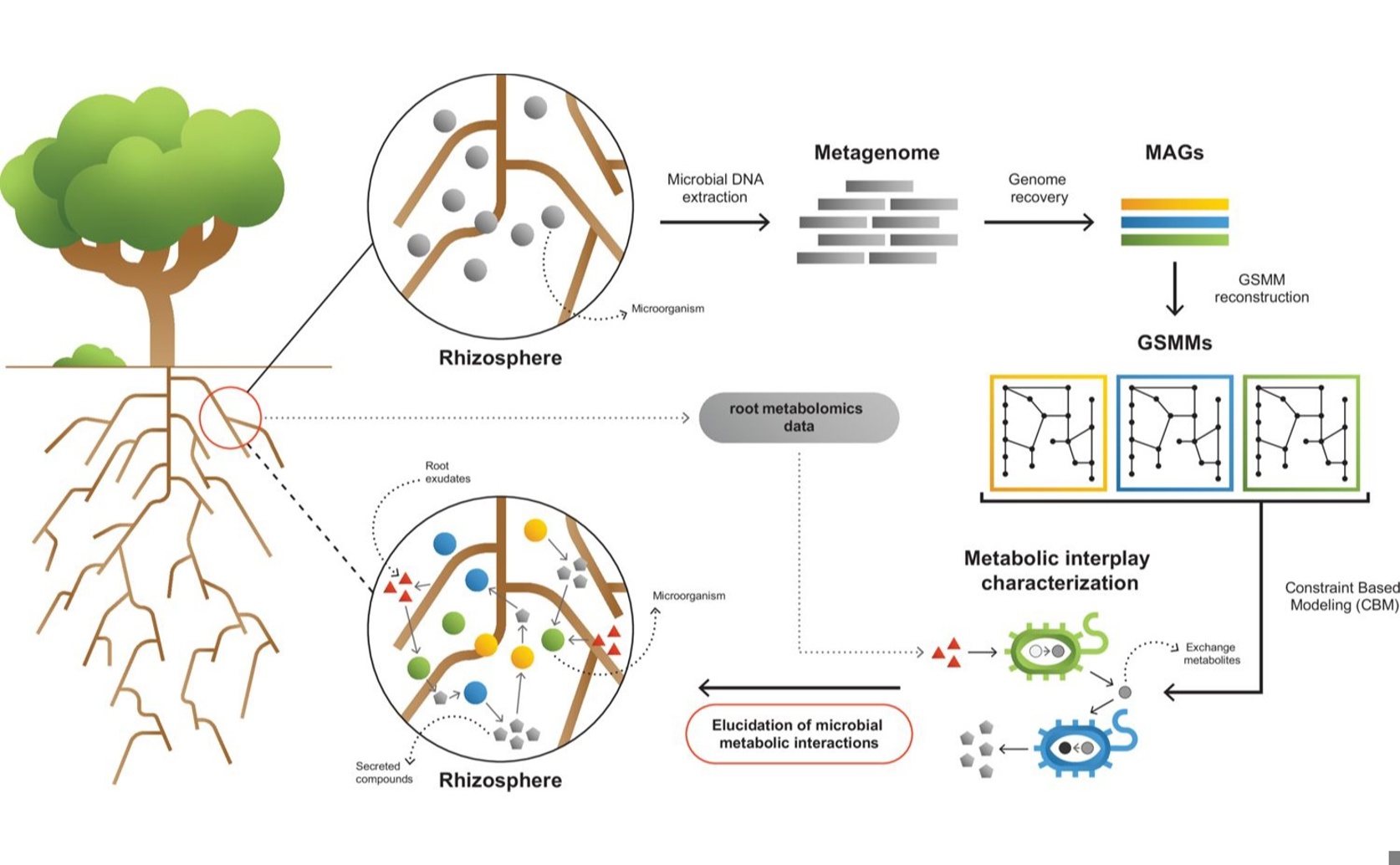
This computational framework integrates genomic data from soil microbes and metabolic data from plant root secretions to model and predict the network of nutrient exchanges that structures the native rhizosphere community.

Image adapted from: Ginatt et al. / CC BY (Source)

Key Findings

  • The study focused on apple root systems to understand microbial interactions in the rhizosphere
  • Researchers used genomics and modeling to simulate microbial communities and their interactions
  • The findings help identify specific microbes and compounds that can promote plant health or suppress disease
Understanding the complexity of microbial interactions in the rhizosphere is crucial for optimizing plant health and soil sustainability. The rhizosphere, the narrow region of soil influenced by root secretions and associated microorganisms, plays a pivotal role in plant growth and disease suppression. A recent study by the Agricultural Research Organization (Volcani Institute)[1] has developed a novel framework to systematically understand these microbial interactions, specifically focusing on apple root systems. The study utilized genomics and constraint-based modeling to interpret the metabolic interactions between bacteria in disease-suppressive and disease-conducive apple rhizospheres. By drafting 243 genome-scale metabolic models based on genome-resolved metagenomes, the researchers created an in silico microbial community. This community was iteratively simulated in a metabolomics-based environment resembling apple roots, revealing potential trophic successions and forming a network of communal dependencies. The findings from this study are significant as they offer a detailed understanding of how different microbial species interact and how these interactions can be manipulated to promote plant health. By identifying specific compounds and microbial species that either support or suppress disease, the framework provides a basis for targeted manipulation of the rhizosphere microbiome. This research builds upon earlier findings that have highlighted the importance of microbial interactions in various environments. For example, a study on a cellulose-degrading mixed culture demonstrated that the balance of positive and negative relationships among bacterial strains is essential for stable coexistence and functional stability[2]. Similarly, the role of Bacteroidetes in degrading high molecular weight organic matter across diverse habitats underscores the adaptability and importance of microbial communities in different ecological niches[3]. The current study's approach of using genomics and constraint-based modeling to understand microbial interactions is particularly innovative. By simulating the growth of microbial community members in a controlled environment, the researchers could predict how different species would interact and what metabolic exchanges would occur. This method allows for a more precise understanding of the metabolic capabilities of microbial communities and how they can be harnessed for specific functions. Furthermore, this study aligns with previous research on substrate-mediated recruitment of beneficial microbes in the rhizosphere[4]. By identifying specific metabolites that influence microbial community composition, the current study provides a more targeted approach to engineering the rhizosphere microbiome. This could lead to more predictable and effective outcomes in promoting plant health and suppressing pathogens. In conclusion, the framework developed by the Agricultural Research Organization (Volcani Institute) represents a significant advancement in our understanding of microbial interactions in the rhizosphere. By integrating genomics and constraint-based modeling, this study offers a detailed and systematic approach to manipulating microbial communities for specific predefined functions. This research not only enhances our knowledge of microbial ecology but also provides practical applications for improving plant health and soil sustainability.

AgricultureBiotechPlant Science

References

Main Study

1) A metabolic modeling-based framework for predicting trophic dependencies in native rhizobiomes of crop plants.

Published 17th October, 2024

https://doi.org/10.7554/eLife.94558


Related Studies

2) Stable coexistence of five bacterial strains as a cellulose-degrading community.

Journal: Applied and environmental microbiology, Issue: Vol 71, Issue 11, Nov 2005


3) Environmental and gut bacteroidetes: the food connection.

https://doi.org/10.3389/fmicb.2011.00093


4) A framework for the targeted recruitment of crop-beneficial soil taxa based on network analysis of metagenomics data.

https://doi.org/10.1186/s40168-022-01438-1


Related Articles

An unhandled error has occurred. Reload 🗙