Using Computer Vision to Predict Biomass of Salt-Tolerant Plants

Greg Howard
18th November, 2024

Using Computer Vision to Predict Biomass of Salt-Tolerant Plants

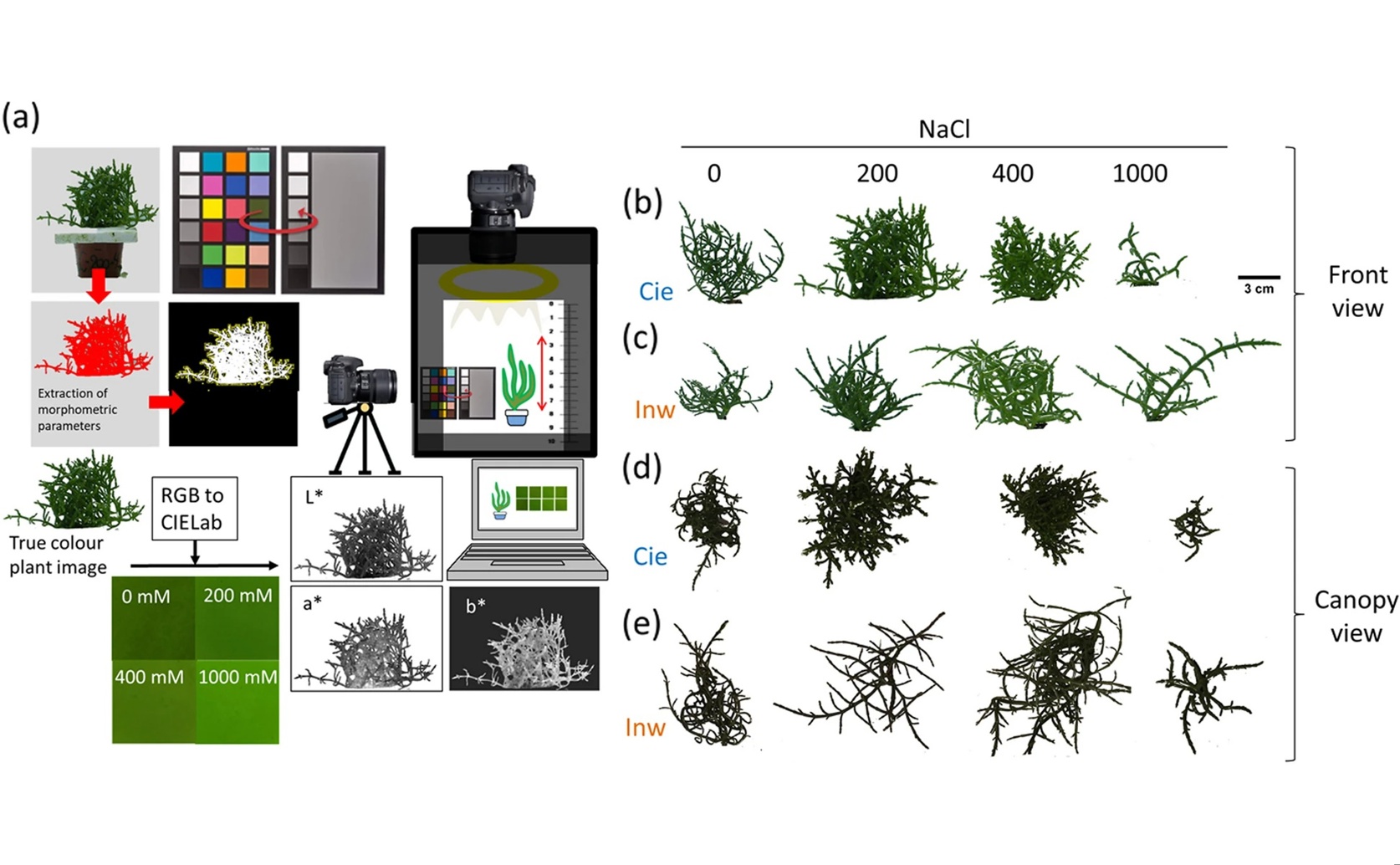
The computer vision system (a) captures and processes front (b, c) and canopy (d, e) view images that reveal clear morphological differences between two Salicornia europaea populations under varying salinity levels, providing the basis for the study's successful, non-destructive classification of salt tolerance.

Image adapted from: Cárdenas-Pérez et al. / CC BY (Source)

Key Findings

  • Researchers from Nicolaus Copernicus University in Toruń developed a computer vision system (CVS) to classify salt tolerance in Salicornia europaea
  • The CVS accurately assessed plant traits like shoot diameter and height, showing strong correlations with biomass weight
  • The system achieved a 90% accuracy rate in classifying plants based on salinity tolerance, validated with 100% effectiveness
  • This method helps predict plant biomass and salinity levels, aiding in the development of salt-tolerant crops
Salicornia europaea L., commonly known as glasswort, is a halophyte—a plant that thrives in high-salinity environments. Given its potential as a versatile crop, there is a pressing need for efficient, low-cost, non-destructive methods to classify its salt tolerance to aid selective breeding. Researchers from Nicolaus Copernicus University in Toruń have developed a promising computer vision system (CVS) combined with multivariate analysis to address this need[1]. The study involved a trial and validation set of 96 and 24 plants from two distinct populations of S. europaea. The CVS assessed the plants using morphometric traits (such as shoot diameter and height) and CIELab colour variability. The results demonstrated a strong correlation between fresh biomass weight (FW) and projected area (PA), with a correlation coefficient of 0.91. Similarly, there was a high correlation (0.94) between anatomical cross-section (ACS) and shoot diameter (Sd). Interestingly, the correlation between PA and FW differed between populations with varying salt tolerance. For the higher salt-tolerant population, the relationship was best described by a linear equation (R² = 0.93), while for the lower salt-tolerant population, a second-degree polynomial fit was more accurate (R² = 0.90). The higher salt-tolerant population reached maximum biomass at 400 mM NaCl, whereas the lower salt-tolerant population produced less biomass under both 200 and 400 mM NaCl conditions. The study's findings align with previous research that highlighted the importance of non-destructive methods in evaluating plant responses to salinity. For example, image analysis has been shown to effectively detect phenotypic variability in S. europaea by assessing morphometric and colour parameters[2]. Additionally, the role of maternal habitat in influencing physiological and anatomical responses to salinity has been documented, with populations from lower-salinity environments demonstrating greater adaptive plasticity[3]. In the current study, multivariate discriminant analysis (MDA) was used to classify plants based on their salinity level and tolerance, achieving a 90% accuracy rate. This method was validated with 100% effectiveness, demonstrating its robustness. Furthermore, multiple linear regression models were developed to predict biomass production and the salinity substrate (Sal.s.) using non-destructive parameters. These models showed high accuracy, with R² values of 0.97 and 0.90 for PA, and 0.95 and 0.97 for Sal.s., for lower and higher salt-tolerant populations, respectively. The research underscores the effectiveness of CVS in extracting morphological and colour features from S. europaea cultivated at different salinity levels. This approach enables accurate classification and sorting of plants, facilitating selective breeding programs. The integration of artificial intelligence (AI), machine learning, and smartphone technology further enhances the potential applications of this method in ecology, bio-agriculture, and industry. In conclusion, the study by Nicolaus Copernicus University in Toruń presents a cost-effective tool for managing S. europaea breeding. By leveraging CVS and multivariate analysis, researchers can predict plant biomass and salinity levels with high accuracy, thereby advancing efforts to develop salt-tolerant crops. This innovative approach not only builds on previous findings but also opens new avenues for sustainable agriculture in saline environments.

AgricultureBiotechPlant Science

References

Main Study

1) Prediction of Salicornia europaea L. biomass using a computer vision system to distinguish different salt-tolerant populations.

Published 16th November, 2024

https://doi.org/10.1186/s12870-024-05743-9


Related Studies

2) Image and fractal analysis as a tool for evaluating salinity growth response between two Salicornia europaea populations.

https://doi.org/10.1186/s12870-020-02633-8


3) Maternal salinity influences anatomical parameters, pectin content, biochemical and genetic modifications of two Salicornia europaea populations under salt stress.

https://doi.org/10.1038/s41598-022-06385-3


Related Articles

An unhandled error has occurred. Reload 🗙