
Predicting Landslides After Earthquakes With AI
Jim Crocker
12th August, 2025


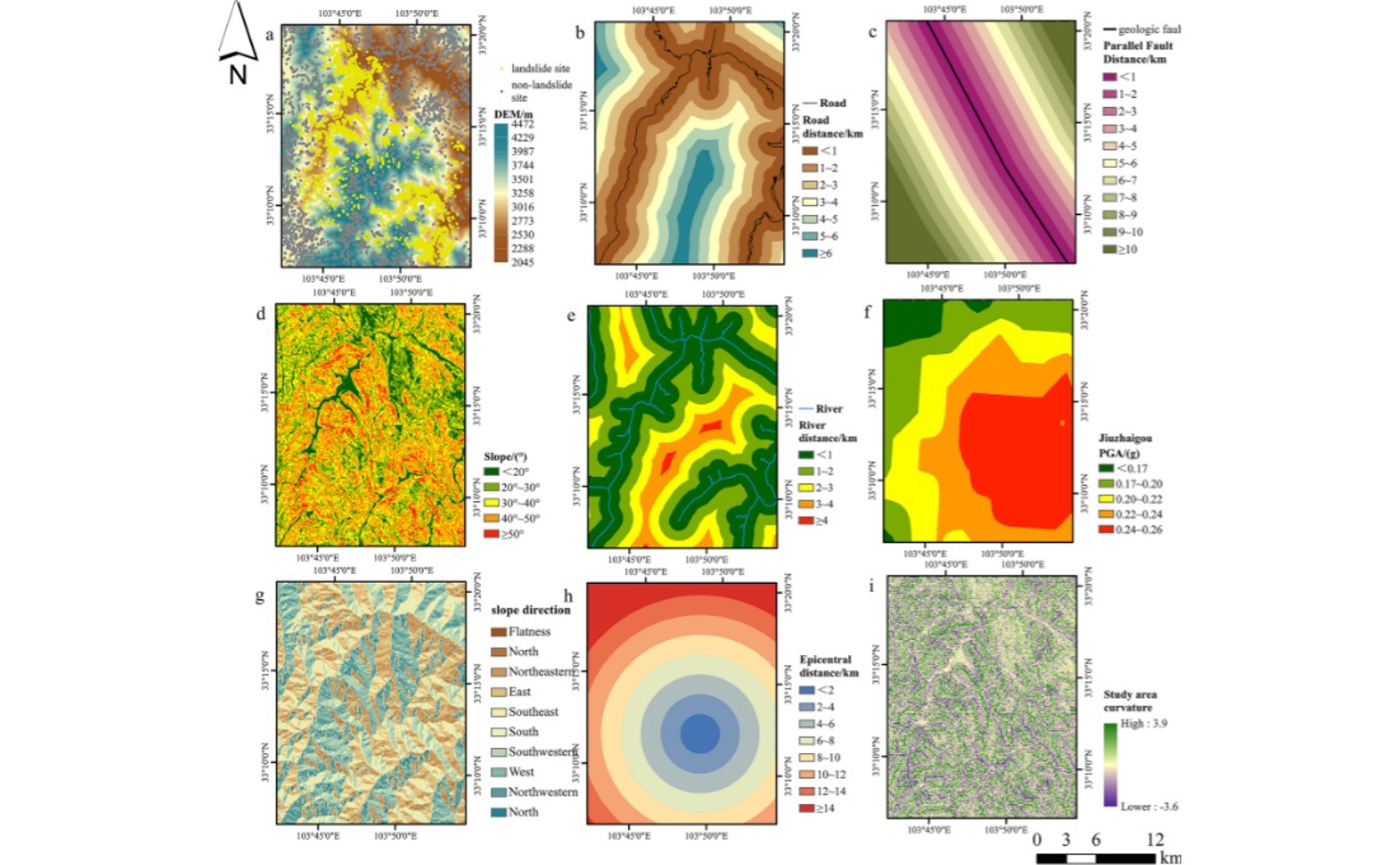
To construct the N_XGBoost susceptibility model, nine key environmental variables were selected via correlation analysis, comprising the digital elevation model (a), distance to road (b), distance to parallel fault (c), slope (d), distance to river (e), peak ground acceleration (f), slope direction (g), epicentral distance (h), and curvature (i).
Key Findings
- Researchers at Henan University developed a new hybrid model for the Jiuzhaigou region, combining a physics-based model with machine learning to better predict earthquake-triggered landslides
- This new N_XGB model significantly improved prediction accuracy for landslides in Jiuzhaigou, outperforming other methods by integrating a key slope stability factor
- Crucially, the N_XGB model also proved highly effective in predicting landslides in other diverse regions, making it a robust tool for wider disaster risk management
References
Main Study
1) Evaluation of coseismic landslide susceptibility by combining Newmark model and XGBoost algorithm
Published 11th August, 2025
https://doi.org/10.1371/journal.pone.0328705
Related Studies
2) An essential update on the inventory of landslides triggered by the Jiuzhaigou Mw6.5 earthquake in China on 8 August 2017, with their spatial distribution analyses.
3) Insights into geospatial heterogeneity of landslide susceptibility based on the SHAP-XGBoost model.
Related Articles
 11th July, 2025 | Jim Crocker