How Soil Tilling Boosts Natural Protection in Organic Farming

Jim Crocker
2nd August, 2025

How Soil Tilling Boosts Natural Protection in Organic Farming

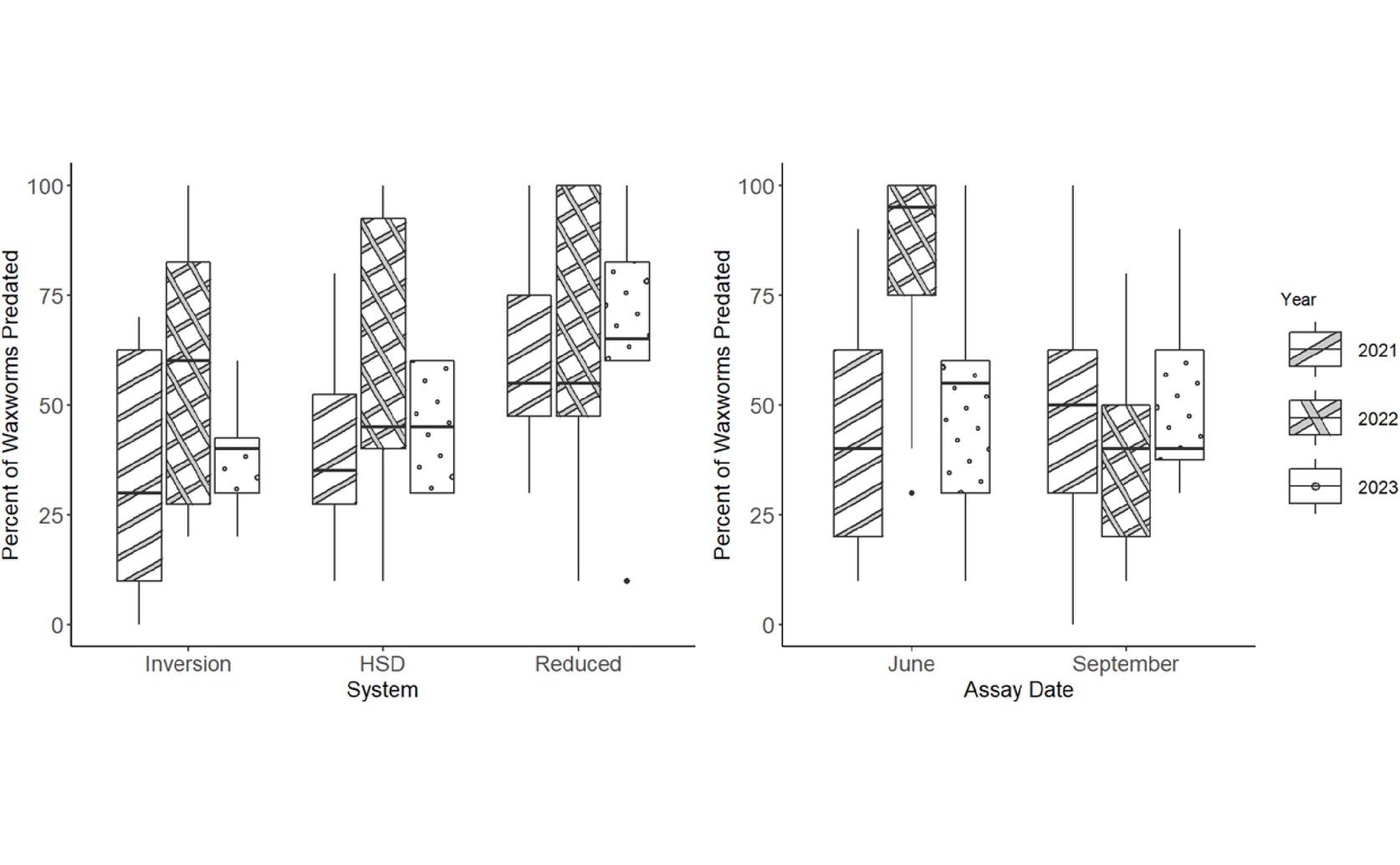
Demonstrating the benefits of limiting soil disturbance, epigeal predation rates on sentinel waxworms (Galleria mellonella) in organic soybean (Glycine max) were significantly higher in the reduced-tillage system compared to systems utilizing inversion tillage or high-speed disks (left panel), although predation activity varied significantly by season and year (right panel).

Image adapted from: Tillotson et al. / CC BY (Source)

Key Findings

  • At Penn State, organic farms using less soil disturbance (reduced tillage) significantly boosted beneficial ground-dwelling insects that eat pests, especially in soybean fields
  • However, tillage methods didn't affect insect predators on corn plants, but shallow high-speed disk tillage led to more corn ear damage from pests
  • Despite varying pest damage, corn yields remained similar across all organic tillage systems, suggesting flexibility for farmers
Organic farming relies on natural processes to manage pests, avoiding synthetic chemicals. A key challenge for organic growers is controlling pest populations without disrupting the beneficial organisms that prey on them. Often, organic farms use various forms of soil disturbance, known as tillage, to prepare fields, manage weeds, and incorporate organic matter. However, these practices can impact the very predators that help control pests. Understanding how different tillage methods affect these natural enemies is crucial for developing sustainable and effective organic pest management strategies. Recent research from Penn State University and Lavras Federal University[1] investigated the effects of different soil disturbance levels on arthropod predation in various organic farming systems. The study aimed to determine if less intensive tillage could enhance the activity of generalist predators – organisms that feed on a variety of prey, including pests – and consequently reduce pest damage. The researchers studied three annual organic feed grain systems (corn, soybean, wheat rotation) and one perennial forage system (alfalfa and orchardgrass). These systems varied in the frequency and intensity of soil disturbance, ranging from predominantly reduced tillage to systems using more frequent or intense inversion tillage (where soil is turned over) or a shallow high-speed disk. To measure predation, the team used a technique involving "sentinel prey"[2]. This method involves placing vulnerable organisms in the field and observing how many are consumed. For ground-level predation, they used live greater waxworm larvae, and for predation on plants, they used eggs of common pests like the western bean cutworm and European corn borer. This approach provides a direct, quantitative measure of predation under real-world conditions[2], and live prey, as used in this study, are known to offer more realistic data than artificial alternatives[2]. This method is one of several available for assessing invertebrate predation in terrestrial ecosystems, valued for its simplicity and ease of use[3]. The study found that the rate of ground-level predation on sentinel waxworms was significantly higher in the system managed predominantly with reduced tillage compared to systems that relied more on inversion tillage or a shallow high-speed disk. This suggests that minimizing soil disturbance can indeed foster a more active community of ground-dwelling predatory arthropods. This finding aligns with previous research indicating that agricultural practices profoundly affect arthropod communities and their activities[4]. For instance, earlier work showed that specific cover crop combinations, like hairy vetch and triticale, significantly increased the activity density of ground-dwelling predatory arthropods, including spiders (Araneae) and ground beetles (Carabidae), compared to cereal rye[4]. While the current study focused on tillage, the principle is similar: management choices directly influence the presence and activity of beneficial predators. Interestingly, the study observed no significant effect of soil disturbance intensity or frequency on predation rates occurring on plant foliage, nor on the composition of foliar predator communities in corn. This indicates that the impact of tillage might be more pronounced on ground-dwelling predators than on those active higher up on the plants. Regarding pest damage, the study revealed that damage to corn ears from naturally occurring lepidopteran pests (like corn borers) was lower in the systems predominantly managed with reduced tillage or inversion tillage compared to the system using a shallow high-speed disk. This suggests that while reduced tillage enhanced ground-level predation, even occasional inversion tillage did not necessarily lead to increased pest damage, at least for the pests measured. Despite these differences in predation and pest damage, there was no significant difference in corn yield across the various systems, although the reduced tillage system showed greater variability in yield. This research contributes to the broader understanding of how organic farming practices benefit biodiversity and ecosystem services like pest control. A comprehensive meta-analysis[5] previously demonstrated that organic farming, on average, increases species richness – a key measure of biodiversity – by about 30% compared to conventional farming. The current study provides a more detailed look at how specific management decisions within organic systems, such as the choice of tillage, can influence the populations of beneficial predatory arthropods, thereby refining our understanding of how organic practices support biodiversity and natural pest control. The findings suggest that organic growers might not need to completely abandon occasional inversion tillage, as it may not have lasting detrimental effects on predator activity, particularly on foliage, and can still contribute to managing pest damage effectively.

AgricultureEcology

References

Main Study

1) Effect of tillage system on epigeal and foliar insect predation in an organic cropping system in Pennsylvania, USA

Published 31st July, 2025

https://doi.org/10.1371/journal.pone.0328896


Related Studies

2) A review of the sentinel prey method as a way of quantifying invertebrate predation under field conditions.

https://doi.org/10.1111/1744-7917.12405


3) Methods to identify the prey of invertebrate predators in terrestrial field studies.

https://doi.org/10.1002/ece3.2791


4) Cover Crop Species and Management Influence Predatory Arthropods and Predation in an Organically Managed, Reduced-Tillage Cropping System.

https://doi.org/10.1093/ee/nvx149


5) Land-use intensity and the effects of organic farming on biodiversity: a hierarchical meta-analysis.

Journal: The Journal of applied ecology, Issue: Vol 51, Issue 3, Jun 2014


Related Articles

An unhandled error has occurred. Reload 🗙