Diverse Crop Plantings Reduce Pesticide Resistance Growth in Pests

Jim Crocker
21st May, 2025

Diverse Crop Plantings Reduce Pesticide Resistance Growth in Pests

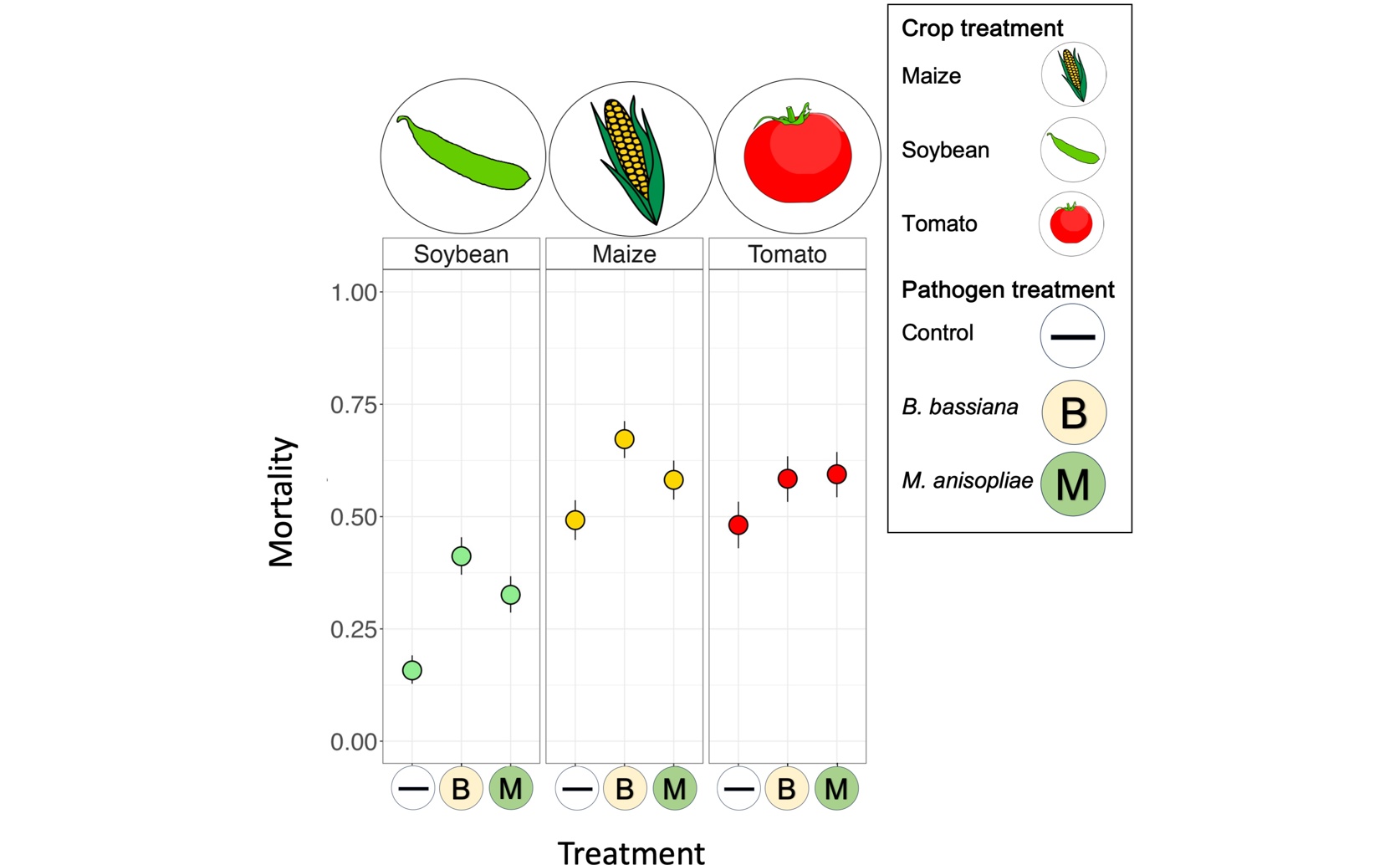
Supporting the study's conclusion that host diet alters selection pressure, the mortality of Cotton bollworm (Helicoverpa armigera) larvae exposed to fungal biopesticides varied significantly by crop, where Beauveria bassiana was more lethal than Metarhizium anisopliae on soybean and maize but performed similarly on tomato.

Image adapted from: Mangan et al. / CC BY (Source)

Key Findings

  • A University of Edinburgh study found that the type of plant pests feed on affects their survival against fungal biopesticides
  • Pests have significant genetic differences that influence their resistance to these pathogens, increasing the risk of resistance
  • Changing the crops grown can create varying pressures, helping to prevent pests from becoming resistant to biopesticides
Pathogens continuously challenge populations of insects, driving the evolution of defense mechanisms. Despite this ongoing pressure, significant genetic variation in infection resistance remains within these populations. Understanding why this variation persists is crucial, especially for applications like biological control in agriculture, where pathogens are used to manage pest populations. A recent study from the University of Edinburgh[1] explores the factors that maintain genetic diversity in an insect pest by examining how different fungal pathogens and plant diets influence survival. The study addresses a fundamental question: why doesn't natural selection eliminate all variation in genes related to disease resistance? One hypothesis is that varying environmental conditions create trade-offs, where certain genetic traits are beneficial in some contexts but detrimental in others. This balance can prevent any single allele from becoming fixed in the population, thereby maintaining genetic diversity. To investigate this, researchers exposed an insect pest to different combinations of two fungal pathogens and various plant diets. By doing so, they could assess how genetic differences among individuals affected their survival under these varying conditions. The findings revealed substantial heritability in survival rates, indicating that genetic factors play a significant role in how these pests respond to pathogen exposure. This heritability suggests that there is a considerable risk of pests evolving resistance to biopesticides, which are often used in agricultural settings to control pest populations. Interestingly, the study found no strong genetic trade-offs in survival when the pests were exposed to the two different fungal pathogens. This result challenges conventional thinking in host-pathogen biology, where it is typically expected that resistance to one pathogen might come at the expense of susceptibility to another. Instead, the lack of trade-offs implies that different genetic mechanisms may be involved in resisting each pathogen, allowing for independent survival strategies without compromising overall resistance. However, the research uncovered a significant finding related to diet. Changes in the plant diet of the pests dramatically altered the selection pressures, revealing that diet-mediated genetic trade-offs do exist. These trade-offs were not directly related to the pests' infection responses but instead involved traits linked to how the pests utilized different plant resources. For example, a genotype that thrives on one type of plant might be less effective on another, influencing overall survival rates in the presence of pathogens. This suggests that factors unrelated to pathogen resistance, such as nutrition and metabolism, can influence the maintenance of genetic variation in natural and agricultural environments. This study builds on previous research that has highlighted the complexity of genetic variation in disease resistance. For instance, a study on Drosophila melanogaster by the University of Gothenburg[2] demonstrated that different genes affect maternal and paternal transmission of a virus, with no direct correlation between transmission and resistance to infection. Another study from Júlio de Mesquita Filho State University of São Paulo[3] found that host populations exhibit more genetic variation in susceptibility to pathogens they have coevolved with compared to novel pathogens, emphasizing the role of coevolution in maintaining genetic diversity. Additionally, research from the University of Stirling[4] reviewed how environmental heterogeneity, such as varying temperatures and nutrient availability, can maintain polymorphism by favoring different host genotypes under different conditions. By integrating these insights, the University of Edinburgh's study provides a nuanced understanding of how both biotic factors like pathogens and abiotic factors like diet contribute to the preservation of genetic variation in pest populations. The finding that diet can mediate genetic trade-offs offers a new perspective on how non-pathogen-related traits can influence the evolutionary dynamics of disease resistance. This has practical implications for agriculture, where managing plant diets could be a strategy to mitigate the risk of pests developing resistance to biopesticides. The researchers employed a robust experimental design, using controlled combinations of fungal pathogens and plant diets to isolate the effects of each factor on pest survival. By quantifying genetic variation and covariation, they were able to assess the heritability of survival traits and identify the presence of trade-offs. This methodological approach allowed them to disentangle the complex interactions between genetics, diet, and pathogen resistance, providing clear evidence of how these factors interplay to maintain genetic diversity. In conclusion, the study from the University of Edinburgh advances our understanding of the mechanisms that sustain genetic variation in natural and agricultural pest populations. By demonstrating that diet-induced trade-offs can maintain genetic diversity independent of direct pathogen resistance, the research highlights the importance of considering multiple environmental factors in the study of evolutionary biology and pest management. This comprehensive approach not only deepens our scientific knowledge but also offers practical strategies for enhancing the sustainability of biological control methods in agriculture.

AgricultureEcologyEvolution

References

Main Study

1) Crop diversity induces trade-offs in microbial biopesticide susceptibility that could delay pest resistance evolution

Published 20th May, 2025

https://doi.org/10.1371/journal.ppat.1013150


Related Studies

2) Genetic variation affecting host-parasite interactions: different genes affect different aspects of sigma virus replication and transmission in Drosophila melanogaster.

https://doi.org/10.1534/genetics.107.085449


3) Host-pathogen coevolution increases genetic variation in susceptibility to infection.

https://doi.org/10.7554/eLife.46440


4) Immunity in a variable world.

https://doi.org/10.1098/rstb.2008.0141


Related Articles

An unhandled error has occurred. Reload 🗙