Mapping Yeast Traits: A Closer Look at Genes in Each Cell

Jim Crocker
31st July, 2025

Mapping Yeast Traits: A Closer Look at Genes in Each Cell

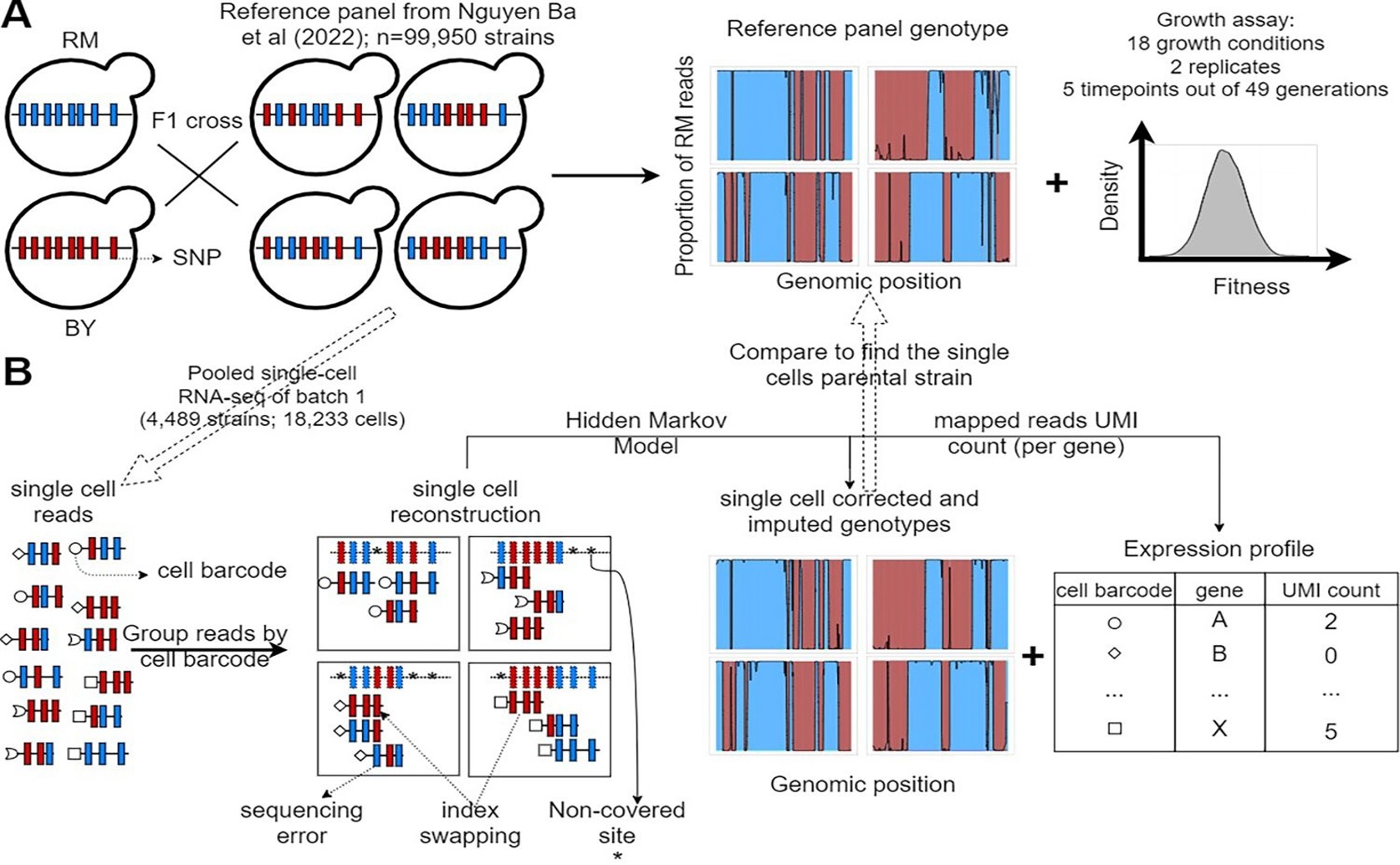
By leveraging a reference panel of yeast (Saccharomyces cerevisiae) segregants characterized by bulk sequencing (a), this study validates a high-throughput single-cell RNA sequencing approach (b) that accurately captures linked genotype and transcriptomic profiles to refine the resolution of the genotype–phenotype map.

Image adapted from: N'Guessan et al. / CC BY (Source)

Key Findings

  • Researchers at the University of Toronto used a new single-cell RNA sequencing method on yeast to better map genetic differences to traits
  • Their large-scale study revealed that genetic elements far from a gene (trans-acting) largely control gene activity more than nearby ones (cis-acting)
  • This improved method also identified new gene regulation hotspots and highly heritable gene functions, confirming gene expression significantly shapes traits
Understanding how genetic differences translate into the observable characteristics of an organism, known as phenotypes, is a central and long-standing problem in biology. While we know that variations in our DNA sequences contribute to differences in everything from physical traits to disease susceptibility, pinpointing the exact genetic changes responsible and how they exert their effects remains complex. This challenge is often highlighted by the concept of "missing heritability," where genetic mapping studies can only explain a fraction of the inherited contribution to trait variation[2]. Traditional approaches to connect genetic variations to traits frequently overlook a crucial intermediate step: the transcriptome, which is the complete set of RNA molecules expressed from an organism's genes. These methods also often lack the statistical power needed to untangle the intricate web of genetic influences, especially when dealing with the vast scale of genetic data. For instance, it has been unclear how natural selection shapes the activity of genes, or whether genetic changes located close to a gene (cis-regulatory elements) or far away (trans-regulatory elements) play a more significant role in controlling its expression. Researchers at the University of Toronto have made significant progress in addressing these challenges by leveraging a powerful technique called single-cell RNA sequencing (scRNA-seq)[1]. This method allows scientists to measure the activity of thousands of genes in individual cells, providing a much more detailed picture than traditional "bulk" measurements that average gene activity across many cells. In their study, the team analyzed an unprecedented 18,233 yeast cells derived from a cross between two different yeast strains, a laboratory strain and a vineyard strain. By collecting this massive dataset, the team performed what is known as expression quantitative trait loci (eQTL) mapping. An eQTL is a region of the genome – the complete set of an organism's DNA – that influences the level of gene expression. By mapping these eQTLs at a single-cell resolution, they could identify specific genetic variations that affect how genes are turned on or off, and how these expression patterns relate to observable traits, including fitness. This large-scale, high-resolution approach allowed the researchers to confirm and expand upon findings from decades of genetic research in yeast. For example, earlier studies had already shown that heritable variation in gene expression forms a crucial bridge between genomic variation and the biology of many traits[3]. The new study not only reinforced this but provided a much deeper understanding by revealing new associations between phenotypic and transcriptomic variations at a broad scale. A key finding from the University of Toronto study was the revelation that trans-acting regulatory elements have a larger overall effect on gene expression compared to cis-acting elements. To elaborate, cis-acting elements are genetic regions located very close to the gene they control, often within the gene itself or its immediate vicinity. Trans-acting elements, in contrast, are located far away from the genes they regulate, sometimes even on different chromosomes. This finding aligns with and significantly expands upon previous research which found that most expression variation in yeast arose from trans-acting eQTLs, often clustering at specific "hotspot" locations that influenced the expression of thousands of genes[3]. The current study not only confirmed the dominance of trans-regulation but also identified new such hotspots of gene expression regulation that are directly associated with variations in traits. These hotspots are often enriched for genes that act as "transcription factors," which are proteins that control the rate at which genetic information is copied from DNA to RNA, thereby regulating gene activity[3]. The study also shed light on the heritability of gene expression, identifying new gene functions with high expression heritability. Heritability refers to the proportion of variation in a trait that is due to genetic factors. This is crucial for understanding how genetic variations are passed down and contribute to differences in traits. While previous work showed that detected genetic loci could explain nearly the entire additive contribution to heritable variation for some traits, the contribution of gene-gene interactions was more complex and often "missing" from our understanding[2]. By focusing on the transcriptome, the current study provides a more comprehensive view of how genetic influences manifest, helping to bridge the gap in our understanding of how traits are inherited. The power of this large-scale dataset also allows for a more nuanced understanding of how different types of genetic variation contribute to traits. While this study focused on eQTLs, which are often single-nucleotide polymorphisms (SNPs) or small insertions/deletions, other research has highlighted the importance of different forms of genomic variation. For instance, studies have shown that genome content variation, such as the presence or absence of entire genes or changes in their copy number, can be significant within yeast populations[4]. Furthermore, studies have shown that rare genetic variants, which are less common in a population, can make a disproportionate contribution to trait variation[5]. The high resolution of single-cell eQTL mapping in the current study can potentially capture the subtle effects of such diverse genetic variations on gene expression, thereby providing a more complete picture of how genetic differences shape an organism's characteristics. By integrating large-scale single-cell RNA sequencing data into genotype-phenotype mapping, this research significantly advances our understanding of how genetic variations lead to observable traits, particularly through the intricate regulation of gene expression.

BiotechGeneticsBiochem

References

Main Study

1) Refining the resolution of the yeast genotype–phenotype map using single-cell RNA-sequencing

Published 28th July, 2025

https://doi.org/10.7554/eLife.93906


Related Studies

2) Finding the sources of missing heritability in a yeast cross.

https://doi.org/10.1038/nature11867


3) Genetics of trans-regulatory variation in gene expression.

https://doi.org/10.7554/eLife.35471


4) A high-definition view of functional genetic variation from natural yeast genomes.

https://doi.org/10.1093/molbev/msu037


5) Rare variants contribute disproportionately to quantitative trait variation in yeast.

https://doi.org/10.7554/eLife.49212


Related Articles

An unhandled error has occurred. Reload 🗙