RNA-Sensing Guides For Boosting Genes With CRISPR In Cells

Jim Crocker
31st July, 2025

RNA-Sensing Guides For Boosting Genes With CRISPR In Cells

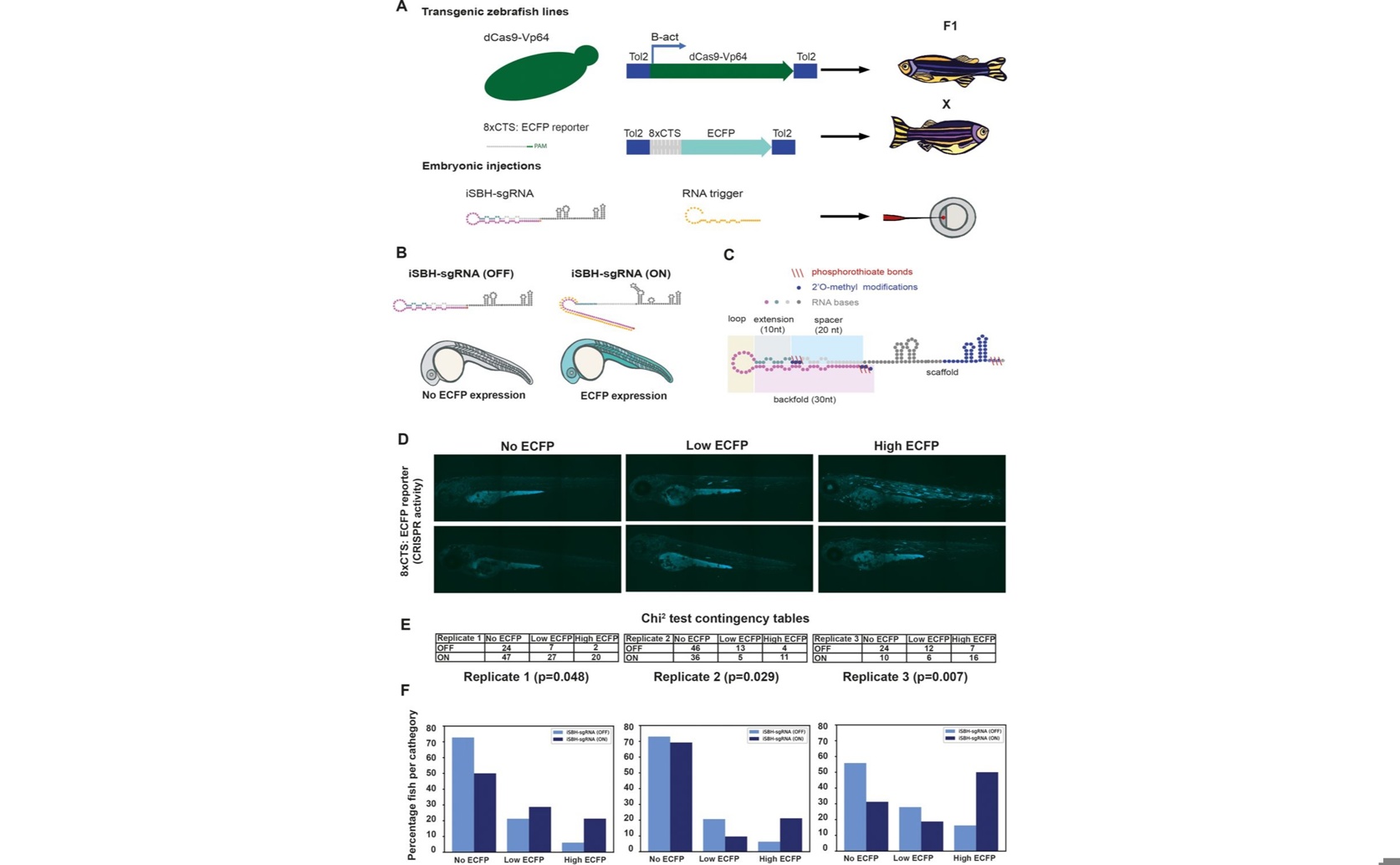
Implementation of a chemical modification strategy to stabilize iSBH-sgRNAs (c) enabled the specific detection of RNA triggers in transgenic zebrafish embryos (a, b), resulting in significantly enhanced ECFP reporter expression in the presence of the trigger (d–f) and validating the platform for in vivo conditional CRISPR activation.

Image adapted from: Pelea et al. / CC BY (Source)

Key Findings

  • Researchers at the University of Oxford developed a new CRISPR system that only turns on when it detects specific RNA molecules, acting like a smart switch for gene editing
  • This system uses specially designed guide RNAs that stay inactive until they find a matching RNA "trigger" in a cell, allowing CRISPR to precisely target only desired cells, like diseased ones
  • They also created computer tools to design these smart guide RNAs for any target and found ways to make them stable for use in living organisms
Gene editing technologies, particularly those based on CRISPR, hold immense promise for treating a wide array of diseases by precisely altering cellular DNA sequences. However, a significant challenge remains: ensuring these powerful tools act only in the intended cells and tissues, without affecting healthy ones. Achieving this level of spatiotemporal precision – control over where and when the genetic changes occur – is crucial for safe and effective therapies. Recent research from the University of Oxford has introduced a novel method to address this fundamental problem[1]. This study presents a simple yet highly specific platform that allows CRISPR activity to be modulated, or controlled, in direct response to the presence of specific RNA molecules within a cell. RNA, or ribonucleic acid, is a molecule found in all living cells that carries genetic information and plays various roles in gene expression. Different cells, or cells in different states (like disease), produce unique sets of RNA molecules, which can serve as "biomarkers" or indicators of their identity or condition. The core of this new approach lies in engineering the single-guide RNA (sgRNA) that directs the CRISPR-Cas9 system. Normally, sgRNA guides the Cas9 enzyme to a specific DNA sequence, allowing it to cut and edit the gene. In this innovative design, the sgRNAs are engineered to fold into complex three-dimensional structures. In this folded, or "ground," state, they are inactive, preventing the Cas9 enzyme from performing its gene-editing function. The magic happens when these engineered sgRNAs encounter specific complementary RNA molecules – the biomarkers – within the cell. Upon recognizing and binding to these target RNAs, the sgRNAs unfold and change shape, becoming active and enabling Cas9 to cut the DNA. This effectively means CRISPR is only "switched on" in cells that express the specific RNA biomarker of interest. This concept of identifying and acting upon specific cell types based on their molecular signatures resonates with earlier scientific efforts. For instance, understanding cell identity is a critical task in biomedical research. While some cell types can be identified by specific "marker genes," many lack such exclusive indicators. One approach has been to use machine learning, particularly deep neural networks, to analyze whole gene expression profiles (GEPs) – the complete set of genes active in a cell at a given time – to discriminate between cell types. This has led to the development of a "cell identity code" (CIC), a numerical representation that can characterize a cell's biological aspects[2]. The RNA biomarkers used in the Oxford study could be specific components of these GEPs, allowing for highly targeted activation of CRISPR in cells whose identity has been precisely defined by such advanced computational methods. Furthermore, getting the CRISPR components into the right cells in the first place is another significant hurdle for therapeutic applications. Previous work has focused on developing strategies for selective delivery. For example, a technique called Selective Organ Targeting (SORT) has been developed to engineer lipid nanoparticles – tiny fat-based bubbles used to deliver genetic material – to selectively target specific tissues and cell types, such as those in the lung, spleen, or liver[3]. While SORT focuses on delivering the CRISPR machinery to the desired location, the new Oxford study provides a complementary layer of control, ensuring that even once delivered, the CRISPR system only becomes active within the specific cells that display the correct RNA biomarker, thus preventing unwanted activity in surrounding cells within the same tissue. The broader context for this research is the rapidly advancing field of therapeutic genome editing. CRISPR technology is already being explored in clinical trials for several diseases, with many more applications under development[4]. However, the challenges of precise targeting and avoiding unintended "off-target" effects have been central to discussions about responsible use. The University of Oxford's new platform directly addresses this by providing a mechanism for highly localized and conditional CRISPR activation. By linking CRISPR activity to endogenous RNA biomarkers, the system offers unprecedented spatiotemporal precision, which is vital for developing safer and more effective gene therapies. The researchers demonstrated the effectiveness of their approach in both human cells (HEK293T cells) and in living organisms, specifically zebrafish embryos. Through iterative design optimizations, they developed computational tools that can generate these engineered sgRNAs to detect virtually any chosen RNA sequence. Mechanistic investigations revealed that the engineered sgRNAs are actually cleaved, or cut, during the RNA detection process, and the team identified key positions where chemical modifications could improve the stability of these engineered sgRNAs within a living body. This stability is crucial for ensuring the system functions reliably over time in a therapeutic setting. This innovative sensor technology opens up novel opportunities for both fundamental research into cell biology and for developing new therapeutic applications where CRISPR activation needs to be tightly controlled in response to specific RNA signals within the body.

BiotechGeneticsBiochem

References

Main Study

1) Specific modulation of CRISPR transcriptional activators through RNA-sensing guide RNAs in mammalian cells and zebrafish embryos

Published 29th July, 2025

https://doi.org/10.7554/eLife.87722


Related Studies

2) Cell Identity Codes: Understanding Cell Identity from Gene Expression Profiles using Deep Neural Networks.

https://doi.org/10.1038/s41598-019-38798-y


3) Selective organ targeting (SORT) nanoparticles for tissue-specific mRNA delivery and CRISPR-Cas gene editing.

https://doi.org/10.1038/s41565-020-0669-6


4) The promise and challenge of therapeutic genome editing.

https://doi.org/10.1038/s41586-020-1978-5


Related Articles

An unhandled error has occurred. Reload 🗙