AI Predicts How Genetic Information Connects

Jim Crocker
26th June, 2025

AI Predicts How Genetic Information Connects

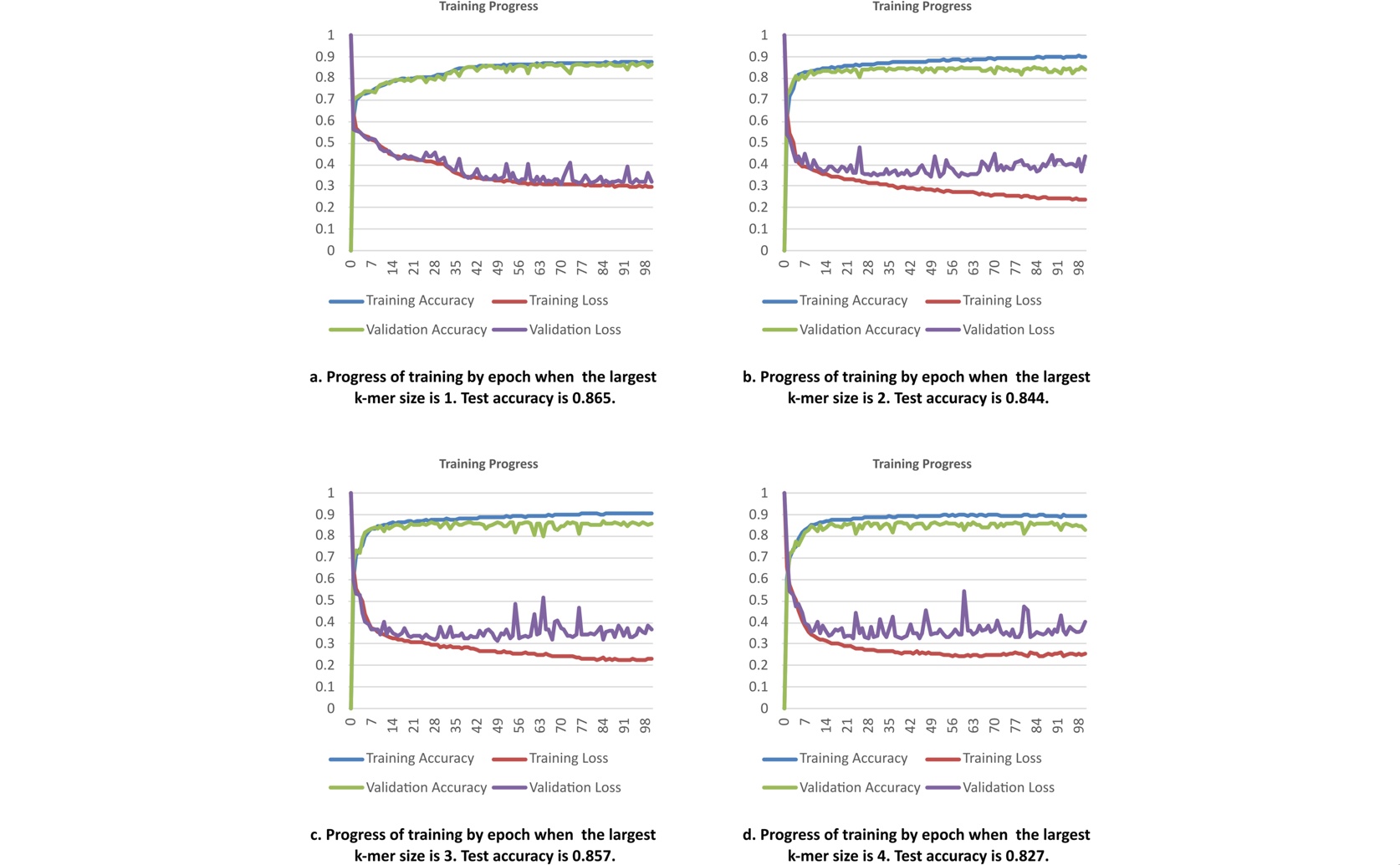
Training and validation results get separated as we increase the k-mer size, and larger fluctuations are observed for larger k-mer sizes.

Image adapted from: Ahmet Gürhanlı / CC BY (Source)

Key Findings

  • Researchers at Istanbul Topkapi University and NIH developed rbpTransformer, a new AI model that accurately predicts how regulatory piRNAs bind to mRNAs, achieving a 94.38% prediction success rate
  • This model was optimized by systematically testing various AI design choices, revealing that specific settings and larger datasets are key to its high performance in understanding gene regulation
The ability to accurately predict how different biological molecules interact is fundamental to advancing our understanding of life and developing new treatments. One such crucial interaction involves small non-coding RNAs called piRNAs, or Piwi-interacting RNAs, and messenger RNAs (mRNAs). PiRNAs are known for their role in silencing harmful genomic elements called transposable elements, which are segments of DNA that can move around the genome and potentially disrupt gene function. Beyond this, researchers have discovered that piRNAs also regulate the expression of various genes by binding to their corresponding mRNAs. Understanding and predicting these binding events is vital because it holds potential for significant breakthroughs in disease research, the discovery of new drugs, and the precise control of genes and genomic stability. However, despite their importance, a comprehensive understanding of how piRNAs bind to mRNAs and target specific genes has been elusive. While computational methods exist for predicting interactions involving other similar non-coding RNAs, like microRNAs (miRNAs), piRNAs possess unique characteristics that necessitate their own specialized computational models[2]. Early efforts to map these interactions, such as PRG-1 CLASH experiments in C. elegans (a type of worm often used in research), have provided valuable data on piRNA-mRNA binding pairs. Building on this, researchers have begun to devise computational approaches. For instance, one pioneering study developed the first deep learning architecture specifically for computationally identifying piRNA targeting sites on C. elegans mRNAs[2]. This model used a sophisticated approach, combining sequence encoding with convolutional operations to find motif patterns, and incorporating a multi-head attention sub-network to uncover the hidden rules governing piRNA binding. This initial model achieved high prediction accuracy, demonstrating the promise of deep learning in this field[2]. More broadly, the regulation of gene expression at the post-transcriptional level – after DNA has been copied into RNA – is a complex process involving various RNA binding proteins (RBPs) and microRNAs (miRNAs). These molecules bind to RNA and together form a kind of "regulatory code" that dictates how and when genes are expressed. Databases like doRiNA have been developed to systematically collect and integrate binding site data for RBPs and miRNAs, aiding researchers in deciphering this intricate code[3]. The challenge for piRNAs is similar: to understand their specific regulatory role, we need accurate ways to predict their interactions. While numerous deep learning models have emerged for predicting piRNA and mRNA binding, a thorough evaluation of how best to adapt powerful "transformer" models for this specific task, and the impact of various design choices within these models, has been lacking. To address this, a recent study by researchers at Istanbul Topkapi University and NIH introduced a novel deep learning model and systematically evaluated different design alternatives[1]. Their work aimed to refine and optimize the computational prediction of piRNA-mRNA binding. The core of their approach involves a type of artificial intelligence known as deep learning, specifically utilizing a model architecture called a transformer. Transformer models are particularly adept at processing sequences, which makes them well-suited for analyzing biological sequences like RNA. The researchers developed a new model called rbpTransformer, which builds upon the principles of deep learning and attention mechanisms that were also central to earlier work in this area[2]. Attention mechanisms allow the model to focus on the most relevant parts of the input sequences (piRNA and mRNA) when making predictions, mimicking how biological molecules might recognize specific patterns. The study systematically investigated how various design choices affect the rbpTransformer's accuracy. These choices included the "k-mer size" (the length of short sequence fragments the model analyzes), the number of "core modules" (layers within the deep learning network), the specific "optimization algorithm" used to train the model, and crucially, whether to incorporate "self-attention." Self-attention is a key component of transformer models, enabling them to weigh the importance of different parts of a single sequence relative to each other, which is essential for understanding complex binding patterns. The results of this evaluation were highly promising. The rbpTransformer model achieved a strong discriminatory power with an AUC (Area Under the Curve) value of 94.38% on an independent test set. AUC is a common metric used to evaluate the performance of classification models, with higher values indicating better prediction accuracy. This high performance suggests that rbpTransformer is a strong candidate for building advanced AI models to predict piRNA and mRNA binding. Furthermore, the study provided valuable insights into how different design decisions impact the model's accuracy, offering a roadmap for future development in this field. By systematically exploring these design elements, the researchers have not only provided a high-performing model but also advanced our understanding of how to construct effective deep learning tools for deciphering the intricate world of RNA interactions.

BiotechGeneticsBiochem

References

Main Study

1) rbpTransformer: A novel deep learning model for prediction of piRNA and mRNA bindings

Published 25th June, 2025

https://doi.org/10.1371/journal.pone.0324462


Related Studies

2) Identifying piRNA targets on mRNAs in C. elegans using a deep multi-head attention network.

https://doi.org/10.1186/s12859-021-04428-6


3) doRiNA: a database of RNA interactions in post-transcriptional regulation.

https://doi.org/10.1093/nar/gkr1007


Related Articles

An unhandled error has occurred. Reload 🗙