Predicting Cell Communication From Gene Activity

Jim Crocker
17th June, 2025

Predicting Cell Communication From Gene Activity

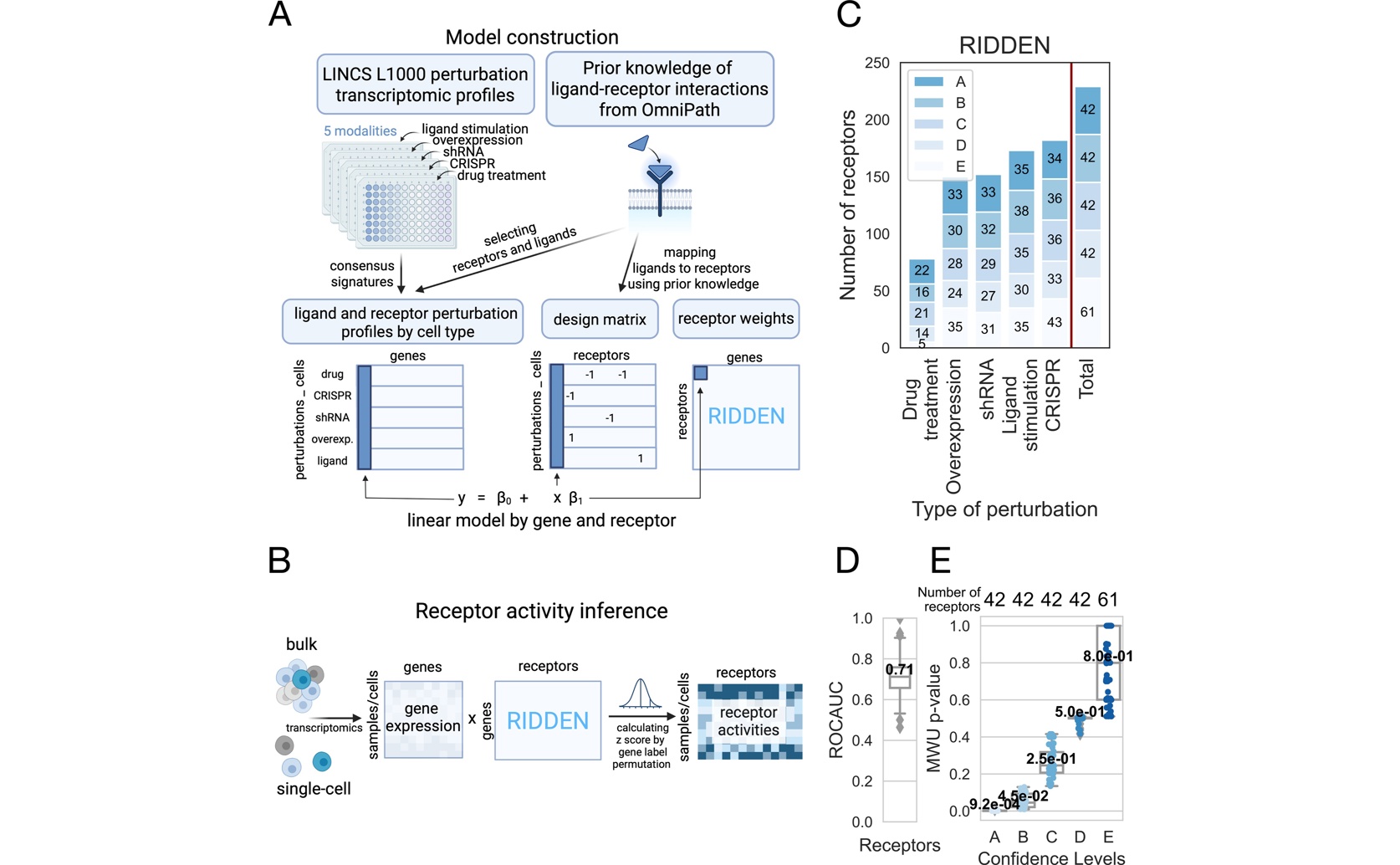
The RIDDEN model was constructed using thousands of receptor perturbation gene expression profiles to infer receptor activities (a, b), resulting in a validated tool for 229 receptors (c) that demonstrates robust predictive performance across statistically-defined confidence levels (d, e).

Image adapted from: Barsi et al. / CC BY (Source)

Key Findings

  • Researchers from Hungary, Germany, and the US developed RIDDEN, a new computational tool that accurately predicts how active cell communication receptors are by analyzing gene activity patterns
  • Unlike older methods, RIDDEN provides a more accurate picture of functional receptor activity, validated in lab and living systems, by looking at the downstream effects of receptor activation
  • This tool can identify specific receptors misbehaving in diseases like cancer, helping predict patient response to therapies and potentially leading to more personalized treatments
Cells within our bodies are constantly communicating, a fundamental process that orchestrates everything from our development and daily functions to how diseases emerge. This communication happens through molecular messages, often involving specialized proteins on the cell surface called receptors. Think of receptors as locks on a cell's surface, waiting for specific keys, called ligands, to bind to them. When a ligand binds, it triggers a chain of events inside the cell, influencing its behavior. When cells don't communicate properly, or when these molecular messages are improperly decoded, it can lead to various diseases. For this reason, receptors are frequent targets for drug development, as modulating their activity can potentially correct cellular dysfunction. Understanding these intricate cell-cell interactions and the activity of receptors has become a critical area of research. Historically, studying cell communication was limited to a few cell types and genes. However, recent advancements, particularly in RNA sequencing technologies, which allow scientists to measure the activity of thousands of genes at once (known as transcriptomics), have opened new avenues[2]. These technologies provide rich information to infer how cells interact and communicate[3]. Researchers often use the presence of ligand and receptor genes to infer potential interactions between cells[2]. However, simply seeing that a ligand and receptor gene are active in two different cells doesn't necessarily mean they are actively communicating or that the receptor is functionally engaged and triggering a response inside the cell. This gap in understanding the true activity of receptors, rather than just their presence, has been a challenge. To address this, a new computational tool called RIDDEN (Receptor actIvity Data Driven inferENce) has been developed by researchers from HUN-REN Research Centre for Natural Sciences, Semmelweis University, Heidelberg University and Hospital, and the University of Michigan[1]. Unlike previous methods that primarily infer interactions from the expression levels of ligand and receptor genes themselves, RIDDEN predicts receptor activities by looking at the broader patterns of gene activity within the cell that are known to be influenced by specific receptors. This means it focuses on the downstream consequences of a receptor being activated, essentially analyzing the "receptor-regulated gene expression profiles." This approach is more sophisticated, as it accounts for the "intracellular signaling events" that occur after a ligand binds to a receptor, providing a more accurate picture of functional receptor activity[3]. The development of RIDDEN involved training the model on an extensive dataset: over 14,000 gene expression profiles from experiments where specific receptors were deliberately activated or deactivated. This large collection, covering 229 different receptors, allowed RIDDEN to learn the complex "fingerprints" of gene activity associated with each receptor's activation. The performance of RIDDEN was rigorously validated using independent experimental data, both in laboratory settings and in living organisms. These validations showed that RIDDEN's predictions were accurate. Furthermore, the internal logic of RIDDEN's model, reflected in its "weights," corresponded to known biological relationships between receptors and the "master switch" proteins (called transcription factors) that control the activity of other genes. The predicted receptor activities also correlated well with the actual expression of receptor and ligand genes in real-world biological samples. This new capability is significant for several reasons. For instance, in neurodegenerative diseases like Alzheimer's and Parkinson's, cognitive dysfunction is a hallmark, and it's understood that "pathological alterations in various receptors appear to contribute to cognitive impairment and/or deterioration"[4]. By accurately predicting receptor activity, RIDDEN can help identify precisely which receptors are misbehaving in specific cell types, offering new insights into disease mechanisms and potential targets for treatment. The ability to analyze these complex signaling pathways in brain circuitries could shed light on new therapeutic clues[4]. Moreover, RIDDEN can be applied to both bulk tissue samples and, importantly, to single-cell transcriptomics datasets[5]. Single-cell transcriptomics is a revolutionary technology that allows scientists to examine the gene activity of individual cells, providing unprecedented detail about cellular diversity and communication within tissues. The ability of RIDDEN to work with these datasets represents a significant leap forward, aligning with the "explosion of methods" and "next-generation computational tools" that are enabling researchers to analyze cell-cell communication at much higher resolution[3][5]. This allows researchers to pinpoint specific cell populations within a complex tissue that have altered receptor activity, which is crucial for understanding disease progression and treatment responses. One practical application demonstrated for RIDDEN is its use in identifying "mechanistic biomarkers" in cancer patients undergoing immune checkpoint blockade therapy. This type of therapy helps the body's immune system fight cancer by targeting specific receptors on immune cells. By using RIDDEN to analyze the receptor activity in these patients, researchers can identify molecular indicators that reveal how the treatment is working or why it might not be effective in certain individuals. This could pave the way for more personalized and effective cancer treatments. In essence, RIDDEN represents the largest transcriptomics-based model for inferring receptor activity. By moving beyond simple gene co-expression to analyze the downstream effects of receptor activation, it provides a more accurate and comprehensive understanding of how cells communicate. This advancement will foster deeper studies into cell-cell communication, aiding in the discovery of new disease mechanisms and the development of targeted therapies.

BiotechGeneticsBiochem

References

Main Study

1) RIDDEN: Data-driven inference of receptor activity from transcriptomic data

Published 16th June, 2025

https://doi.org/10.1371/journal.pcbi.1013188


Related Studies

2) Deciphering cell-cell interactions and communication from gene expression.

https://doi.org/10.1038/s41576-020-00292-x


3) The diversification of methods for studying cell-cell interactions and communication.

https://doi.org/10.1038/s41576-023-00685-8


4) Neurotransmitter receptors and cognitive dysfunction in Alzheimer's disease and Parkinson's disease.

https://doi.org/10.1016/j.pneurobio.2012.02.002


5) The landscape of cell-cell communication through single-cell transcriptomics.

https://doi.org/10.1016/j.coisb.2021.03.007


Related Articles

An unhandled error has occurred. Reload 🗙