DNA Tags in Single Cells Reveal Cell History, Gene Activity, and Growth

Jenn Hoskins
11th July, 2025

DNA Tags in Single Cells Reveal Cell History, Gene Activity, and Growth

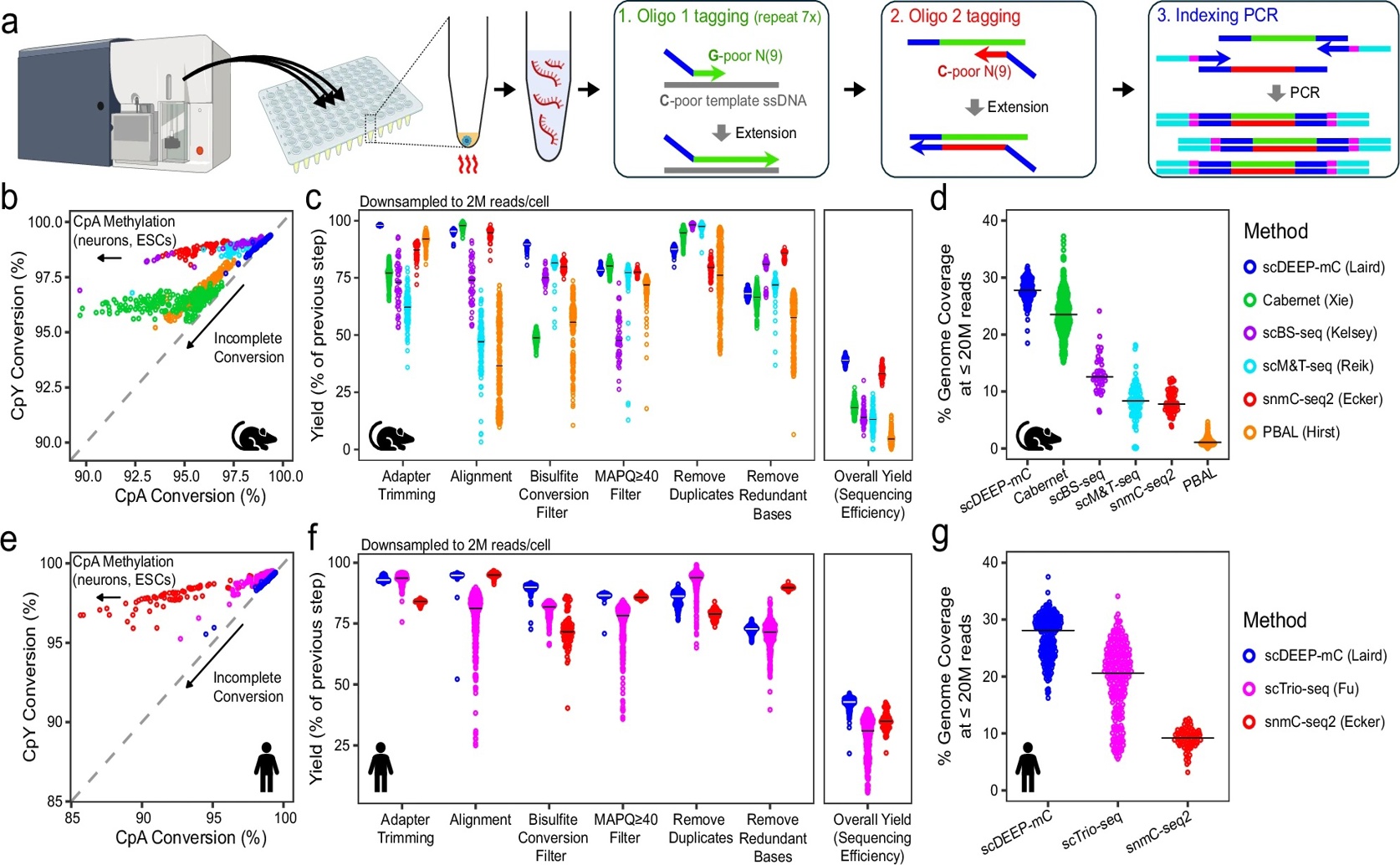
The scDEEP-mC library preparation workflow (a) outperforms existing single-cell whole-genome bisulfite sequencing methods in both mouse and human cells, demonstrating consistent bisulfite conversion (b, e), the highest sequencing efficiency (c, f), and superior genomic coverage (d, g).

Image adapted from: Spix et al. / CC BY (Source)

Key Findings

  • This new method, scDEEP-mC, developed at Van Andel Institute, vastly improves mapping DNA methylation patterns in individual cells with high detail
  • This advanced method allows scientists to precisely identify different cell types and track how DNA tags change as cells divide or during processes like X-inactivation
Our bodies are made of trillions of cells, each with the same fundamental genetic blueprint, DNA. Yet, a skin cell is vastly different from a brain cell or a blood cell. This specialization is largely controlled by a layer of information on top of the DNA itself, known as epigenetics. One crucial epigenetic mark is DNA methylation, a chemical tag often found on specific DNA sequences called CpG sites. These tags act like tiny switches, influencing which genes are turned on or off without altering the underlying genetic code. The precise patterns of DNA methylation at key regions, such as gene promoters (which initiate gene activity) and enhancers (which boost gene activity), convey vital information about a cell's identity and its current state. Understanding these intricate methylation patterns is critical because they play a significant role in normal development, the aging process, and the onset of diseases like cancer[2]. The field of DNA methylation has moved beyond simply identifying these marks to seeking a deeper understanding of their function and how they contribute to robust epigenetic codes[2]. For instance, cancer is increasingly recognized not just as a genetic disease but also one characterized by "nonmutational epigenetic reprogramming"[3]. The rapid and adaptable nature of epigenetic changes can give cancer cells tools to survive in challenging environments, unlike the more fixed genetic structure[3]. To truly grasp these subtle yet profound differences, scientists need to examine DNA methylation at the level of individual cells. Analyzing a large group of cells together, known as "bulk" analysis, can average out important variations, masking critical information about individual cell types or disease progression. This has led to a growing need for high-resolution single-cell DNA methylation profiling. However, existing techniques for single-cell whole-genome bisulfite sequencing (scWGBS), which is the standard method for mapping DNA methylation, have faced significant challenges. They often suffer from inefficient preparation of DNA libraries (the samples ready for sequencing) and low coverage of CpG sites across the genome. This means that researchers couldn't reliably compare methylation patterns directly between individual cells. Instead, they had to group cells into clusters, estimate missing data, or average methylation measurements over large genomic regions. These approaches, while useful, inevitably obscure the precise methylation states at individual regulatory elements and limit the ability to detect subtle but important differences between cells. Addressing these limitations, researchers at the Department of Epigenetics, Van Andel Institute, have developed an improved scWGBS method called single-cell Deep and Efficient Epigenomic Profiling of methyl-C, or scDEEP-mC[1]. This new method significantly enhances the efficiency of preparing DNA libraries and achieves much higher CpG coverage from single cells. This advancement is crucial because it allows for a much more detailed and accurate mapping of DNA methylation patterns in individual cells. The improved data quality from scDEEP-mC unlocks several powerful capabilities. Firstly, it enables precise identification of different cell types based on their unique methylation signatures. This builds upon earlier work that showed how even a small fraction of CpG sites could reflect cell identity and state[4]. While previous methods like those described in[4] provided valuable insights into single-cell DNA methylation states, scDEEP-mC provides a more comprehensive and robust map, allowing for more direct and confident cell-to-cell comparisons. Secondly, scDEEP-mC allows for genome-wide profiling of "hemi-methylation." This refers to a state where only one of the two DNA strands is methylated at a particular CpG site. Hemi-methylation is a transient state that occurs during DNA replication, and its accurate profiling provides insights into how methylation patterns are maintained or altered as cells divide. Thirdly, the method facilitates allele-resolved analysis of X-inactivation epigenetics in single cells. In females, one of the two X chromosomes is largely silenced in each cell through a process called X-inactivation. Understanding how this process is epigenetically regulated at the level of individual alleles (the specific versions of a gene inherited from each parent) provides deeper insights into gene dosage and cellular function. Finally, scDEEP-mC can combine DNA methylation data with information about DNA copy number (the number of copies of a particular gene or DNA segment in a cell). This unique combination allows researchers to identify single cells that are actively replicating their DNA and to profile the dynamics of DNA methylation maintenance both during and immediately after DNA replication. This is a significant step forward, as it allows scientists to observe how these crucial epigenetic marks are passed on, or potentially altered, from one cell generation to the next. The high-complexity and efficiency of scDEEP-mC library construction represent a substantial leap in the field of epigenomics. It provides the detailed, single-cell resolution data needed to explore the dynamic regulation of DNA methylation in unprecedented ways. This precision is particularly relevant for understanding complex diseases like cancer, where epigenetic abnormalities are a defining feature[3]. Earlier studies have highlighted the importance of analyzing genomic instability, epigenetic abnormality, and gene expression at single-cell resolution in cancers like colorectal cancer, revealing consistent patterns of DNA demethylation within cancer cells[5]. scDEEP-mC provides an even more powerful tool to delve into these specific patterns and understand their origins and consequences, potentially revealing new targets for diagnosis and treatment. The collective insights gained from such advanced technologies offer new opportunities to connect the biochemical features of DNA methylation to cell physiology, developmental potential, and disease outcomes[2].

BiotechGeneticsBiochem

References

Main Study

1) High-coverage allele-resolved single-cell DNA methylation profiling reveals cell lineage, X-inactivation state, and replication dynamics

Published 8th July, 2025

https://doi.org/10.1038/s41467-025-61589-1


Related Studies

2) DNA methylation in mammalian development and disease.

https://doi.org/10.1038/s41576-024-00760-8


3) The Epigenetic Hallmarks of Cancer.

https://doi.org/10.1158/2159-8290.CD-24-0296


4) High-Resolution Single-Cell DNA Methylation Measurements Reveal Epigenetically Distinct Hematopoietic Stem Cell Subpopulations.

https://doi.org/10.1016/j.stemcr.2018.07.003


5) Single-cell multiomics sequencing and analyses of human colorectal cancer.

https://doi.org/10.1126/science.aao3791


Related Articles

An unhandled error has occurred. Reload 🗙