Cellular Roads Help Sensory Cells Send Signals As They Grow

Jim Crocker
26th July, 2025

Cellular Roads Help Sensory Cells Send Signals As They Grow

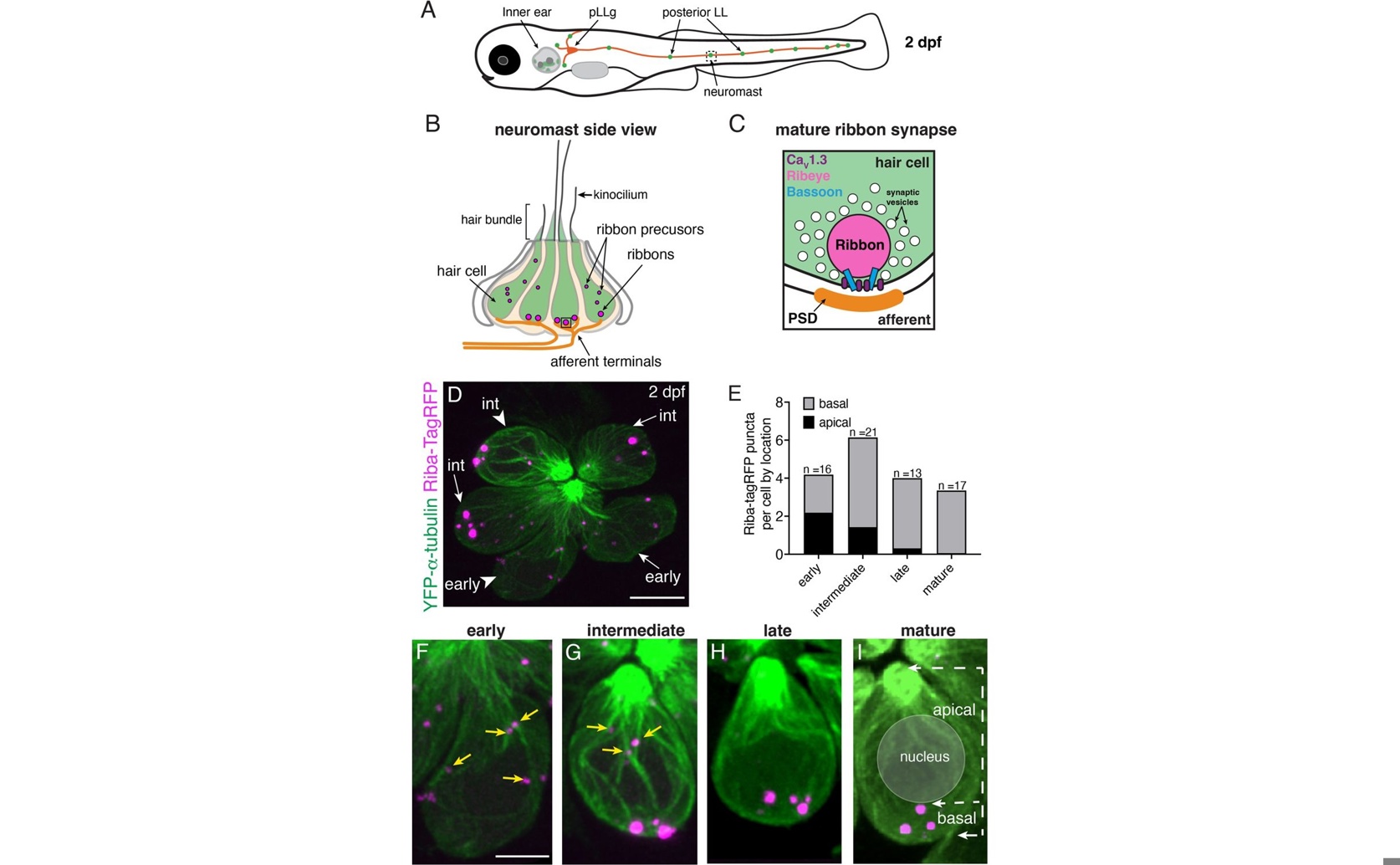
Live imaging of the zebrafish (Danio rerio) posterior-lateral line reveals that developing hair cells initially contain numerous apical ribbon precursors associated with microtubules that progressively decrease in number and localize to the basal presynaptic region as the cell matures (a–i).

Image adapted from: Hussain et al. / CC BY (Source)

Key Findings

  • In zebrafish hair cells, new research reveals that crucial sensory connections, called ribbon synapses, form from many small "precursors" that move and grow
  • These tiny precursors travel along internal cellular "microtubule" tracks and fuse together to build the larger, mature synapses essential for our ability to see and hear
  • Disrupting these internal transport tracks or a key protein involved in this process prevents the proper assembly of these vital sensory connections
Sensory cells in our eyes and ears rely on highly specialized connections called ribbon synapses to transmit vital information to the brain. These unique structures are crucial for our ability to see and hear, and disruptions in their formation or function are directly linked to various forms of visual and auditory impairment. Despite their importance, precisely how these intricate ribbon synapses are assembled has remained largely unclear. Recent research conducted by the Institute on Deafness and Communication Disorders has shed new light on this fundamental process[1]. The study focused on the formation of ribbon synapses in the hair cells of zebrafish, which serve as an excellent model for understanding sensory biology. The researchers observed that in the early stages of development, numerous small structures, termed "ribbon precursors," are present throughout the sensory cell. As development progresses, these smaller precursors coalesce, resulting in fewer, but larger, mature ribbons that settle precisely at the "presynaptic active zone" – the specific site on the transmitting cell where chemical signals, known as neurotransmitters, are released to communicate with the receiving nerve cell. To understand how these precursors reach their destination, the scientists used live imaging techniques, allowing them to track the movement of these tiny structures within living cells. Their observations revealed that ribbon precursors do not move randomly. Instead, they exhibit directed motion, traveling along an organized network of internal cellular tracks called "microtubules." Microtubules are a key component of the cell's internal scaffolding, or "cytoskeleton," providing pathways for transporting various cellular components. The study further demonstrated that these ribbon precursors can actually fuse together while moving along these microtubule tracks, suggesting a dynamic process of assembly and growth during transport. To confirm the critical role of microtubules, the researchers used pharmacological agents to disrupt this internal transport system. They found that interfering with microtubules significantly hindered the movement and fusion of ribbon precursors, ultimately preventing the normal formation of synapses. This indicates that the microtubule network is essential for the proper assembly and positioning of these critical sensory connections. This discovery builds upon and ties together earlier understandings of cellular transport and synapse development. For instance, it has been previously shown that other components necessary for forming a synapse, such as "active zone proteins" and "synaptic vesicle proteins," are also transported along axons – the long projections of nerve cells – in specialized packages called "piccolo-bassoon transport vesicles" (PTVs) and "synaptic vesicle protein transport vesicles" (STVs)[2]. These earlier studies revealed that the trafficking of these different types of transport vesicles is coordinated, with PTVs and STVs often traveling together or sharing pause sites, ensuring that all necessary components arrive at the nascent synapse simultaneously. The current research expands on this by showing that ribbon precursors themselves utilize a similar, microtubule-dependent transport mechanism, highlighting a common strategy for delivering essential building blocks to developing synapses. The reliance on microtubules for ribbon formation also resonates with prior research on microtubule dynamics. For example, in the fungus Ustilago maydis, the microtubule cytoskeleton is known to be crucial for cellular morphogenesis, or the development of cell shape and structure[3]. This earlier work showed that a protein called Eca1, which regulates calcium levels inside the cell, is vital for maintaining proper microtubule organization and behavior. When Eca1 was disrupted, calcium levels increased, leading to disorganized microtubules that were less prone to shrinking ("reduced catastrophe frequencies") and more prone to regrowing ("increased rescue"). This state, known as altered "dynamic instability," severely impacted cell growth. Interestingly, motor proteins like "dynein," which move along microtubules, were also affected. This suggests that calcium signaling can directly influence microtubule dynamics, which in turn impacts cellular processes like growth and, by extension, could play a role in the precise transport and fusion events observed in ribbon synapse formation. The importance of these ribbon synapses, and therefore the significance of understanding their formation, is underscored by their functional role. Previous research on inner hair cells (IHCs) in the cochlea – the auditory part of the inner ear – demonstrated that the protein "RIBEYE" is a key structural component of the ribbon[4]. Mice lacking RIBEYE, and thus the entire ribbon structure, exhibited a mild hearing deficit. While they could still transmit some signals, their ability to sustain signals in response to prolonged stimulation was impaired, indicating that the ribbon facilitates signal transmission by efficiently managing a pool of "synaptic vesicles" – tiny sacs containing chemical messengers. This highlights that while synapses can form without a ribbon, the ribbon itself is crucial for optimal, sustained function at physiological stimulus levels. Furthermore, the maturation of these delicate sensory connections is also influenced by other cellular signals. Studies on outer hair cells (OHCs) have shown that the refinement of their nerve connections, including the number of ribbon synapses, is regulated by spontaneous calcium signals during early development[5]. These calcium signals originate from both the OHCs themselves and from surrounding non-sensory cells. This synchronized calcium activity, often mediated by molecules like ATP and specific receptors, is essential for the proper maturation of the nerve connections. When these calcium waves are disrupted, fewer ribbon synapses and nerve fibers form. This reinforces the idea that the precise formation and maturation of ribbon synapses, as detailed in the current study, are not isolated events but are intricately linked to broader cellular processes, including microtubule dynamics and calcium signaling, ensuring the development of a fully functional sensory system.

BiochemAnimal Science

References

Main Study

1) Microtubule networks in zebrafish hair cells facilitate presynapse transport and fusion during development

Published 23rd July, 2025

https://doi.org/10.7554/eLife.98119


Related Studies

2) Coordinated trafficking of synaptic vesicle and active zone proteins prior to synapse formation.

https://doi.org/10.1186/1749-8104-6-24


3) Calcium signaling is involved in dynein-dependent microtubule organization.

Journal: Molecular biology of the cell, Issue: Vol 15, Issue 4, Apr 2004


4) The presynaptic ribbon maintains vesicle populations at the hair cell afferent fiber synapse.

https://doi.org/10.7554/eLife.30241


5) Coordinated calcium signalling in cochlear sensory and non-sensory cells refines afferent innervation of outer hair cells.

https://doi.org/10.15252/embj.201899839


Related Articles

An unhandled error has occurred. Reload 🗙