Turning On a Hidden Gene Unlocks Stress Resistance in Bacteria

Jim Crocker
22nd July, 2025

Turning On a Hidden Gene Unlocks Stress Resistance in Bacteria

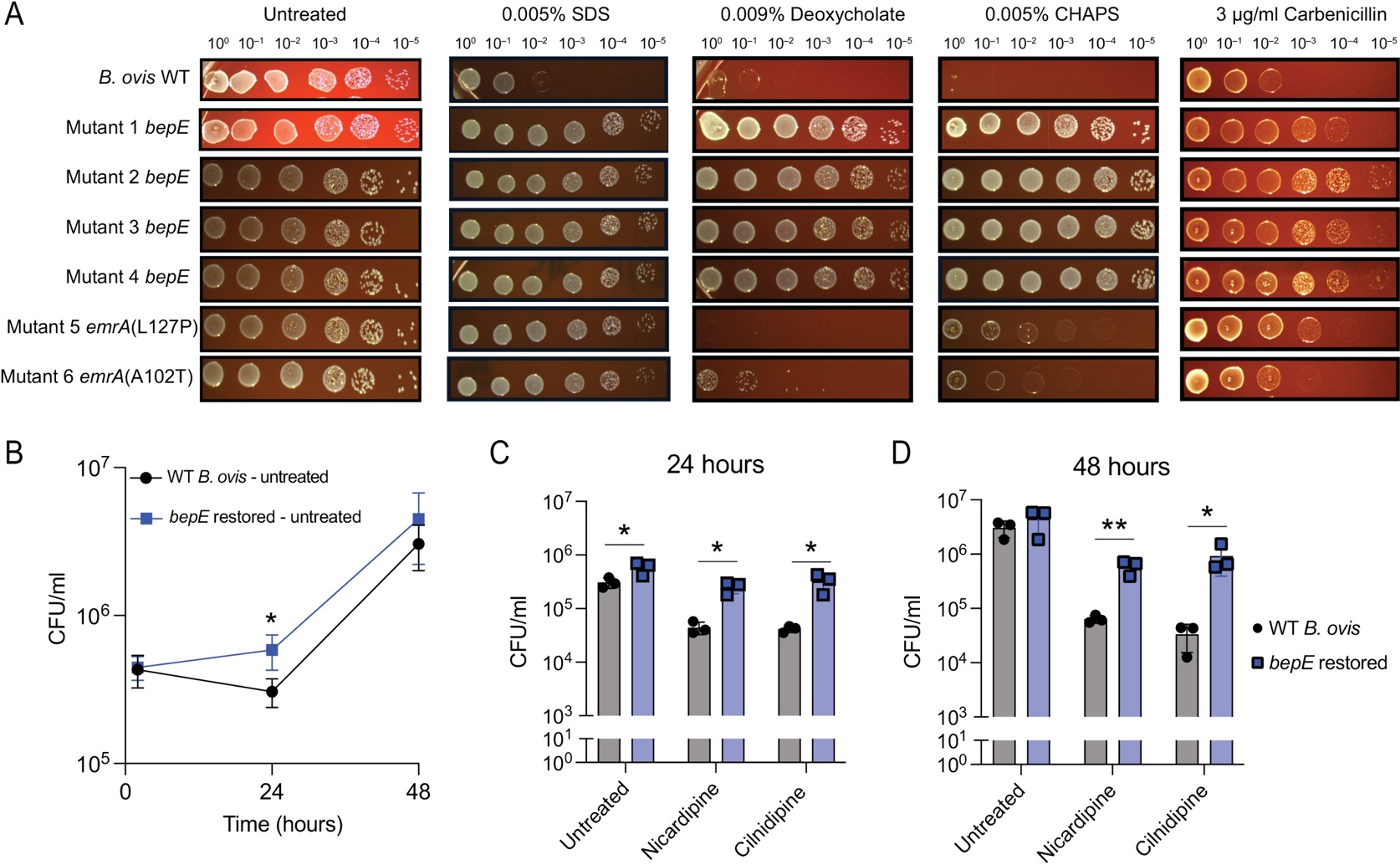
Restoration of the bepE pseudogene reveals latent stress resistance in Brucella ovis by conferring protection against cell envelope disruptors (a) and enhancing bacterial survival in THP-1 macrophages treated with nicardipine and cilnidipine (c, d) without altering growth in untreated cells (b).

Image adapted from: Kim et al. / CC BY (Source)

Key Findings

  • Scientists at Michigan State and Tufts found that common blood pressure drugs, called dihydropyridines, can directly kill Brucella bacteria, even when hidden inside host cells
  • They discovered that a specific bacterial gene, bepE, acts as a pump, making Brucella resistant to these drugs and other harmful chemicals
  • The study explains that Brucella ovis is naturally more vulnerable to these drugs because its bepE gene is broken, but fixing it makes the bacteria resistant
Brucellosis is a widespread and highly pathogenic bacterial infection that poses serious threats to both public health and animal husbandry. Caused by bacteria of the genus Brucella, it leads to significant economic losses globally and causes human illness, with hundreds of thousands of new human infections annually[2]. A major challenge in treating brucellosis is that the bacteria are adept at hiding inside the host's cells, particularly within immune cells called phagocytes[2][3]. This intracellular lifestyle allows Brucella to evade the host's immune responses and limits the effectiveness of many antibiotics[2]. Current treatments typically involve long courses of antibiotics, often for several months, which can easily lead to the emergence of antibiotic resistance[4]. For instance, recent studies have shown Brucella melitensis strains in Northeast China exhibiting resistance to common antibiotics like rifampin and azithromycin, with efflux pumps being a primary mechanism of this resistance[4]. This highlights the urgent need for new therapeutic strategies and a deeper understanding of Brucella biology to overcome these challenges. Recent research conducted by scientists at Michigan State University and Tufts University[1] has shed new light on how to combat Brucella infections, specifically by identifying a new class of drugs that directly target the bacteria and by uncovering a key genetic factor influencing bacterial vulnerability. The study began by screening a large collection of small molecules to find those that could impair the survival of Brucella ovis – a type of Brucella that infects sheep – while it was inside mammalian phagocytes. This screening process, which measured light produced by the bacteria as an indicator of their health, identified a group of clinically approved drugs called dihydropyridines as promising candidates. Dihydropyridines are typically used in medicine to block L-type calcium channels in human cells, which are important for regulating processes like heart function and blood pressure. Initially, the researchers hypothesized that these drugs were working by affecting the host cell itself, perhaps by disrupting the levels of calcium and manganese within the phagocytes. However, further experiments revealed a surprising finding: dihydropyridines had a direct antimicrobial effect on Brucella, meaning they could kill the bacteria even when the bacteria were grown in a laboratory dish without any host cells. This indicated that the drugs were not just influencing the host environment but were directly attacking the bacteria. To understand how Brucella might develop resistance to these new drugs, the scientists then selected for B. ovis mutants that could grow in the presence of cilnidipine, a representative dihydropyridine. They discovered that these drug-resistant mutants had a specific genetic change: a single-nucleotide deletion in a "pseudogene" called bepE was reversed. A pseudogene is a segment of DNA that resembles a functional gene but has lost its protein-coding ability due to mutations. In the case of bepE in B. ovis, this reversal effectively restored the gene's "open reading frame," allowing it to produce a functional protein. This restored bepE gene was found to encode a type of protein known as an RND-family transporter. These transporters act like molecular pumps, actively expelling harmful substances, including antibiotics and other toxic compounds, from inside the bacterial cell. This finding aligns with previous research on Brucella melitensis which identified efflux pumps, particularly those belonging to the resistance nodulation division (RND) family, as a major mechanism by which Brucella develops resistance to antibiotics[4]. The new study thus provides a specific example of how such a pump, when functional, can confer resistance. The implications of this discovery are significant. The researchers found that the restoration of the bepE gene not only made B. ovis resistant to dihydropyridines but also to a broad range of other chemicals that disrupt the bacterial cell's outer layer, known as the cell envelope. Conversely, to further confirm the role of bepE, they performed an experiment on Brucella abortus, a closely related species that causes human brucellosis and naturally possesses an intact, functional version of the bepE gene. When they intentionally deleted the bepE gene in B. abortus, these bacteria became more sensitive to cell envelope-disrupting agents in laboratory settings and, crucially, also became more sensitive to cilnidipine even when residing within host cells. This demonstrates that bepE is a critical factor in Brucella's ability to resist chemical stress, including the effects of dihydropyridines, even in the protective intracellular environment. The study concludes that bepE is a key determinant of chemical stress resistance in Brucella species. It also offers an explanation for a known characteristic of B. ovis: its documented hypersensitivity to chemical stressors. B. ovis is a host-restricted pathogen that has undergone significant "pseudogenization" during its recent evolutionary history, meaning it has accumulated many non-functional genes. The natural pseudogenization of bepE in B. ovis contributes to its increased vulnerability compared to other Brucella species that retain a functional bepE gene. This research not only identifies a potential new class of drugs for treating brucellosis but also deepens our understanding of Brucella's unique biology and its strategies for survival and resistance, particularly how its intracellular lifestyle and specific genetic adaptations, like the loss or gain of efflux pump function, influence its susceptibility to treatments.

GeneticsBiochemAnimal Science

References

Main Study

1) Reversion of a RND transporter pseudogene reveals latent stress resistance potential in Brucella ovis

Published 21st July, 2025

https://doi.org/10.1371/journal.pgen.1011795


Related Studies

2) Pathogenesis and immunobiology of brucellosis: review of Brucella-host interactions.

https://doi.org/10.1016/j.ajpath.2015.03.003


3) The Intracellular Life Cycle of Brucella spp.

https://doi.org/10.1128/microbiolspec.bai-0006-2019


4) Molecular characterization and antimicrobial susceptibility of human Brucella in Northeast China.

https://doi.org/10.3389/fmicb.2023.1137932


Related Articles

An unhandled error has occurred. Reload 🗙