ZBTB48 Gene Connects Telomere Biology to Mitochondrial Function in Zebrafish

Jim Crocker
25th February, 2025

ZBTB48 Gene Connects Telomere Biology to Mitochondrial Function in Zebrafish

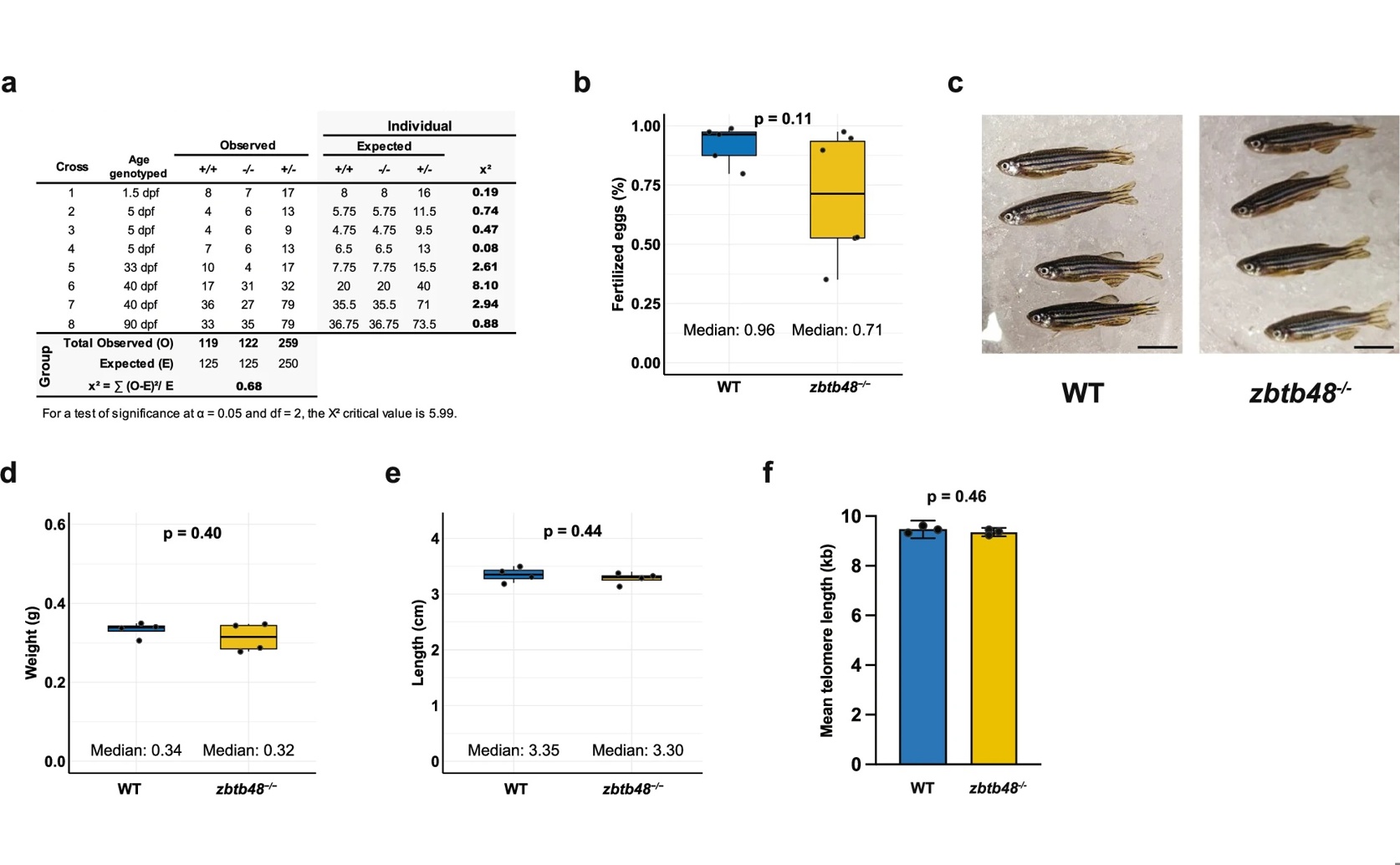
Zebrafish with a knockout of the zbtb48 gene show no apparent physical or developmental abnormalities (a–e) and, importantly, no significant change in telomere length (f), indicating that its function as a negative regulator of telomere length observed in human cell lines is not conserved in this organismal model.

Image adapted from: Goh et al. / CC BY (Source)

Key Findings

  • Researchers in Mainz - Germany used zebrafish to study the ZBTB48 gene's role in cell health
  • Zebrafish without ZBTB48 showed no immediate changes in telomere length or physical behavior
  • However these fish had lower levels of the mtfp1 gene - highlighting ZBTB48's role in maintaining cell energy
Telomeres are protective caps at the ends of chromosomes that play a crucial role in maintaining the stability of our DNA. Each time a cell divides, these telomeres shorten, and when they become too short, the cell can no longer divide and becomes senescent or dies. Telomerase is an enzyme that can extend the length of telomeres, thus enabling cells to divide more times than they normally would. Understanding how telomeres and telomerase function is essential for insights into aging and diseases like cancer. Research has extensively used zebrafish (Danio rerio) as a model organism to study telomere biology due to their genetic similarity to humans and their advantageous experimental manipulation[2][3][4]. Previous studies have shown that telomere length and telomerase activity in zebrafish decline with age, correlating with decreased regenerative abilities and the onset of age-related diseases[2]. Additionally, telomerase-deficient zebrafish exhibit premature aging and reduced lifespan, mirroring human conditions more closely than mouse models[3]. Another study revealed that in zebrafish, short telomeres accumulate in specific tissues like the gut and muscle, independent of their proliferation rates, leading to local dysfunction and systemic disease[4]. Building on this foundation, researchers at the Institute of Molecular Biology in Mainz, Germany, conducted a study to explore the role of ZBTB48 (also known as TZAP), a transcription factor known to bind telomeres and regulate their length in human cells[1]. To determine whether ZBTB48's function is conserved in vertebrates, the team used CRISPR‒Cas genome editing to create zebrafish lacking the zbtb48 gene (zbtb48−/−). Surprisingly, the zbtb48−/− zebrafish did not display any obvious physical or behavioral abnormalities in the first two generations. Additionally, there were no significant changes in telomere length observed in first-generation adult mutants. This finding suggests that, unlike in human cell lines, the absence of ZBTB48 does not immediately impact telomere length in zebrafish, indicating possible compensatory mechanisms or differences in telomere regulation between species. However, the study revealed that the deletion of zbtb48 led to a consistent downregulation of the mtfp1 gene at both the mRNA and protein levels in the mutants. In humans, mtfp1 is involved in mitochondrial function and has been identified as a regulatory target of ZBTB48 in cancer cells. The downregulation of mtfp1 in zebrafish mutants suggests that ZBTB48's role in regulating this gene is evolutionarily conserved. Further analysis of zbtb48 expression across various tissues in zebrafish showed low levels of transcripts in most tissues except for germline stem cells and gametocytes within the gonads. This restricted expression pattern indicates that ZBTB48 may have specific roles in reproductive cells. Correspondingly, the researchers detected reduced levels of Mtfp1 protein in the ovaries of 40-day post-fertilization (dpf) zbtb48−/− mutants and in the testes of both 40 dpf and 10.5-month-old mutants. This tissue-specific downregulation aligns with the earlier findings that telomere shortening in zebrafish affects certain tissues more than others, contributing to localized dysfunction and broader health issues[4]. The absence of immediate telomere length changes in the zbtb48−/− zebrafish suggests that ZBTB48 may not be a primary regulator of telomere length in zebrafish as it is in human cells. Instead, its conserved role in regulating mtfp1 points to a potentially different or additional function in maintaining mitochondrial health and cellular metabolism. This distinction is important as it highlights the complexity of telomere biology and the necessity of studying it across different organisms to fully understand its mechanisms. Moreover, the study's findings contribute to the broader understanding of aging and disease in zebrafish, reinforcing the significance of telomere biology in these processes. By identifying conserved regulatory targets like mtfp1, researchers can better comprehend how telomere-associated factors influence cellular functions beyond just telomere length maintenance. This knowledge could pave the way for new therapeutic targets in age-related diseases and cancers where telomere dynamics play a critical role. In conclusion, the research from the Institute of Molecular Biology in Mainz demonstrates that while ZBTB48 may not directly regulate telomere length in zebrafish as it does in humans, it plays a significant role in the regulation of mtfp1, an essential gene for mitochondrial function. This discovery adds a new layer to our understanding of telomere biology and its impact on aging and disease, emphasizing the value of zebrafish as a model organism for uncovering conserved biological mechanisms.

GeneticsBiochemAnimal Science

References

Main Study

1) Zbtb48 is a regulator of Mtfp1 expression in zebrafish

Published 22nd February, 2025

https://doi.org/10.1038/s42003-025-07666-z


Related Studies

2) Behaviour of telomere and telomerase during aging and regeneration in zebrafish.

https://doi.org/10.1371/journal.pone.0016955


3) Premature aging in telomerase-deficient zebrafish.

https://doi.org/10.1242/dmm.011635


4) Short Telomeres in Key Tissues Initiate Local and Systemic Aging in Zebrafish.

https://doi.org/10.1371/journal.pgen.1005798


Related Articles

An unhandled error has occurred. Reload 🗙