How Certain MicroRNAs and Microbes Boost Reproduction in Citrus Pests

Greg Howard
9th October, 2024

How Certain MicroRNAs and Microbes Boost Reproduction in Citrus Pests

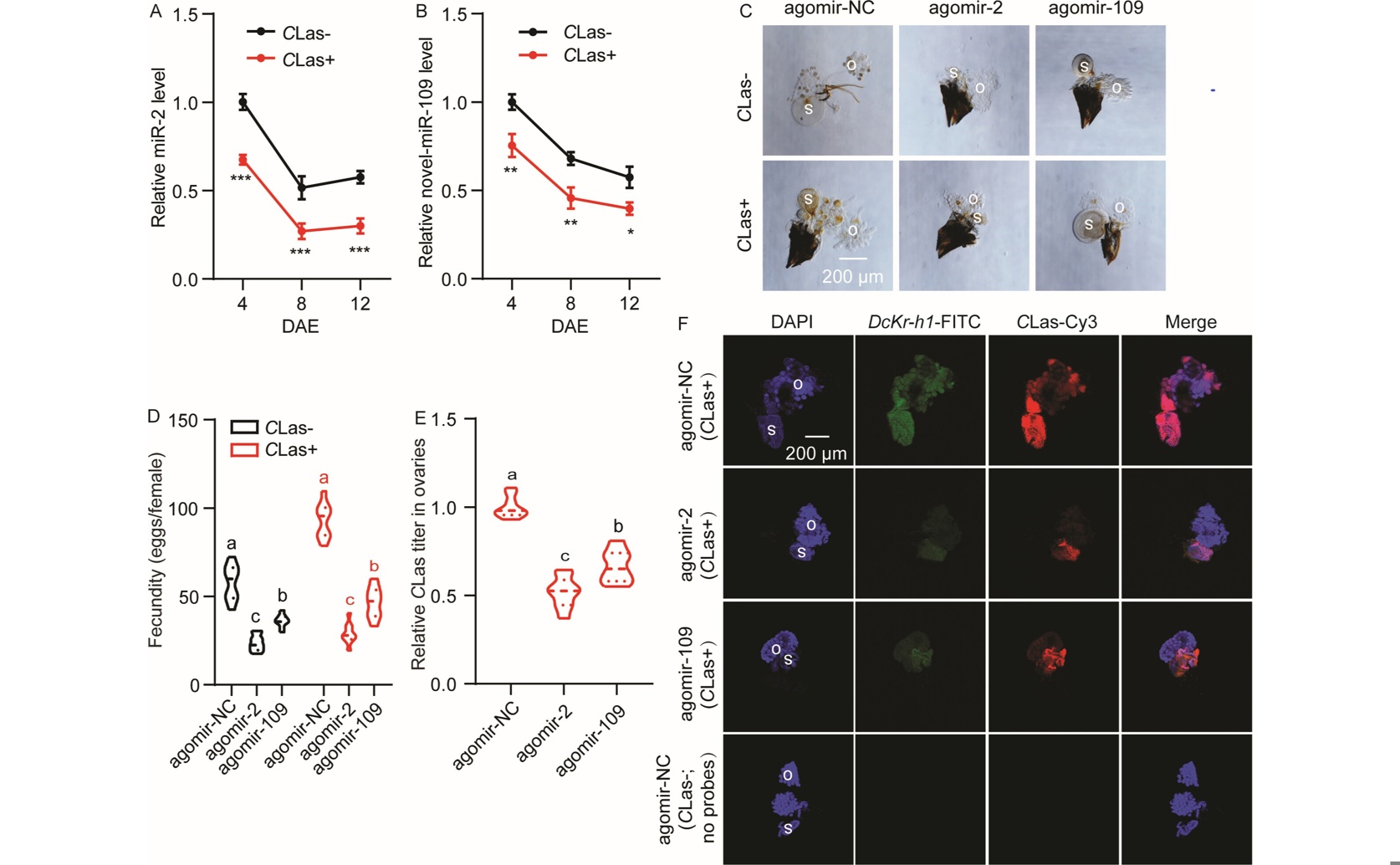
Infection with the bacterium “Candidatus Liberibacter asiaticus” (CLas) increases fecundity in the Asian citrus psyllid (Diaphorina citri) by suppressing ovarian miR-2 and novel-miR-109 (a, b), an effect confirmed by experiments showing that artificially restoring these miRNAs impairs ovarian development (c), reduces egg laying (d), and lowers bacterial presence in the ovaries (e, f).

Image adapted from: Nian et al. / CC BY (Source)

Key Findings

  • Researchers at South China Agricultural University found that two pathogens increase the reproductive ability of the insect Diaphorina citri
  • Two microRNAs, miR-2 and novel-miR-109, were identified as key regulators that control a gene linked to increased fecundity in these insects
  • Lower levels of these microRNAs in infected insects lead to higher expression of the gene, promoting ovarian development and increased reproduction
Understanding how pathogens manipulate their insect vectors to enhance their transmission is a crucial area of research with significant implications for agricultural management and disease control. A recent study conducted by South China Agricultural University[1] has shed light on a posttranscriptional regulatory mechanism that increases the fecundity of Diaphorina citri, a key vector for economically important plant pathogens. This research builds on previous findings that pathogen infections can enhance vector fitness traits, thereby promoting their own spread[2]. The study focuses on the interaction between Diaphorina citri and two pathogens: the bacterium "Candidatus Liberibacter asiaticus" (CLas) and the fungus Cordyceps fumosorosea (Cf). Both pathogens are known to increase the fecundity of D. citri, but the underlying posttranscriptional mechanisms were poorly understood. The researchers identified two microRNAs (miRNAs), miR-2 and novel-miR-109, as key regulators of this process. miRNAs are short, non-coding RNA molecules that play a critical role in regulating gene expression by binding to the 3' untranslated regions (UTRs) of target mRNAs, thereby inhibiting their translation. The study revealed that miR-2 and novel-miR-109 jointly inhibit the expression of DcKr-h1, a gene previously linked to increased fecundity in D. citri infected by CLas and Cf. In the ovaries of CLas-positive psyllids, the levels of miR-2 and novel-miR-109 were significantly lower compared to CLas-negative individuals. This reduction in miR-2 and novel-miR-109 levels ensures high DcKr-h1 expression, which in turn stimulates ovarian development and enhances fecundity. Overexpression of either miR-2 or novel-miR-109 resulted in decreased fecundity and reduced CLas titer in the ovaries, as well as reproductive defects similar to those observed when DcKr-h1 is knocked down. Similarly, in the D. citri-Cf interaction, the levels of miR-2 and novel-miR-109 were also markedly decreased in the ovaries. Upregulation of these miRNAs led to reduced fecundity and ovary defects, mirroring the effects of DcKr-h1 silencing. Furthermore, feeding antagomir-2 or antagomir-109 (molecules that inhibit miRNAs) to the psyllids partially rescued the defective phenotypes caused by DcKr-h1 silencing in both pathogen interactions. The study also delved into the hormonal regulation of this process. Juvenile hormone (JH) was found to suppress the expression of miR-2 and novel-miR-109, thereby facilitating the JH-induced transcription of DcKr-h1. This hormonal regulation ensures high levels of DcKr-h1 expression, which promotes ovarian development and increases fecundity in psyllids infected by both symbiotic bacteria and pathogenic fungi. These findings provide a comprehensive understanding of how pathogens can manipulate their insect vectors at a molecular level to enhance their transmission. The research highlights a conserved regulatory mechanism involving JH and miRNAs that increases vector fecundity, thereby benefiting the pathogens. This study not only advances our understanding of vector-pathogen interactions but also opens up potential avenues for developing new strategies to manage insect-borne plant diseases. Previous studies have shown that the transmission of insect-borne plant pathogens depends on the abundance and behavior of their vectors, and that pathogens can influence vector behavior and performance to enhance their transmission[2]. This new research adds a layer of complexity by elucidating the posttranscriptional mechanisms involved in this process. It underscores the importance of miRNAs in regulating gene expression and shaping phenotypes that favor pathogen spread. In conclusion, the study by South China Agricultural University provides valuable insights into the molecular mechanisms by which pathogens manipulate their insect vectors to enhance their own transmission. By understanding these mechanisms, we can develop more effective strategies to control the spread of economically important plant pathogens and improve agricultural productivity.

GeneticsBiochemAnimal Science

References

Main Study

1) The conserved role of miR-2 and novel miR-109 in the increase in fecundity of Diaphorina citri induced by symbiotic bacteria and pathogenic fungi.

Published 7th October, 2024

https://doi.org/10.1128/mbio.01541-24


Related Studies

2) Insect-Borne Plant Pathogens and Their Vectors: Ecology, Evolution, and Complex Interactions.

https://doi.org/10.1146/annurev-ento-020117-043119


Related Articles

An unhandled error has occurred. Reload 🗙