Backyard Sheds: Understanding Housing to Limit Waste Exposure

Jenn Hoskins
23rd July, 2025

Backyard Sheds: Understanding Housing to Limit Waste Exposure

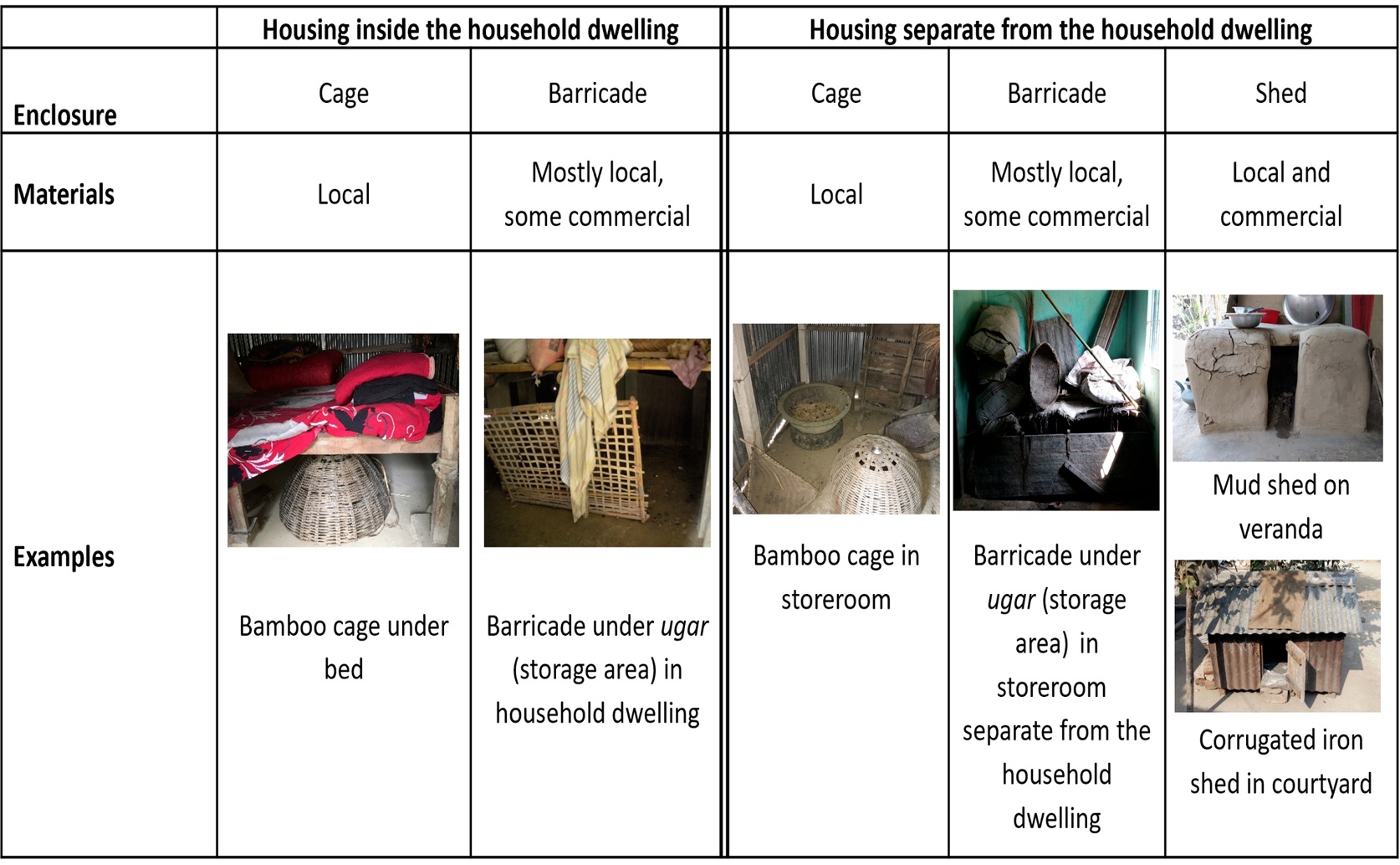
Poultry housing identified inside the household dwelling and separate from the household dwelling.

Image adapted from: Thomas et al. / CC BY (Source)

Key Findings

  • A study in rural Bangladesh found that while many households keep chickens inside overnight, posing health risks, most prefer to house them outside in sheds
  • However, housing poultry outside depends on having suitable sheds, which requires household resources like building materials, skilled labor, and adequate space
  • To improve health, future programs should promote adaptable shed designs that protect birds and fit local needs, rather than a single solution
Backyard poultry rearing plays a crucial role in the livelihoods of rural households in low- and middle-income countries, providing essential food resources and a source of income. However, a common practice involves keeping poultry inside human dwellings overnight, which can pose significant health risks to the people living there, particularly young children. These risks include exposure to poultry feces and potential transmission of infectious diseases, including zoonoses—diseases that can spread from animals to humans. Addressing this challenge is vital for ensuring the continued benefits of family poultry while safeguarding human health. A recent study conducted by researchers at the Johns Hopkins Bloomberg School of Public Health[1] aimed to understand the existing practices and factors influencing where poultry are housed overnight in rural Bangladesh. This research was designed as a foundational step for developing interventions to separate young children from poultry and their waste. The study employed a two-pronged approach: initially, 19 transect walks were conducted through various villages across Bangladesh. These walks involved systematic observations to document how backyard poultry were housed overnight. Following this, 27 semi-structured interviews were carried out with poultry raisers. These interviews delved deeper into specific poultry-raising practices, including the types of housing structures and materials identified during the transect walks. The findings revealed a mix of overnight poultry housing practices. While some households kept their birds inside the dwelling, a significant number housed them separately, most commonly in sheds located in the household courtyard. The study identified a clear preference and willingness among poultry raisers to house their birds outside, provided that a suitable shed was available. However, the researchers noted that overnight housing practices could fluctuate, suggesting that consistent separation is not always maintained. The availability of a shed, it was found, depended on several factors related to household resources, such as access to necessary building materials and skilled labor. Physical space within the household compound, prevailing trends within the area and village, and the specific preferences and concerns of the poultry raisers also played a significant role. This research builds upon a broader understanding of family poultry production systems. For instance, the Food and Agriculture Organization of the United Nations has identified various systems, from small extensive to intensive, each with different environmental impacts and welfare standards[2]. Achieving sustainable production, which includes both environmental health and welfare, is a complex endeavor that requires interdisciplinary collaboration and solutions tailored to local circumstances[2]. The current study directly contributes to this by identifying a context-specific intervention – promoting sheds – that could improve both human health and poultry welfare. The importance of backyard poultry for nutrition, especially for children, has been well-documented. Studies in rural Nepal[3] and Bangladesh[4] have shown a clear association between household poultry ownership and increased consumption of eggs among children. In Nepal, children in households owning one or two chickens consumed eggs nearly three times more frequently per week compared to those without chickens[3]. Similarly, in Bangladesh, infants in households with more poultry consumed eggs more often[4]. These findings underscore the nutritional benefits of small-scale animal production. However, as the Johns Hopkins study highlights, these benefits must be balanced with managing potential health risks. The issue of biosecurity in backyard poultry systems is also critical. Backyard flocks, particularly in developing countries, often operate with low biosecurity measures, increasing the risk of infectious diseases like Newcastle disease or zoonoses such as Highly Pathogenic Avian Influenza (HPAI)[5]. Previous reviews have noted a lack of robust evidence on the impact and feasibility of biosecurity measures specifically for backyard poultry[5]. The current study offers a practical, acceptable intervention—the promotion of sheds for overnight housing—that could significantly enhance biosecurity by reducing direct human-animal contact and exposure to poultry waste. This addresses a critical gap in finding sustained and adapted biosecurity measures for smallholder poultry flocks, as called for by earlier research[5]. The researchers from Johns Hopkins Bloomberg School of Public Health recommend that future studies measuring human exposure to poultry and poultry feces should assess this exposure over time and at regular intervals to capture variations in housing practices. Such studies should also include assessments of poultry housing hygiene. The promotion of sheds for overnight poultry housing appears to be an acceptable intervention approach in rural Bangladesh. However, programs aiming to implement this will need to offer recommendations for housing that not only address the risk of zoonotic disease transmission but also accommodate the diverse preferences and constraints of poultry raisers, moving away from a rigid, "one-size-fits-all" approach.

AgricultureHealthAnimal Science

References

Main Study

1) Who has sheds? Exploring practices and determinants of overnight housing for backyard poultry in rural Bangladesh to inform an intervention to limit exposure to poultry and poultry feces

Published 22nd July, 2025

https://doi.org/10.1371/journal.pgph.0004929


Related Studies

2) Family poultry: Multiple roles, systems, challenges, and options for sustainable contributions to household nutrition security through a planetary health lens.

https://doi.org/10.1111/mcn.12668


3) Small-Scale Livestock Production in Nepal Is Directly Associated with Children's Increased Intakes of Eggs and Dairy, But Not Meat.

https://doi.org/10.3390/nu12010252


4) Household animal ownership is associated with infant animal source food consumption in Bangladesh.

https://doi.org/10.1111/mcn.13495


5) Biosecurity measures for backyard poultry in developing countries: a systematic review.

https://doi.org/10.1186/1746-6148-8-240


Related Articles

An unhandled error has occurred. Reload 🗙