Tracking Farm Movement for Disease Spread Prediction

Jenn Hoskins
21st June, 2025

Tracking Farm Movement for Disease Spread Prediction

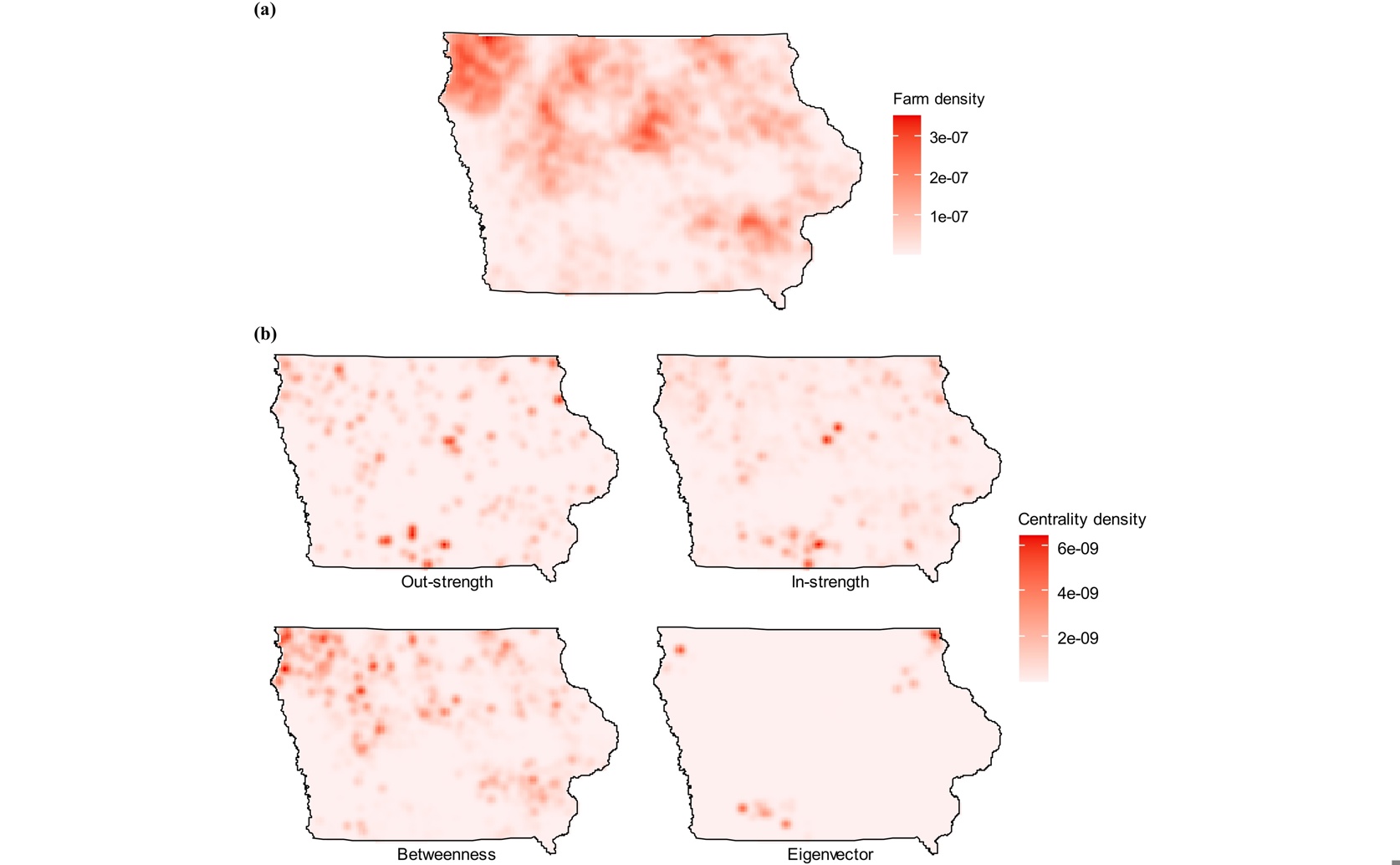
The spatial mapping of swine farm density (a) and various network centrality measures (b) reveals distinct geographic hotspots, underscoring the heterogeneous nature of the movement network where certain premises play a more critical role in potential disease transmission.

Image adapted from: Yang et al. / CC BY (Source)

Key Findings

  • Researchers at Kansas State University developed a new method to create realistic animal movement networks for the Iowa swine industry, helping to model disease spread despite missing data
  • Simulations showed that farms central to the network or those shipping to many others are highly vulnerable and can cause large disease outbreaks like African Swine Fever
  • These findings emphasize the urgent need for better animal movement records and traceability programs across the U.S. livestock industry to control future outbreaks
Animal diseases pose a significant threat to livestock industries worldwide, impacting food security and economies. Understanding how pathogens spread between farms is crucial for effective prevention and control. However, a major challenge in the United States is the lack of readily available, detailed data on animal movements between premises. This data gap makes it difficult for scientists to accurately model epidemics and predict their course, hindering timely and effective responses. To address this critical issue, researchers at Kansas State University have developed a novel method to generate "synthetic" animal movement networks[1]. This approach aims to overcome the scarcity of real-world movement data, which is a common hurdle in the US. For instance, while a past study on the Porcine Epidemic Diarrhea virus (PEDv) in US swine was able to leverage actual farm-level animal movement data[2] – a rare occurrence – such comprehensive datasets are typically unavailable. The PEDv study demonstrated how direct animal movements and local proximity were primary drivers of spread, while indirect methods like contaminated vehicles and feed were responsible for introducing the virus into new geographic areas[2]. The Kansas State University team’s method, however, operates when such direct data is missing. Their new method uses a technique called maximum entropy. This allows them to create realistic-looking networks of animal movements by considering available statistics about farms, such as their operational type (e.g., breeding or finishing farms), their size, and the geographical distance between them. For example, understanding farm size is important, as seen in African Swine Fever (ASF) outbreaks in China, where small farms were disproportionately affected, often linked to swill feeding, while larger farms saw more spread via mechanical dissemination from vehicles and personnel[3]. The maximum entropy approach essentially builds the most probable network of connections given these limited but crucial pieces of information. Once these synthetic networks are generated, the researchers apply principles from social network analysis (SNA) and graph theory[4]. These analytical tools, which have been widely used in fields from sociology to human epidemiology to map relationships and identify key players, are increasingly valuable in preventive veterinary medicine. They provide a conceptual framework to study contact patterns between farms and identify units that are frequently or intensely connected within the network, ultimately helping to understand disease spread[4]. The Kansas State University team then used these generated networks to simulate the spread of African Swine Fever (ASF) within the US swine industry, a disease of significant concern. ASF is a highly contagious and often fatal viral disease in pigs, and its global spread, including in China, has highlighted various transmission routes, such as contaminated feed, vehicles, and personnel[3]. The simulations revealed important insights into potential vulnerabilities. They found that farms with a "central role" in the network – meaning they are highly connected to many other farms – are more susceptible to outbreaks and play a significant role in spreading the disease. Similarly, outbreaks originating from farms with a high "out-degree," meaning they ship animals to a large number of other farms, could lead to very large epidemics. Conversely, simulations where outbreaks started from random farms generally did not result in widespread epidemics, suggesting a relative robustness of the overall system against arbitrary disease introductions. These findings underscore the critical importance of specific farms within the animal movement network in determining the scale of a disease outbreak. The study highlights the ongoing need for improved animal movement records and traceability programs across the US livestock industry. Making such detailed data available to epidemiologists and modelers would significantly enhance our ability to understand disease risk and inform more effective, cost-efficient strategies for disease prevention and control. The approach developed by Kansas State University offers a valuable tool that can be adapted to estimate movement networks in other animal production systems and to inform disease spread models for various infectious diseases, even when comprehensive real-world movement data remains scarce.

AgricultureHealthAnimal Science

References

Main Study

1) Animal movement estimation and network-based epidemic modeling: Illustration for the swine industry in Iowa (US)

Published 18th June, 2025

https://doi.org/10.1371/journal.pone.0326234


Related Studies

2) Role of animal movement and indirect contact among farms in transmission of porcine epidemic diarrhea virus.

https://doi.org/10.1016/j.epidem.2018.04.001


3) Epidemic situation and control measures of African Swine Fever Outbreaks in China 2018-2020.

https://doi.org/10.1111/tbed.13968


4) Social network analysis. Review of general concepts and use in preventive veterinary medicine.

https://doi.org/10.1111/j.1865-1682.2009.01073.x


Related Articles

An unhandled error has occurred. Reload 🗙