The Cell's Code for Efficient Protein Delivery to Powerhouses

Jim Crocker
22nd July, 2025

The Cell's Code for Efficient Protein Delivery to Powerhouses

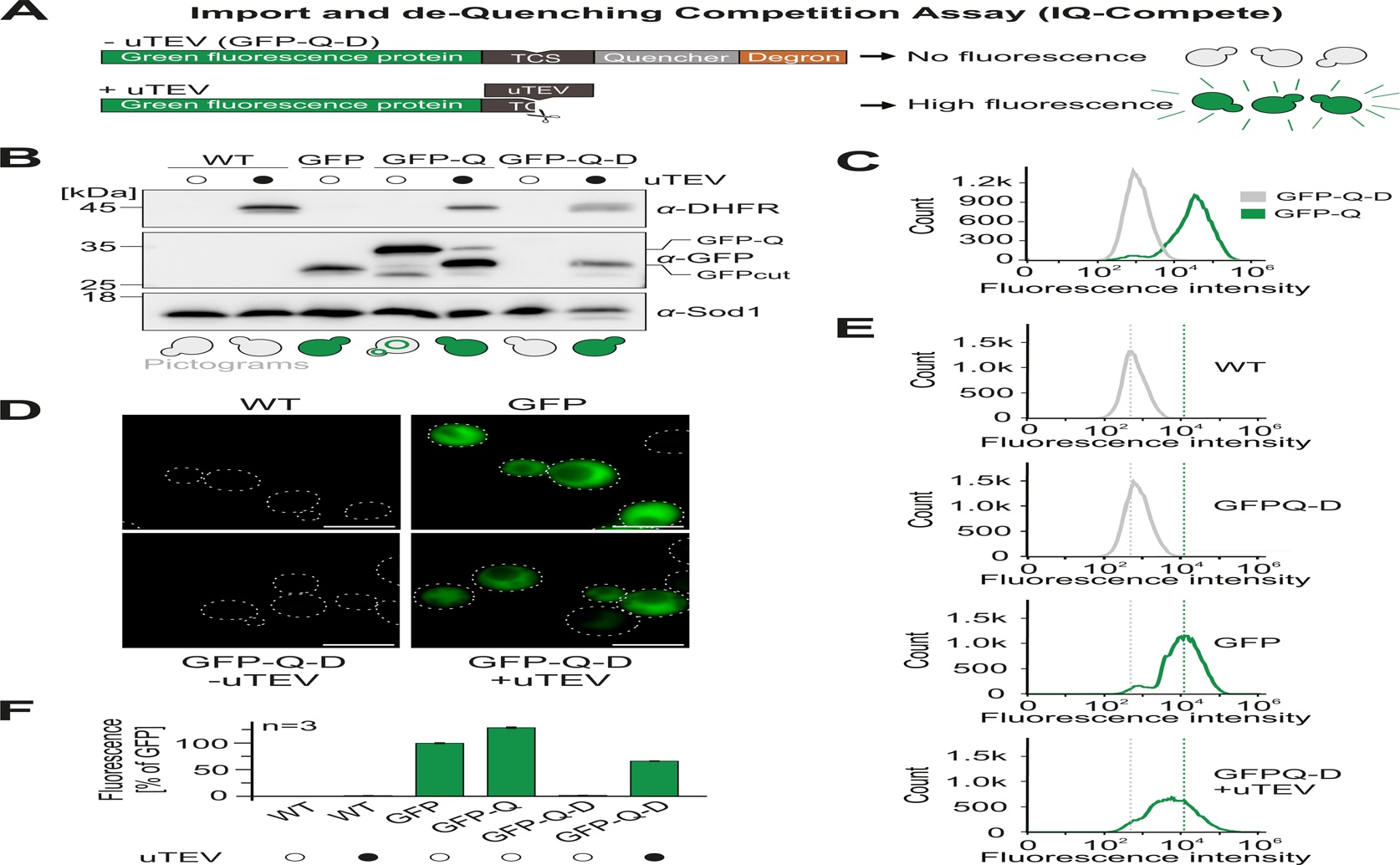
The validation of the novel IQ-Compete assay in yeast (Saccharomyces cerevisiae) demonstrates that the GFP-quencher-degron reporter (a) effectively suppresses background fluorescence (c) and generates a robust signal only upon cleavage by a cytosolic protease (b, d–f), thereby establishing a quantitative method to monitor the cytosolic accumulation of mitochondrial precursor proteins in vivo.

Image adapted from: Rödl et al. / CC BY (Source)

Key Findings

  • Researchers from the University of Kaiserslautern and partners discovered that "address labels" on mitochondrial proteins act as a "priority code" for efficient entry into cells' powerhouses
  • These "priority" labels recruit a helper protein, TOMM34, which speeds up the protein's journey into mitochondria, ensuring vital proteins get there faster
Mitochondria are vital components of nearly all cells, often called the "powerhouses" because they generate most of the energy a cell needs to function. Beyond energy production, they are involved in countless other essential processes, and when they malfunction, it can lead to a wide range of diseases. Most of the hundreds of different proteins required for mitochondrial function are not made inside the mitochondria themselves. Instead, they are produced in the main body of the cell, the cytosol, and then must be transported into the mitochondria. This transport process relies on specific "address labels" called N-terminal presequences, which are short protein segments at the beginning of these precursor proteins. While these presequences consistently form a specific coiled shape known as an amphipathic helix – meaning one side is attracted to water and the other repels it – they vary considerably in their exact structure and length. The challenge for scientists has been to understand how such diverse presequences can efficiently and accurately guide their respective proteins to the correct location within the mitochondria. Recent research, conducted by scientists from the University of Kaiserslautern, RPTU, Masaryk Memorial Cancer Institute, Saarland University, and Universitat Bern[1], has shed new light on this complex problem. Their findings suggest that these presequences contain a sophisticated "priority code" that dictates the targeting mechanism and import efficiency of individual mitochondrial proteins. The study began by classifying mitochondrial presequences into seven distinct groups based on their unique features. Through experiments, they observed that precursor proteins carrying presequences from "group A" consistently showed improved import characteristics in laboratory settings. To confirm these findings in living cells, the researchers developed a novel technique called IQ-Compete (for Import and de-Quenching Competition assay). This assay uses changes in fluorescence to monitor how efficiently proteins are imported into mitochondria within a living cell, providing a dynamic view of the process. Using IQ-Compete, they confirmed that group A presequences indeed lead to increased import competence. To understand how these group A presequences achieve better import, the team used mass spectrometry, a powerful technique that identifies and measures molecules by their mass. This led to a crucial discovery: the presequence of a specific group A protein, Oxa1, actively recruits a protein called TOMM34 from the cytosol. TOMM34, which contains a common protein interaction motif called a tetratricopeptide repeat (TPR), appears to act as a specific targeting factor. It essentially helps a particular subset of mitochondrial precursor proteins get into the mitochondria more efficiently. This discovery builds upon decades of research into how proteins enter mitochondria. We know that the main entry point for most mitochondrial proteins is a large protein complex called the Translocase of the Outer Mitochondrial Membrane, or TOM complex[2]. This complex acts as a gate, allowing proteins to cross the outer mitochondrial membrane. The TOM complex itself is made up of several subunits, including a central channel protein called Tom40 and various receptor and regulatory subunits like Tom20, Tom22, and Tom70. Previous studies, aided by advanced techniques like cryoelectron microscopy, have revealed the intricate structure of the TOM complex and shown that it can exist in different forms – a dimeric complex and a trimeric complex containing Tom22[2]. Importantly, these different forms may handle different sets of mitochondrial precursor proteins and even have different pathways for them to enter. The new findings from the study suggest that TOMM34 acts as an intermediary, specifically guiding "priority" proteins, identified by their group A presequences, to the TOM complex. This implies that the "priority code" within the presequence isn't just a general signal, but a specific instruction that might dictate which form of the TOM complex a protein interacts with, or how efficiently it is presented to the complex's import channels. This adds a new layer of complexity and specificity to the well-established understanding of TOM complex function[2]. Furthermore, the detailed classification of presequences in this study, and the identification of specific features that enhance import, could significantly advance computational methods designed to predict mitochondrial proteins. For instance, tools like MitoFates[3] have been developed to predict mitochondrial proteins and their targeting signals (presequences) from amino acid sequences. MitoFates already incorporates features like positively charged amphiphilicity, a known characteristic of presequences, and specific presequence motifs to improve its accuracy. The new insights from the study, particularly the identification of a "priority code" and the role of factors like TOMM34, provide valuable experimental data that could be integrated into future iterations of such prediction algorithms, making them even more precise in identifying undiscovered mitochondrial proteins and understanding their import mechanisms. In essence, this research reveals that the seemingly simple presequence is far more sophisticated than previously thought, acting as a coded instruction set that prioritizes and directs proteins to their mitochondrial destination, potentially by recruiting specific helper proteins like TOMM34 to facilitate their journey through the TOM complex.

GeneticsBiochem

References

Main Study

1) A protein-specific priority code in presequences determines the efficiency of mitochondrial protein import

Published 21st July, 2025

https://doi.org/10.1371/journal.pbio.3003298


Related Studies

2) Structural snapshot of the mitochondrial protein import gate.

https://doi.org/10.1111/febs.15661


3) MitoFates: improved prediction of mitochondrial targeting sequences and their cleavage sites.

https://doi.org/10.1074/mcp.M114.043083


Related Articles

An unhandled error has occurred. Reload 🗙