White Blood Cell Profiles in Autoimmune Blood Disorders

Jenn Hoskins
18th June, 2025

White Blood Cell Profiles in Autoimmune Blood Disorders

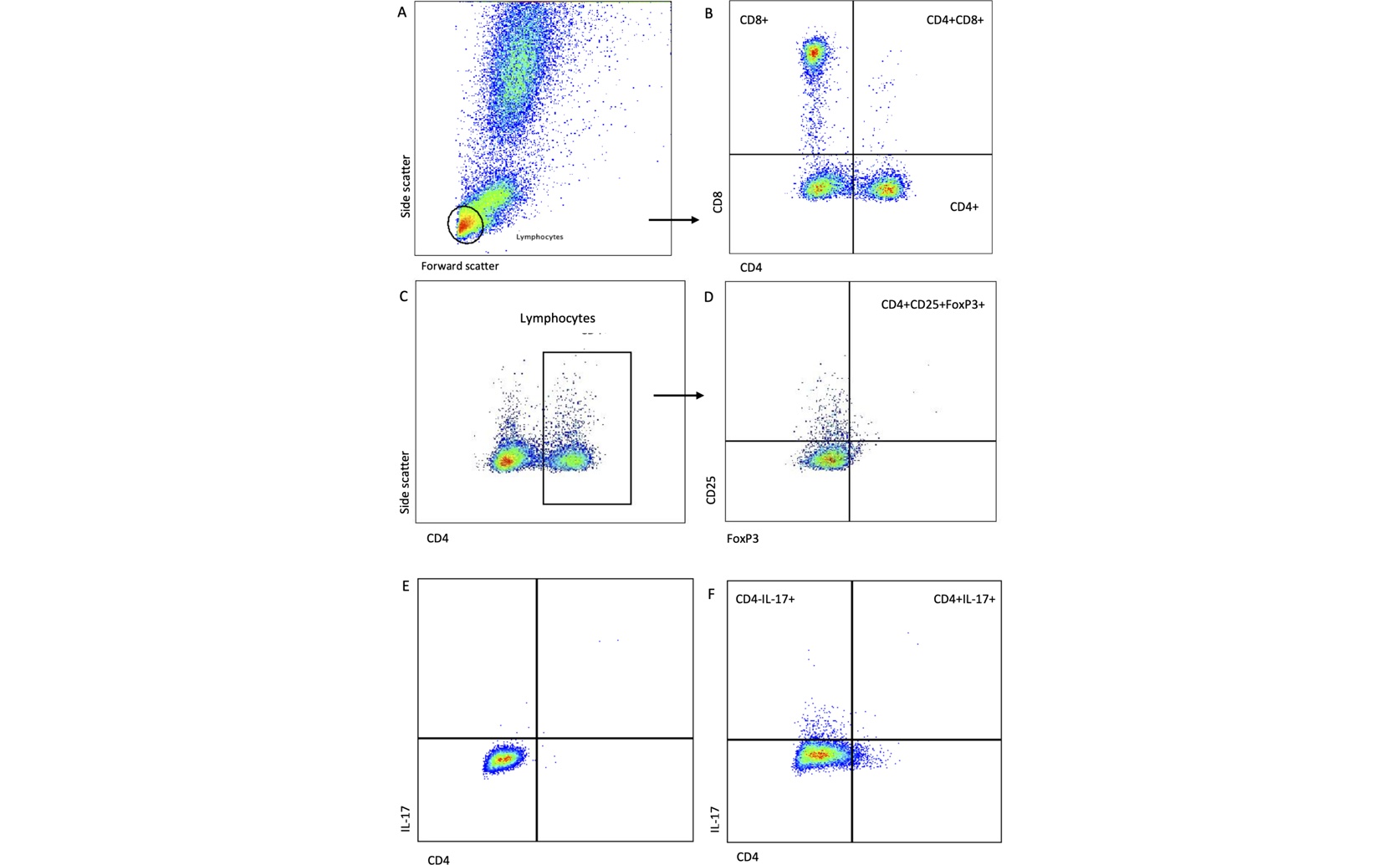
This figure illustrates the flow cytometry gating strategy used to identify key lymphocyte populations, including CD4+ and CD8+ cells (B), T regulatory cells (D), and IL-17+ lymphocytes (F), which were quantified to demonstrate the immune system imbalance central to immune-mediated hematologic disease in dogs.

Image adapted from: Blois et al. / CC BY (Source)

Key Findings

  • Researchers at the University of Guelph found dogs with severe immune blood disorders (IMHD) have fewer "brake" cells (T regulatory cells) and more "inflammation-boosting" cells (IL-17+ lymphocytes)
  • This immune imbalance suggests a weakened self-control, causing the body to mistakenly attack its own blood cells, leading to conditions like anemia or bleeding
  • Surprisingly, these affected dogs also had lower levels of other important immune cells (CD4+ and CD8+ lymphocytes) compared to healthy dogs
Immune-mediated hematologic diseases (IMHD) are severe conditions affecting dogs, where the body's own immune system mistakenly attacks its blood components. Two common forms are immune-mediated hemolytic anemia (IMHA), which targets red blood cells, and immune thrombocytopenia (ITP), which targets platelets. These conditions can lead to life-threatening anemia or bleeding. Despite their severity, the precise abnormalities within the immune system that cause these diseases have remained largely unknown. This lack of understanding makes developing targeted and effective treatments challenging, as current approaches often rely on broad immunosuppression, and evidence-based guidelines for treatment are still evolving[2]. For instance, while glucocorticoids are a first-line treatment for ITP, optimal regimens beyond this remain uncertain, and other drugs are often chosen based on clinician preference[2]. Similarly, the destruction of red blood cells in IMHA involves complex mechanisms, including autoantibodies and various immune cells, leading to a wide range of clinical outcomes[3]. A recent study by researchers from the University of Guelph and Sveuciliste u Splitu[1] aimed to shed light on these underlying immune system abnormalities. The team hypothesized that dogs with IMHD would show specific changes in certain types of immune cells: an increase in helper T cells (CD4+ lymphocytes) and cytotoxic T cells (CD8+ lymphocytes), a decrease in T regulatory cells, and an increase in lymphocytes producing a signaling molecule called Interleukin-17 (IL-17+ lymphocytes). To investigate this, the researchers conducted a prospective study involving fifteen dogs newly diagnosed with IMHA or ITP and fifteen healthy control dogs. They used a technique called flow cytometry, which allows scientists to identify and count different types of cells in a blood sample based on specific markers on their surface. They measured the proportions of CD4+ lymphocytes, CD8+ lymphocytes, T regulatory cells (specifically identified by markers CD4+, CD25+, and Foxp3+), and lymphocytes producing IL-17. These measurements were taken at the time of diagnosis and then again two and four days after the dogs began immunosuppressive treatment. The findings provided crucial insights into the immune system's role in these diseases. Contrary to their initial hypothesis, the study found that dogs with IMHD actually had a lower proportion of CD4+ and CD8+ lymphocytes compared to healthy dogs. However, their other hypotheses were supported: T regulatory cells were significantly reduced in IMHD dogs at diagnosis, and the proportion of lymphocytes positive for IL-17 was higher in IMHD dogs early in their treatment. These findings are significant because they point to a specific imbalance in the immune system of dogs with IMHD. T regulatory cells are a type of lymphocyte, a white blood cell crucial for the immune system, that acts like a "brake" on the immune system, helping to prevent it from attacking the body's own tissues. A deficiency in these cells, as observed in the study, means the immune system's self-control mechanism is weakened. This could explain why the immune system mistakenly targets red blood cells in IMHA, leading to their destruction by autoantibodies and other immune mechanisms[3], or platelets in ITP. Furthermore, the increase in IL-17+ lymphocytes suggests an elevated inflammatory response. Interleukin-17 is a cytokine, a signaling molecule that plays a key role in inflammation and is often implicated in autoimmune diseases. An excess of IL-17-producing cells could contribute to the ongoing immune attack on blood cells. While previous research has explored other aspects of ITP, such as the development of canine models and the unexpected finding of platelets as a source of IL-8, a different signaling molecule, in both dogs and humans[4], the current study highlights a broader T-cell dysregulation involving IL-17 and T regulatory cells. This expands our understanding beyond specific platelet interactions to the fundamental T-cell imbalances driving the autoimmune process. The observation that CD4+ and CD8+ lymphocytes were lower in IMHD dogs, rather than higher, is an interesting finding that warrants further investigation. It might suggest that these cells are migrating out of the bloodstream into tissues where they are causing damage, or that their relative proportions are altered due to other changes in the immune cell population. By identifying these specific immune system alterations—a deficiency in T regulatory cells and an increase in IL-17+ lymphocytes—the study provides a clearer picture of the underlying pathogenesis of IMHA and ITP in dogs. This improved understanding is critical. As highlighted by the consensus statement on ITP management, there is a significant need for more comparative treatment studies and evidence-based guidelines[2]. Uncovering the precise immune abnormalities, as this study begins to do, can pave the way for more targeted therapies that aim to restore immune balance, rather than just broadly suppressing the immune system. This could lead to more effective treatments with fewer side effects, ultimately improving outcomes for dogs suffering from these severe diseases.

MedicineHealthAnimal Science

References

Main Study

1) Lymphocyte immunophenotype in dogs with immune-mediated hematologic disease

Published 17th June, 2025

https://doi.org/10.1371/journal.pone.0326341


Related Studies

2) ACVIM consensus statement on the treatment of immune thrombocytopenia in dogs and cats.

https://doi.org/10.1111/jvim.17079


3) New Insights in the Pathogenesis of Autoimmune Hemolytic Anemia.

https://doi.org/10.1159/000439002


4) A novel canine model of immune thrombocytopenia: has immune thrombocytopenia (ITP) gone to the dogs?

https://doi.org/10.1111/bjh.13005


Related Articles

An unhandled error has occurred. Reload 🗙