Does Vitamin D Affect Sudden Hearing Loss? Insights from a Genetic Study

Jenn Hoskins
20th May, 2025

Does Vitamin D Affect Sudden Hearing Loss? Insights from a Genetic Study

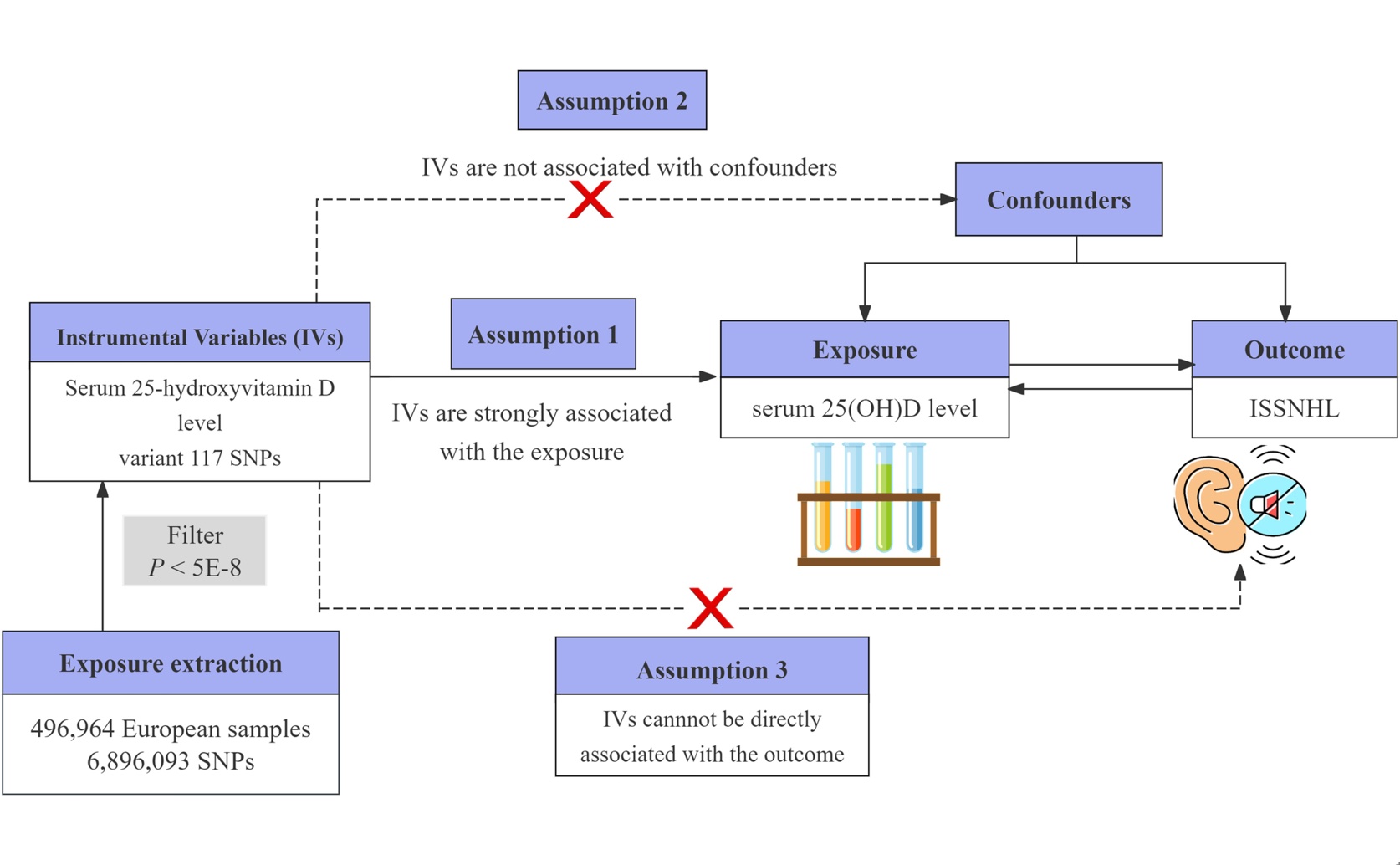
This schematic illustrates the two-sample Mendelian randomization framework which determined that there is no causal association between serum 25-hydroxyvitamin D levels and the risk of idiopathic sudden sensorineural hearing loss.

Image adapted from: Zhao et al. / CC BY (Source)

Key Findings

  • A Guangzhou Medical University study found that vitamin D levels do not directly cause sudden hearing loss
  • Genetic analysis of nearly half a million individuals showed no link between low vitamin D and the risk of developing ISSNHL
  • These results suggest that other factors, not vitamin D deficiency, may contribute to sudden hearing loss
Sudden sensorineural hearing loss (SSNHL) is a rapid loss of hearing, typically occurring in one ear, without a clear cause. Understanding the factors that contribute to SSNHL is crucial for developing effective treatments and prevention strategies. A recent study conducted by Guangzhou Medical University[1] aimed to explore whether low levels of vitamin D in the blood are a cause of idiopathic sudden sensorineural hearing loss (ISSNHL), a specific type of SSNHL with no identifiable origin. Previous research by the same institution[2] found that patients with SSNHL had significantly lower levels of 25-hydroxyvitamin D (25(OH)D), a marker for vitamin D status, compared to healthy individuals. In that study, 70% of SSNHL patients were vitamin D insufficient, compared to 44% of the control group, suggesting a possible link between vitamin D deficiency and the development of SSNHL. However, while these findings showed an association, they did not establish whether low vitamin D levels directly cause SSNHL or if the relationship is influenced by other factors. To address this uncertainty, the new study utilized a method called Mendelian randomization (MR), which uses genetic information to determine causal relationships. By analyzing large-scale genome-wide association study (GWAS) data, the researchers investigated whether genetically predicted vitamin D levels influence the risk of developing ISSNHL. The study included data from nearly half a million European individuals for vitamin D levels and over a million for ISSNHL cases and controls, ensuring robust and reliable results. The researchers identified specific genetic variations, known as single-nucleotide polymorphisms (SNPs), that are strongly associated with vitamin D levels. These SNPs served as instrumental variables (IVs) to evaluate the potential causal effect of vitamin D on ISSNHL. By using various statistical models, including MR-Egger and inverse variance weighted (IVW) methods, the study aimed to provide a comprehensive assessment of the relationship while accounting for possible confounding factors. The findings of the study were clear: there was no causal association between serum vitamin D levels and the risk of developing ISSNHL in the European population studied. The statistical analysis showed that changes in vitamin D levels did not significantly affect the likelihood of experiencing sudden sensorineural hearing loss. Additionally, the study confirmed that there was no evidence of heterogeneity or pleiotropy, meaning that the genetic variants used did not influence ISSNHL through other pathways unrelated to vitamin D. These results challenge the earlier findings[2] by suggesting that while low vitamin D levels are more common in individuals with SSNHL, they may not be a direct cause of the condition. This distinction is important for clinicians and researchers as it shifts the focus from vitamin D supplementation as a preventive measure for SSNHL to exploring other underlying mechanisms that might contribute to sudden hearing loss. The use of Mendelian randomization in this study is particularly noteworthy. Unlike observational studies that can be influenced by various confounding factors, MR analysis provides a more reliable approach to determining causality. By leveraging genetic data, the researchers could isolate the effect of vitamin D levels on ISSNHL, offering more definitive evidence regarding their relationship. While the study was comprehensive, focusing on a European population, it highlights the need for further research in diverse populations to confirm whether these findings are universally applicable. Additionally, exploring other potential factors that might contribute to SSNHL remains essential. Understanding the true causes of sudden hearing loss can lead to better diagnostic tools and more targeted treatments, ultimately improving outcomes for those affected by this condition. In summary, the recent research by Guangzhou Medical University provides important insights into the relationship between vitamin D levels and sudden sensorineural hearing loss. By employing advanced genetic analysis techniques, the study concluded that low vitamin D is not a causal factor for ISSNHL, despite previous associations observed in earlier studies[2]. This advancement underscores the complexity of SSNHL and the necessity for continued investigation into its underlying causes.

MedicineHealthGenetics

References

Main Study

1) Exploring the causal link between serum 25-hydroxyvitamin D concentrations and idiopathic sudden sensorineural hearing loss: Insights gained from a Mendelian randomization study involving two independent samples

Published 19th May, 2025

https://doi.org/10.1371/journal.pone.0322898


Related Studies

2) Association between Serum Vitamin D Levels and Risk of Sudden Sensorineural Hearing Loss: A cross-sectional Study.

https://doi.org/10.1007/s12070-023-03917-9


Related Articles

An unhandled error has occurred. Reload 🗙