Using Genetics in Healthcare: Insights, Challenges, and Future Steps

Jenn Hoskins
13th April, 2025

Using Genetics in Healthcare: Insights, Challenges, and Future Steps

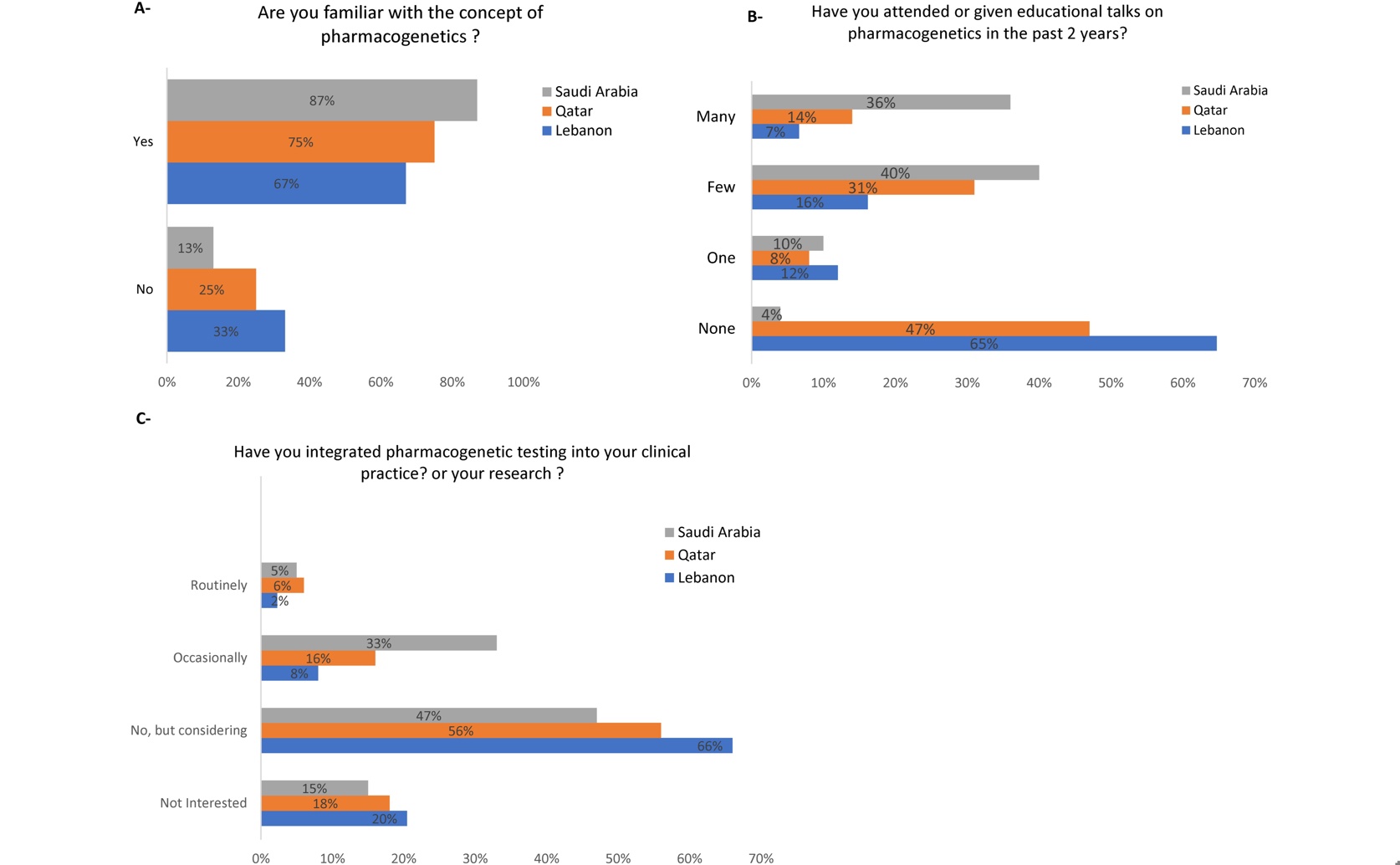
Healthcare professionals in Saudi Arabia and Qatar reported greater familiarity with pharmacogenomics (a) and higher participation in educational talks (b) compared to those in Lebanon, highlighting national disparities even as most respondents in all three countries are still only considering its integration into their practice (c).

Image adapted from: Shamieh et al. / CC BY (Source)

Key Findings

  • In Lebanon, Qatar, and Saudi Arabia, healthcare professionals show different levels of knowledge and training in pharmacogenomics (PGx)
  • High costs of PGx testing, especially in Lebanon, and limited infrastructure are significant barriers to its use
  • Most respondents believe PGx can enhance patient care and support its broader adoption in healthcare
Pharmacogenomics (PGx), the study of how genes affect a person's response to drugs, represents a significant advancement in personalized medicine. By understanding an individual's genetic makeup, healthcare providers can tailor drug therapies to enhance efficacy and minimize adverse effects. Despite its promise, the implementation of PGx in clinical settings varies globally, particularly in countries like Lebanon, Qatar, and Saudi Arabia. A recent study conducted by researchers from Beirut Arab University and other institutions[1] sheds light on the current state of PGx in these regions, highlighting both progress and challenges. The study aimed to assess the attitudes, knowledge, and implementation of PGx among healthcare professionals in Lebanon, Qatar, and Saudi Arabia. An anonymous online survey was distributed to a diverse group of participants, including healthcare professionals, academics, and clinicians. The survey comprised 18 questions designed to evaluate familiarity with PGx, current practices, perceived obstacles, integration strategies, and future educational needs. A total of 337 responses were analyzed, revealing significant differences in PGx familiarity and educational involvement across the three countries. Healthcare professionals in Qatar and Saudi Arabia demonstrated higher familiarity with PGx, with 83% and 75% of respondents respectively, compared to 67% in Lebanon. Participation in PGx-related educational activities was highest in Saudi Arabia (96%), followed by Qatar (53%) and Lebanon (35%). These findings align with previous research indicating that while pharmacogenomics holds great potential for improving patient outcomes[2], its adoption is uneven across different regions due to various systemic factors. One of the primary challenges identified in the study was the cost of PGx testing. Lebanon reported the highest concern regarding test costs at 16%, whereas Saudi Arabia had the lowest concern at 5%. This echoes the findings from a systematic review on the cost-effectiveness of PGx testing in developing countries, which highlighted that genotyping costs and the prevalence of risk alleles significantly influence the economic viability of PGx[3]. In addition to cost, insufficient physician knowledge and lack of infrastructure were major barriers to PGx implementation. These obstacles are consistent with broader challenges in integrating pharmacogenomics into healthcare systems, as noted in earlier studies[4]. Despite these challenges, there was a strong consensus among respondents about the potential of PGx to enhance patient care. Over 86% of participants across all three countries believed that PGx could lead to better treatment outcomes. This optimism is supported by the understanding that PGx can move beyond the trial-and-error approach traditionally used in prescribing medications, thereby reducing the risk of toxicity and adverse effects[2]. The study also highlighted varying educational interests, with significant focus on PGx applications in cancer chemotherapy in Saudi Arabia and Lebanon, and diabetes mellitus in Qatar. This specialization reflects the differing healthcare priorities and disease burdens in each country. The research conducted by Beirut Arab University and its collaborators underscores the importance of targeted strategies to overcome the barriers to PGx implementation. Integrating PGx education into healthcare training programs is essential to bridge the knowledge gap among physicians. Additionally, establishing robust infrastructure to support PGx testing can facilitate its adoption in clinical practice. These steps are crucial for unlocking the full potential of pharmacogenomics in optimizing patient care. Furthermore, the study's findings resonate with the global movement towards personalized medicine. As highlighted in previous research, advancements in genomics and data analysis are pivotal for the individualization of therapy[2][4]. By addressing the specific challenges identified in Lebanon, Qatar, and Saudi Arabia, these countries can contribute to the broader goal of mainstreaming genomic medicine worldwide. In conclusion, the study from Beirut Arab University and its partners provides valuable insights into the current landscape of pharmacogenomics in Lebanon, Qatar, and Saudi Arabia. It emphasizes the need for continued education, cost-effective testing solutions, and infrastructural improvements to facilitate the integration of PGx into clinical practice. Building on previous research, this study highlights both the potential benefits and the hurdles that must be addressed to realize the promise of personalized medicine in these regions.

MedicineHealthGenetics

References

Main Study

1) Integrating pharmacogenomics in three Middle Eastern countries’ healthcare (Lebanon, Qatar, and Saudi Arabia): Current insights, challenges, and strategic directions

Published 11th April, 2025

https://doi.org/10.1371/journal.pone.0319042


Related Studies

2) The Impact of Pharmacogenomics in Personalized Medicine.

https://doi.org/10.1007/10_2019_110


3) A systematic review on the cost effectiveness of pharmacogenomics in developing countries: implementation challenges.

https://doi.org/10.1038/s41397-022-00272-w


4) Pharmacogenomics: current status and future perspectives.

https://doi.org/10.1038/s41576-022-00572-8


Related Articles

An unhandled error has occurred. Reload 🗙