Detailed Study of Treated Celiac Disease Gut Bacteria Shows Varied Types

Jenn Hoskins
30th April, 2025

Detailed Study of Treated Celiac Disease Gut Bacteria Shows Varied Types

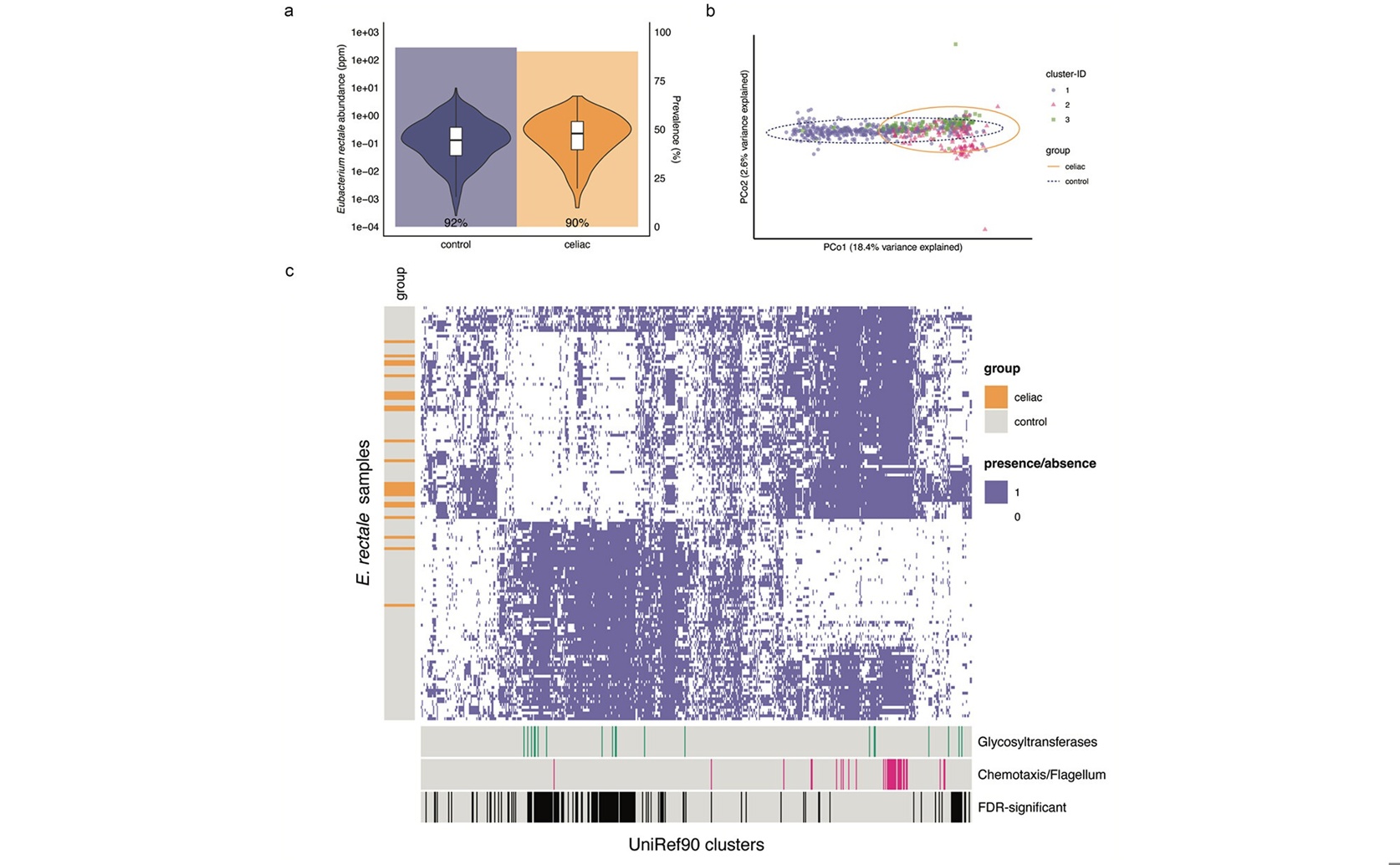
While the overall abundance of Eubacterium rectale is similar between treated Celiac disease patients and controls (a), strain-level analysis reveals that the non-motile European subspecies is nearly absent in patients, who are instead colonized by motile strains with a distinct carbohydrate metabolism potential (b, c).

Image adapted from: Slager et al. / CC BY (Source)

Key Findings

  • Researchers at the University of Groningen found that celiac disease patients on a gluten-free diet maintain a diverse gut microbiome, unlike those with IBS or IBD
  • Celiac patients showed higher levels of specific beneficial bacteria and greater variation in their gut bacteria compared to healthy individuals
  • A helpful European strain of Eubacterium rectale was nearly absent in celiac patients, highlighting unique changes in their gut microbiome
Celiac disease (CeD) is a chronic autoimmune disorder affecting approximately 1% of the global population[2]. Triggered by the ingestion of gluten, a protein found in wheat, barley, and rye, CeD causes inflammation and damage to the small intestine in genetically predisposed individuals[2][3]. While a strict gluten-free diet is the primary treatment, many patients continue to experience symptoms, highlighting the need for a deeper understanding of the disease's underlying mechanisms. Recent research conducted by the University of Groningen[1] explores the relationship between CeD and the gut microbiome—the community of microorganisms residing in the digestive tract. Previous studies have suggested that alterations in the gut microbiome may play a significant role in the development and progression of CeD[2][3]. However, these studies often faced limitations such as small sample sizes and limited analytical resolution, making it challenging to draw definitive conclusions. To address these gaps, the Groningen team analyzed fecal samples from two large Dutch cohorts: CeDNN, which included 128 treated CeD patients (tCeD) and 106 controls, and the Lifelines Dutch Microbiome Project, encompassing 24 self-reported tCeD individuals and 654 controls. They employed shotgun metagenomic sequencing, a comprehensive method that sequences all genetic material in a sample, allowing for detailed identification of microbial species and their functions. The study also compared the gut microbiomes of CeD patients with those of individuals with irritable bowel syndrome (IBS) and inflammatory bowel disease (IBD), conditions that also affect the gastrointestinal tract but have different underlying causes. By examining interindividual variation—the differences in microbiome composition between individuals—the researchers aimed to uncover specific patterns associated with CeD. One of the key findings was that, unlike IBS and IBD, which showed decreased microbiome diversity within individuals, tCeD patients maintained their microbiome diversity. Diversity in the gut microbiome is often linked to overall health, with higher diversity generally considered beneficial. This suggests that CeD may influence the microbiome in unique ways compared to other gastrointestinal disorders. The Groningen study identified several bacterial species that were more abundant in tCeD patients, including Clostridium sp. CAG:253, Roseburia hominis, and Eggerthella lenta. These findings align with previous research indicating that specific microbial patterns are associated with CeD[2][3]. Additionally, the study revealed that adherence to a gluten-free diet partially explained the observed changes in the microbiome, emphasizing the impact of dietary interventions on gut health. Another significant discovery was the increased interindividual variation in the gut microbiome of tCeD patients. This variation was further linked to a higher frequency of bacterial mutations at the strain level, suggesting that CeD may drive the evolution of certain gut bacteria. Moreover, the study found that the immotile European subspecies of Eubacterium rectale, known for its distinct carbohydrate metabolism, was nearly absent in tCeD patients. This absence could have implications for how carbohydrates are processed in the gut, potentially influencing CeD symptoms and overall intestinal health. These insights build on earlier studies that highlighted the genetic and environmental factors contributing to CeD[2][3][4]. For instance, genetic predispositions involving specific human leukocyte antigen (HLA) types are well-established risk factors for developing CeD[4]. The new findings from Groningen add another layer of complexity by demonstrating how the gut microbiome interacts with these genetic factors and dietary habits to influence disease outcomes. Understanding the interplay between the gut microbiome and CeD is crucial for developing novel treatments. While the gluten-free diet remains the cornerstone of CeD management, the persistent symptoms in some patients indicate that additional therapeutic strategies are needed[2]. By elucidating the specific changes in the microbiome associated with CeD, researchers can explore targeted interventions, such as probiotics or microbiome-modulating therapies, to complement dietary restrictions. The Groningen study also distinguishes CeD from other gastrointestinal disorders like IBS and IBD through unique microbial signatures. This differentiation is essential for accurate diagnosis and personalized treatment approaches, as it underscores that each condition has distinct underlying microbial dynamics despite some overlapping symptoms[2][3]. In summary, the research from the University of Groningen provides valuable insights into the role of the gut microbiome in celiac disease. By leveraging large cohorts and advanced sequencing techniques, the study overcomes previous limitations and reveals increased microbial variation and specific bacterial alterations in tCeD patients. These findings not only enhance our understanding of CeD but also pave the way for innovative treatments that go beyond the traditional gluten-free diet, potentially improving the quality of life for those affected by this complex autoimmune disorder.

MedicineHealthGenetics

References

Main Study

1) High-resolution analysis of the treated coeliac disease microbiome reveals strain-level variation

Published 27th April, 2025

https://doi.org/10.1080/19490976.2025.2489071


Related Studies


3) Celiac disease and non-celiac gluten sensitivity.

https://doi.org/10.1136/bmj.h4347


4) Celiac disease: prevalence, diagnosis, pathogenesis and treatment.

https://doi.org/10.3748/wjg.v18.i42.6036


Related Articles

An unhandled error has occurred. Reload 🗙