New Tool Uses Immune Cells to Predict Pancreatic Cancer Outcomes

Jenn Hoskins
4th May, 2025

New Tool Uses Immune Cells to Predict Pancreatic Cancer Outcomes

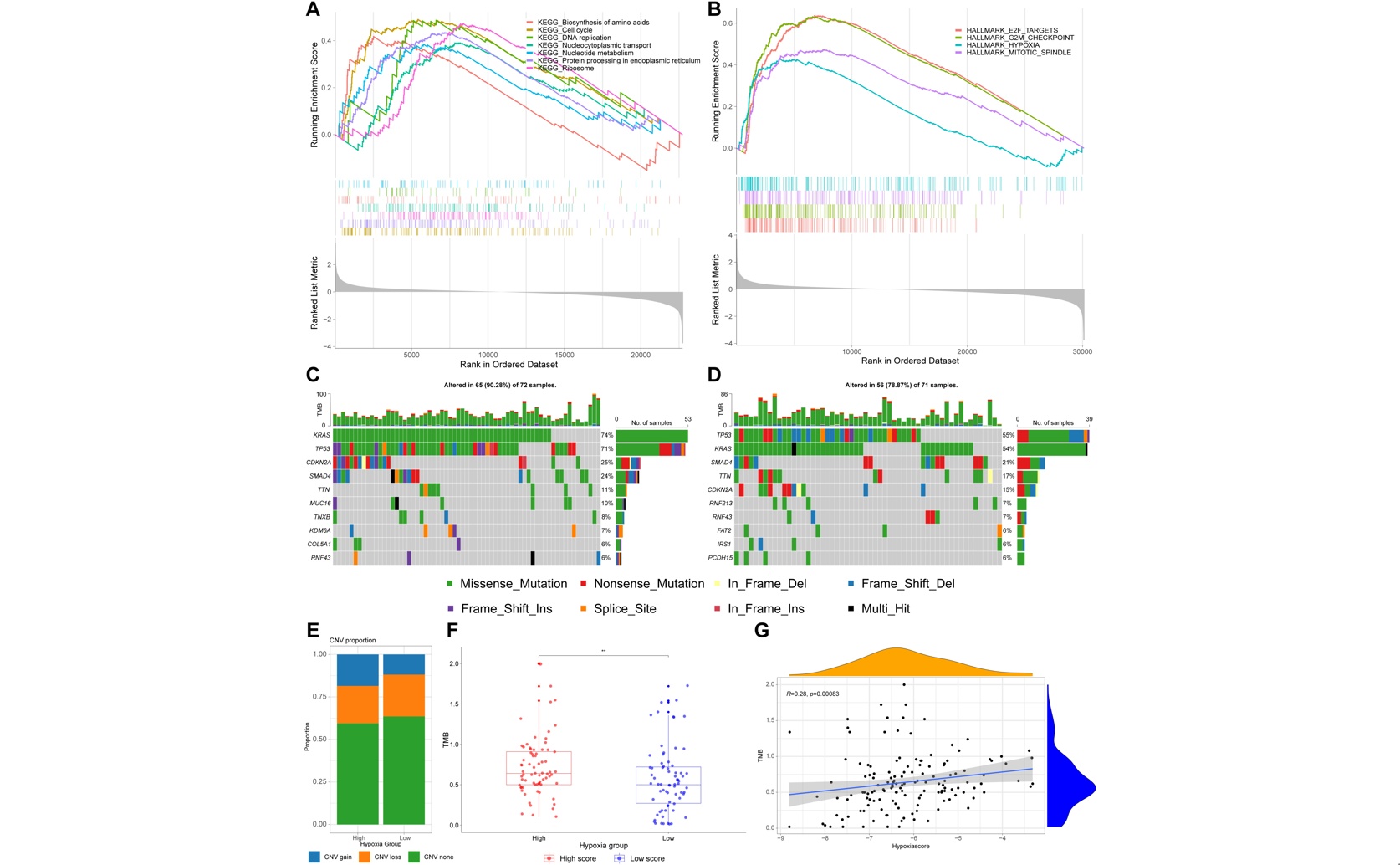
Patients with high hypoxia scores exhibit molecular features linked to poorer prognosis, including the enrichment of pathways related to cancer progression (a, b) and greater genomic instability, as shown by higher rates of genetic mutations (c–e) and a larger tumor mutational burden (f, g).

Image adapted from: Ge et al. / CC BY (Source)

Key Findings

  • Researchers at University Medical Center Hamburg-Eppendorf found that low oxygen levels in pancreatic tumors significantly affect certain immune cells called macrophages
  • They developed a new 13-gene model that more accurately predicts patient survival and response to chemotherapy than traditional methods
  • The gene KRTCAP2 was identified as a key marker associated with worse outcomes, highlighting it as a potential target for new treatments
Pancreatic cancer remains one of the most lethal malignancies, with a five-year survival rate of merely 4%[2]. One of the major challenges in treating pancreatic ductal adenocarcinoma (PDAC) is its resistance to conventional therapies, partly due to the tumor's hypoxic microenvironment. Hypoxia, a condition of low oxygen levels, plays a crucial role in tumor progression and resistance to treatment by altering the behavior of cancer cells and the surrounding immune cells. Researchers at the University Medical Center Hamburg-Eppendorf, Central South University, and the University of Nebraska Medical Center conducted a study to better understand how hypoxia influences PDAC and to develop a prognostic model that could predict patient outcomes more accurately[1]. By utilizing advanced techniques like single-cell RNA sequencing (scRNA-seq) and integrating data from the TCGA-PAAD database, the team identified specific subsets of macrophages—immune cells that can either suppress or promote tumor growth—that respond to hypoxic conditions. The study employed several statistical methods, including Kaplan-Meier survival analysis, Cox regression, and Lasso regression, to construct and validate a hypoxia-related prognostic model based on 13 critical genes. This model was able to independently predict both the sensitivity to chemotherapy and overall survival rates of PDAC patients, outperforming traditional clinicopathologic features such as tumor stage and patient age. This approach builds on earlier research that highlighted the importance of understanding the biological mechanisms behind pancreatic cancer progression and the role of the tumor microenvironment[2][3]. For instance, previous studies have shown that pancreatic cancer's desmoplastic and immunosuppressive microenvironment contributes significantly to its resistance to treatments like chemotherapy and immunotherapy[4]. By focusing on hypoxia-related genes, the new model provides a more nuanced view of the tumor's behavior and its interaction with the immune system. One of the standout findings from the study is the identification of KRTCAP2 as a pivotal biomarker. Higher levels of KRTCAP2 were associated with worse prognosis and reduced immune cell infiltration, suggesting that this gene could be a potential target for new therapies. Additionally, the pan-cancer analysis indicated that the hypoxia-related genes identified in PDAC are relevant across multiple types of cancer, underscoring the broader applicability of these findings. The study also echoes the need for early detection and improved management strategies in pancreatic cancer. Previous research has indicated that screening high-risk individuals, such as first-degree relatives of patients with pancreatic cancer, can help identify non-invasive precursors to the disease, potentially leading to earlier interventions[2]. The new hypoxia-related prognostic model could further enhance these efforts by providing more precise risk assessments and tailoring treatment strategies to individual patient profiles. In laboratory experiments, the researchers demonstrated that knocking down the gene EPS8 in pancreatic cancer cell lines significantly reduced the cells' viability, clonogenicity, migration, and invasion capabilities. This suggests that EPS8 plays a crucial role in the aggressiveness of pancreatic cancer and could be a target for future therapeutic interventions[2]. Overall, the study by the University Medical Center Hamburg-Eppendorf and its collaborators provides valuable insights into the role of hypoxia in pancreatic cancer and introduces a robust prognostic tool that could improve patient outcomes. By integrating single-cell sequencing data with large-scale genomic databases, the researchers have advanced our understanding of the tumor microenvironment and opened new avenues for personalized treatment approaches in one of the most challenging cancers to treat.

MedicineHealthGenetics

References

Main Study

1) Development of a hypoxia-responsive macrophage prognostic model using single-cell and bulk RNA sequencing in pancreatic cancer

Published 2nd May, 2025

https://doi.org/10.1371/journal.pone.0322618


Related Studies


3) A necroptosis related prognostic model of pancreatic cancer based on single cell sequencing analysis and transcriptome analysis.

https://doi.org/10.3389/fimmu.2022.1022420


4) Oncolytic adenovirus as pancreatic cancer-targeted therapy: Where do we go from here?

https://doi.org/10.1016/j.canlet.2023.216456


Related Articles

An unhandled error has occurred. Reload 🗙