Parent Behavior Influences Vocal Practice and Learning Processes

Greg Howard
16th May, 2025

Parent Behavior Influences Vocal Practice and Learning Processes

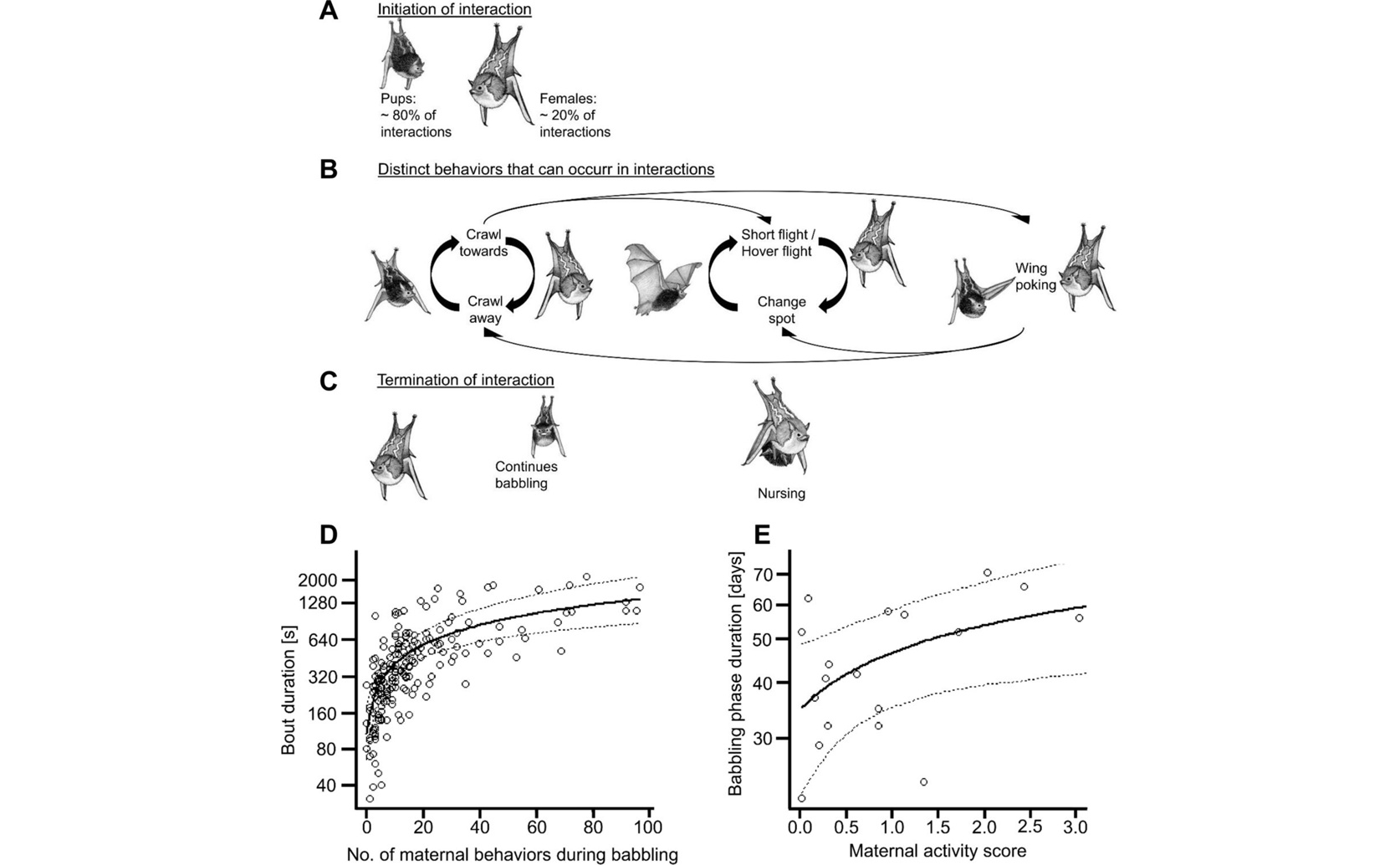
Illustrations of typical social interactions (a–c) accompany results demonstrating that maternal behavioral feedback significantly increases vocal practice in the Greater sac-winged bat (Saccopteryx bilineata) by prolonging both daily babbling bouts (d) and the overall duration of the babbling phase (e).

Image adapted from: Fernandez et al. / CC BY (Source)

Key Findings

  • *In Panama and Costa Rica, bat pups with more engaged mothers practice singing longer each day.*
  • *These pups develop a wider variety of adult-like song sounds and more mature vocalizations.*
  • *Having more adult singing males nearby did not enhance the bats' vocal learning.*
Understanding how young animals learn their vocalizations is crucial for unraveling the complexities of communication and social interaction in the animal kingdom. While extensive research has been conducted on human infants, exploring how social interactions shape vocal learning in non-human species remains a challenging endeavor. A recent study by Fernandez et al. from the Museum für Naturkunde, Leibniz Institute, Berlin[1] sheds light on this topic by investigating the vocal development of greater sac-winged bat pups in their natural habitat. Greater sac-winged bats, native to the rainforests of Central and South America, exhibit a unique form of vocal learning similar to human infant babbling. These bat pups spend a significant portion of their daytime engaged in vocal practice, imitating the songs of adult males. Unlike humans, where multiple caregivers interact with infants, bat pups primarily interact with their mothers, while adult males serve as the main source of acoustic input. This distinct social structure provides an excellent opportunity to examine the role of maternal feedback in vocal learning. Fernandez et al. followed nineteen bat pups from wild colonies in Panama and Costa Rica over two breeding seasons. The researchers focused on three key aspects of vocal learning: the duration of babbling practice, the diversity and number of song syllables produced, and the maturity of these syllables compared to those of adult males. Additionally, they monitored the frequency of maternal interactions, such as hovering or touching, and the number of adult males present in the pups' environment. The study revealed that bat pups with more involved mothers engaged in longer and more frequent vocal practice sessions. These pups also developed a broader range of adult-like song syllables and a higher proportion of mature syllables resembling those of adult singers. Interestingly, the presence of multiple singing males did not correlate with improved vocal learning outcomes. This indicates that it is not merely the quantity of adult vocal input that matters, but the quality and nature of maternal interactions that significantly influence vocal development. These findings resonate with earlier research on vocal coordination and social interactions. For instance, previous studies have demonstrated that vocal coordination between infants and adults plays a vital role in the development of social, cognitive, emotional, and linguistic abilities[2]. Moreover, the social function of babbling in human infants involves eliciting parental behaviors that facilitate learning about speech and language[3]. Fernandez et al.'s work extends these concepts to a non-human species, highlighting that maternal feedback is equally crucial in shaping vocal learning processes in bats. Furthermore, the study contrasts with research on other vocal learners, such as songbirds. In zebra finches, for example, the presence of adult females enhances song imitation accuracy, and specific neural mechanisms respond to female calls during singing in juveniles[4]. While both studies emphasize the importance of social feedback in vocal learning, they also illustrate species-specific differences in how social environments influence learning processes. The methodology employed by Fernandez et al. involved meticulous long-term monitoring of bat pups in their natural settings, allowing for the observation of natural behaviors and interactions. By correlating vocal development metrics with maternal interaction frequencies and the presence of adult males, the researchers could isolate the impact of maternal feedback on vocal learning. This approach provides a comprehensive understanding of the social dynamics involved in the acquisition of complex vocalizations. In summary, the study by Fernandez et al. underscores the pivotal role of maternal behavior in the vocal ontogeny of greater sac-winged bats. It demonstrates that maternal feedback significantly enhances the amount of vocal practice, the diversity of song syllables, and the maturation of these vocalizations in bat pups. By bridging findings from human infant studies and research on other vocal learners, this work advances our understanding of the universal and species-specific mechanisms underlying vocal learning in the animal kingdom.

EcologyAnimal Science

References

Main Study

1) Maternal behavior influences vocal practice and learning processes in the greater sac-winged bat

Published 13th May, 2025

https://doi.org/10.7554/eLife.99474


Related Studies

2) Multiple Coordination Patterns in Infant and Adult Vocalizations.

https://doi.org/10.1111/infa.12165


3) The social functions of babbling: acoustic and contextual characteristics that facilitate maternal responsiveness.

https://doi.org/10.1111/desc.12641


4) Female calls promote song learning in male juvenile zebra finches.

https://doi.org/10.1038/s41467-024-53251-z


Related Articles

An unhandled error has occurred. Reload 🗙