Predicting Livestock Disease with Habitat Models

Jenn Hoskins
23rd April, 2025

Predicting Livestock Disease with Habitat Models

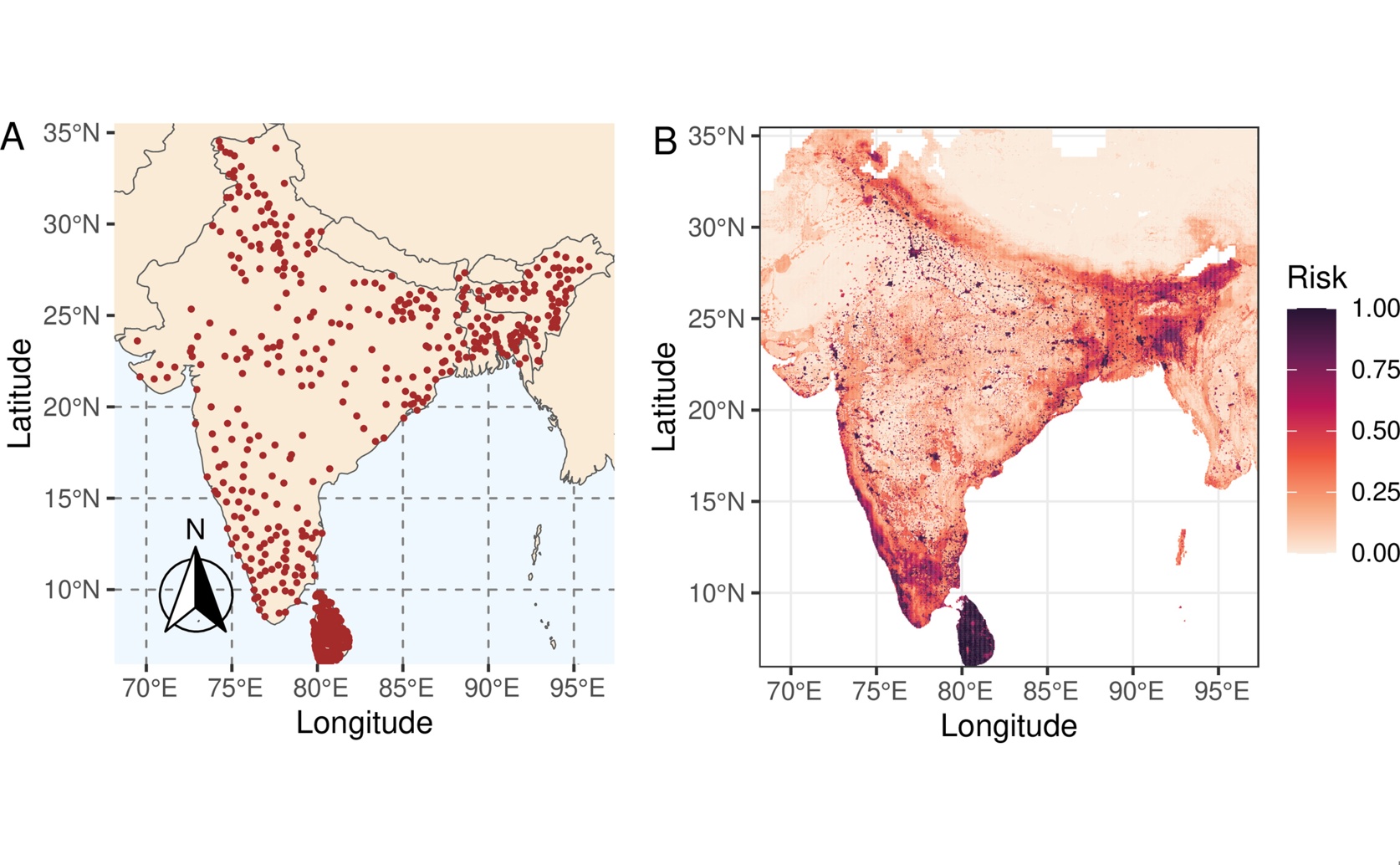
Based on reported outbreak locations in India, Bangladesh, and Sri Lanka (a), the machine learning model predicts a high probability of foot-and-mouth disease risk across much of India, while identifying comparatively lower risk in Bangladesh and Sri Lanka (b).

Image adapted from: Gunasekera et al. / CC BY (Source)

Key Findings

  • In South Asia, a study by the University of Minnesota identified India as having higher risk areas for Foot-and-mouth disease compared to Bangladesh and Sri Lanka
  • The research found that high cattle densities and certain climate conditions significantly increase the chances of disease spreading in these regions
  • Using advanced modeling techniques, the study helps target monitoring and control efforts more effectively, supporting farmers and protecting the agriculture sector
Foot-and-mouth disease (FMD) is a highly contagious viral disease that affects livestock such as cattle, buffaloes, sheep, and goats. Controlling FMD is challenging due to its ability to spread rapidly through animal populations and the complexities involved in monitoring and managing outbreaks across different regions. Effective control strategies are essential to prevent significant economic losses in the agriculture sector and ensure food security. A recent study by the University of Minnesota[1] has advanced our understanding of FMD risk in South Asia by using an ecological niche model (ENM) that accounts for under-reporting of outbreaks. This study focused on three South Asian countries: India, Bangladesh, and Sri Lanka. By analyzing 660 reported FMD outbreaks over 13 years (2009–2022), the researchers aimed to identify high-risk areas and the factors contributing to the spread of the disease. The University of Minnesota team employed a multi-algorithm machine-learning ensemble, which included methods such as random forest, support vector machines, and gradient boosting. They considered 15 predictive variables, including livestock densities, land cover, and climate data. The model was primarily fitted using data from India and then applied to predict risks in Bangladesh and Sri Lanka. The results indicated that Sri Lanka and Bangladesh have a low to medium risk of FMD outbreaks, with risk probabilities ranging from 0.04 to 0.55. In contrast, certain regions in India showed higher levels of risk, highlighting areas where surveillance and control measures should be intensified. This approach builds on previous research that has explored the spatial distribution of FMD in different contexts. For instance, a study in Pakistan[2] utilized a probability co-kriging model to map FMD outbreaks between 1996 and 2000, identifying the Punjab region as a high-risk area due to its dense livestock populations and its position along an international animal trade route. Similarly, research in Vietnam[3] analyzed FMD cases from 2007 to 2017, revealing significant temporal patterns and spatial clusters, particularly during the dry season. These studies underscore the importance of regional factors such as livestock density and climatic conditions in the spread of FMD. Furthermore, the use of ecological niche modeling as highlighted in the University of Minnesota’s study aligns with broader advancements in spatial epidemiology[4]. Ecological niche models consider the interactions between hosts and pathogens, providing a more comprehensive understanding of disease dynamics. This method allows for the incorporation of various biological and environmental factors, enhancing the accuracy of risk predictions. The University of Minnesota’s study identified key predictors of FMD outbreaks, including production systems, isothermality (which measures temperature variability), cattle density per square kilometer, and the mean diurnal temperature range. These factors are critical in determining areas where FMD is more likely to spread. For example, high cattle densities can facilitate the transmission of the virus, while specific climate conditions may favor the virus’s survival and transmission. The high predictive performance of the machine learning models, with accuracy exceeding 0.87, demonstrates the effectiveness of this approach in forecasting FMD risk. By accurately identifying low-risk areas, resources for surveillance can be allocated more efficiently, reducing the burden on regions with minimal threat. Conversely, high-risk areas can receive enhanced monitoring and additional confirmatory testing to quickly identify and contain outbreaks. This targeted strategy is particularly beneficial in regions like South Asia, where large populations of livestock and varying climatic conditions can complicate disease control efforts. By focusing on regions with the highest relative probabilities of outbreaks, policymakers and veterinary authorities can implement more effective and cost-efficient control measures. Incorporating findings from Pakistan and Vietnam, the University of Minnesota’s study provides a more nuanced understanding of FMD distribution across South Asia. It highlights the importance of regional cooperation and data sharing in managing transboundary diseases. Additionally, the study emphasizes the need for continuous improvement in surveillance systems to better capture outbreak data and refine predictive models. Overall, this research represents a significant step forward in the fight against FMD. By leveraging advanced modeling techniques and integrating diverse data sources, it offers a robust framework for predicting and controlling FMD outbreaks. As ecological niche modeling continues to evolve, its application in veterinary epidemiology is likely to expand, providing even greater insights into the dynamics of infectious diseases in livestock populations.

AgricultureEcologyAnimal Science

References

Main Study

1) Ecological niche modeling for surveillance of foot-and-mouth disease in South Asia

Published 22nd April, 2025

https://doi.org/10.1371/journal.pone.0320921


Related Studies

2) Spatial distribution of foot-and-mouth disease in Pakistan estimated using imperfect data.

Journal: Preventive veterinary medicine, Issue: Vol 76, Issue 3-4, Oct 2006


3) Temporal patterns and space-time cluster analysis of foot-and-mouth disease (FMD) cases from 2007 to 2017 in Vietnam.

https://doi.org/10.1111/tbed.13370


4) Ecological Niche Modeling: An Introduction for Veterinarians and Epidemiologists.

https://doi.org/10.3389/fvets.2020.519059


Related Articles

An unhandled error has occurred. Reload 🗙