Protein Droplets Help Create New Purines in Cells

Jim Crocker
11th April, 2025

Protein Droplets Help Create New Purines in Cells

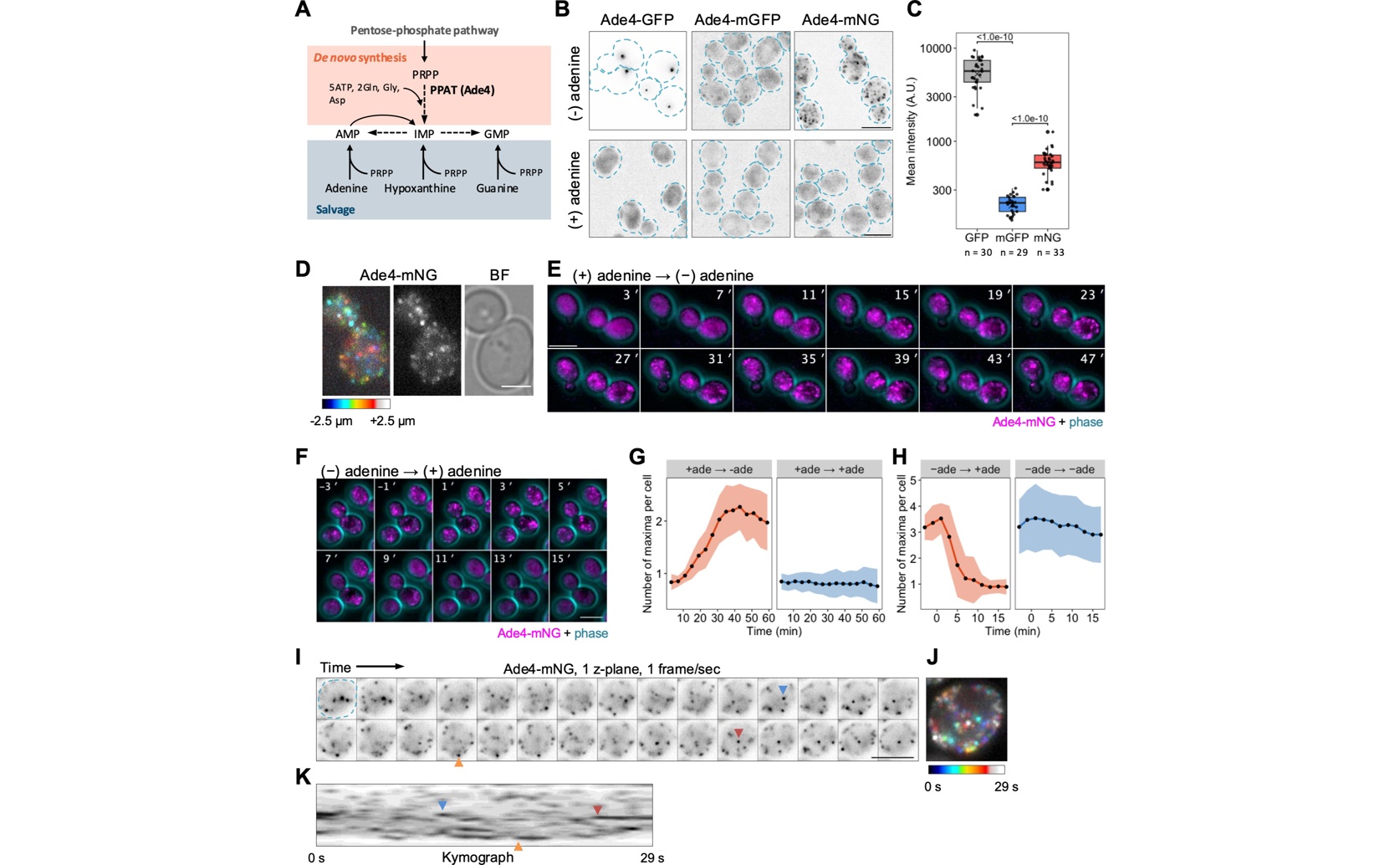
In budding yeast (Saccharomyces cerevisiae), the key purine synthesis enzyme PPAT (Ade4) demonstrates a crucial regulatory behavior by rapidly assembling into fine, motile cytoplasmic particles when external purines are removed (b–e, g, i–k) and quickly disassembling when purines are added back (f, h).

Image adapted from: Takaine et al. / CC BY (Source)

Key Findings

  • *University of Geneva researchers discovered that cells form special clusters of the enzyme PPAT to increase purine production when needed.*
  • *These PPAT clusters are controlled by the TORC1 pathway, which manages cell growth and metabolism.*
  • *Cells that cannot form PPAT clusters show significant growth problems, highlighting the importance of this mechanism.*
Purine nucleotides are essential molecules that serve not only as the building blocks for DNA and RNA but also play crucial roles in cellular energy transfer and signaling. Ensuring a steady supply of purines is vital for cell survival and proliferation, particularly in rapidly growing cells such as cancer cells. While cells can produce purines through two pathways—the de novo synthesis pathway and the salvage pathway—the regulation of these pathways during different growth conditions remains not fully understood[2]. Recent research conducted by scientists at the University of Geneva[1] has shed light on the regulatory mechanisms governing the de novo purine synthesis (DPS) pathway. DPS is up-regulated when cells experience high purine demand, ensuring the production of necessary genetic materials and energy to support cell growth. However, the precise mechanisms that control DPS activation under these conditions were previously unclear. The study focused on PRPP amidotransferase (PPAT), a key enzyme in the DPS pathway that acts as a rate-limiting step in purine nucleotide biosynthesis. The researchers discovered that under purine-depleted conditions, PPAT forms dynamic and motile condensates within Saccharomyces cerevisiae cells. These condensates are specialized structures where multiple PPAT molecules cluster together, enhancing the efficiency of purine synthesis. The formation of these condensates is driven by a process known as phase separation, which is influenced by the activity of the target of rapamycin complex 1 (TORC1). TORC1 is a central regulator of cell growth and metabolism, and its role in ribosome biosynthesis is crucial for the formation and maintenance of PPAT condensates[3]. The study employed molecular dynamics simulations to understand how PPAT molecules interact within these condensates. The simulations suggested that the clustering of PPAT facilitates a process called substrate channeling, where intermediates are efficiently passed between enzymes without diffusing away. This mechanism increases the overall rate of purine synthesis, making the process more efficient in response to cellular demands. Furthermore, the research revealed that intracellular levels of PRPP and purine nucleotides regulate the self-assembly of PPAT molecules into condensates. High levels of purine nucleotides, which indicate sufficient purine availability, inhibit condensate formation, thereby reducing DPS activity. Conversely, low purine levels promote condensate formation, ensuring that purine synthesis is ramped up to meet cellular needs. This regulatory feedback ensures that cells maintain purine homeostasis without expending unnecessary energy on de novo synthesis when salvage pathways can suffice[2]. The physiological importance of PPAT condensates was demonstrated by observing yeast cells that were genetically modified to be unable to form these condensates. These cells exhibited significant growth defects, highlighting that the ability to form PPAT condensates is critical for normal cell proliferation under purine-depleted conditions. This finding underscores the adaptive nature of condensate formation in responding to metabolic demands. This study builds on previous findings that have explored the regulation of purine metabolism. For example, research from Gunma University[2] showed that the activity of amidophosphoribosyltransferase (ATase), another key enzyme in the de novo pathway, is closely linked to cell growth rates and that the salvage pathway is preferentially used when hypoxanthine is available. Additionally, studies from the University of Tsukuba[4] introduced the concept of purinosomes—multienzyme complexes that form under high purine demand to streamline purine synthesis. The discovery of PPAT condensates complements these findings by providing a molecular mechanism through which purinosomes may be regulated and stabilized within the cell. Moreover, the work from Gunma University[3] on the phase separation of metabolic enzymes emphasizes the broader significance of condensate formation in regulating metabolic pathways. The University of Geneva's study extends this understanding by linking TORC1 activity to the formation of PPAT condensates, thereby connecting environmental and cellular signals to metabolic regulation. In conclusion, the formation of PPAT condensates represents a sophisticated regulatory mechanism that allows cells to efficiently manage purine synthesis in response to varying metabolic demands. By leveraging phase separation and substrate channeling, cells can dynamically adjust DPS activity, ensuring the availability of essential purines while conserving energy. This adaptive strategy not only enhances our understanding of cellular metabolism but also opens potential avenues for therapeutic interventions targeting purine synthesis in diseases characterized by abnormal cell proliferation, such as cancer.

Biochem

References

Main Study

1) Phase separation of the PRPP amidotransferase into dynamic condensates promotes de novo purine synthesis in yeast

Published 10th April, 2025

https://doi.org/10.1371/journal.pbio.3003111


Related Studies

2) Amidophosphoribosyltransferase limits the rate of cell growth-linked de novo purine biosynthesis in the presence of constant capacity of salvage purine biosynthesis.

Journal: The Journal of biological chemistry, Issue: Vol 272, Issue 28, Jul 1997


3) Regulation of Cellular Metabolism through Phase Separation of Enzymes.

https://doi.org/10.3390/biom8040160


4) A New View into the Regulation of Purine Metabolism: The Purinosome.

https://doi.org/10.1016/j.tibs.2016.09.009


Related Articles

An unhandled error has occurred. Reload 🗙