Understanding Early Bud Growth in Grapevines Through Gene Activity Comparisons

Greg Howard
8th April, 2025

Understanding Early Bud Growth in Grapevines Through Gene Activity Comparisons

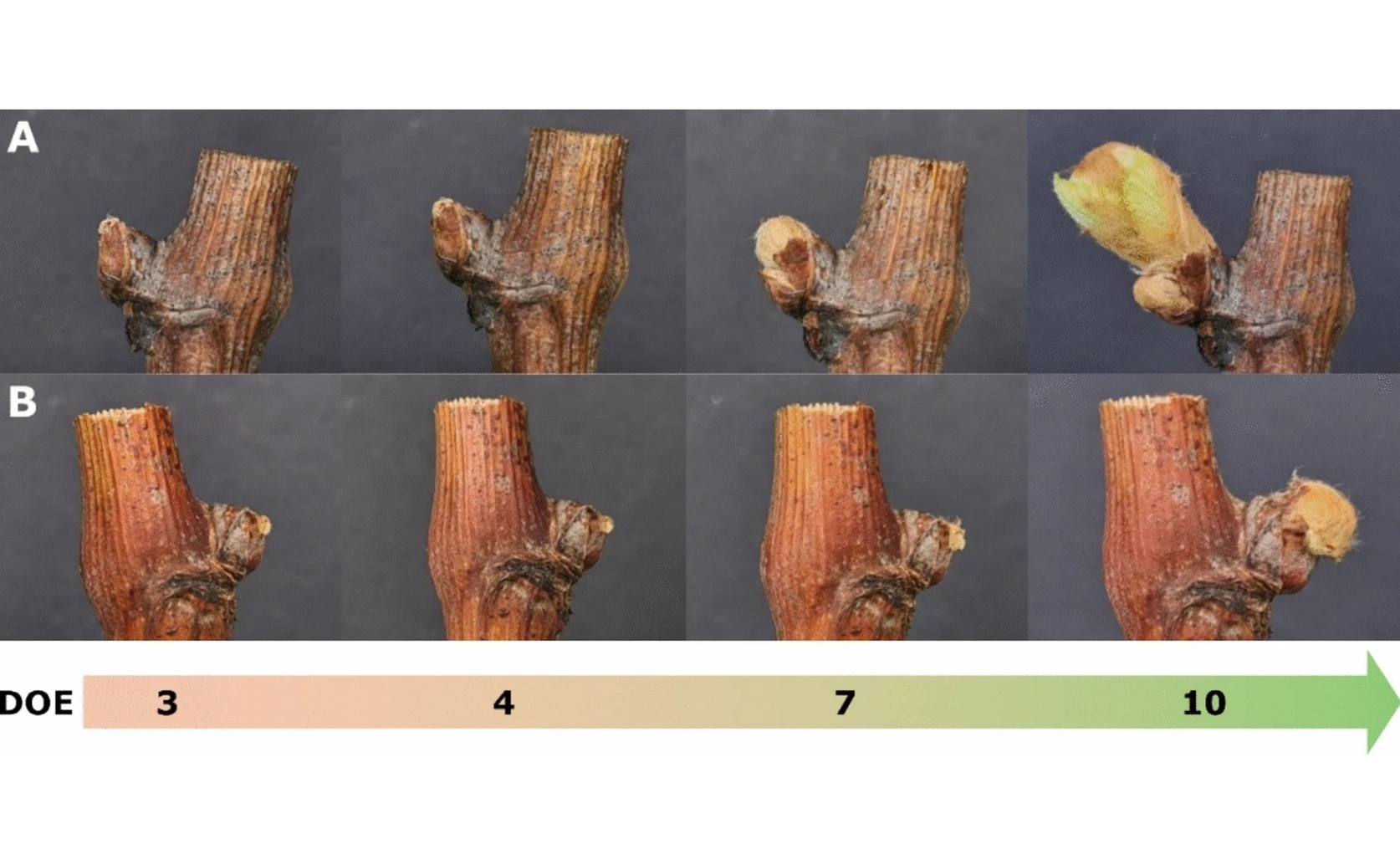
This visual timeline confirms that buds of the early-breaking grapevine (Vitis vinifera) cultivar Chardonnay (A) develop significantly faster than those of the late-breaking cultivar Cabernet Sauvignon (B), providing the physical basis for the study's molecular investigation into budbreak timing.

Image adapted from: Rosa et al. / CC BY (Source)

Key Findings

  • Researchers at the University of Udine found that Chardonnay grapevines resume growth from dormancy earlier than Cabernet Sauvignon, helping reduce frost damage risks
  • They identified key genes and hormones, like VviFT and ABA, that regulate this dormancy cycle in different grape varieties
  • These insights can aid grape growers in developing and selecting varieties that are more resilient to climate change and frost threats
Grapevine cultivation faces increasing challenges due to global warming, which accelerates bud development and heightens the risk of spring frost damage. Understanding the dormancy cycle of grapevines is crucial for mitigating these risks and ensuring sustainable production. Dormancy, a period when growth temporarily ceases, helps grapevines survive unfavorable conditions. However, studying dormancy, particularly budbreak—the process where buds resume growth—is complex due to reduced plant activity during winter[2]. Researchers at the University of Udine have advanced our understanding of grapevine dormancy by using single-node cuttings to study budbreak timing and the genetic regulation involved in different grapevine cultivars, specifically Chardonnay and Cabernet Sauvignon[1]. This approach addresses the limitations of traditional field studies, which are time-consuming and heavily influenced by environmental variables. The study began by confirming that Chardonnay and Cabernet Sauvignon exhibit different rates of dormancy release, a finding supported by both visual phenotyping and differential thermal analysis. Visual phenotyping involves observing and recording budbreak progression, while differential thermal analysis measures changes in bud temperature, which correlate with metabolic activities related to growth resumption. Building on previous research that established methods for analyzing budbreak distribution[2], the University of Udine team developed a robust framework to classify dormancy stages—paradormancy, endodormancy, and ecodormancy—based on the timing of budbreak events. This classification allows for a more precise understanding of when each dormancy stage occurs, moving away from arbitrary criteria and instead relying on statistical confidence. The study delved into the molecular mechanisms controlling dormancy by examining gene expression patterns. Gene Ontology (GO) analysis revealed specific categories where Chardonnay and Cabernet Sauvignon showed similar but shifted expression patterns. This suggests that while both cultivars regulate common molecular processes during dormancy, they do so on different timelines. A key finding was the role of the VviFT gene, which aligns with the observed timing shifts in budbreak, highlighting its potential importance in regulating this process. Additionally, the research identified the ABA (abscisic acid) hormone as a significant inhibitor of growth resumption, corroborating findings from earlier studies that emphasize ABA's role in maintaining dormancy[2]. The study also pinpointed genes such as VviSVP2 and VviDRM1 as possible repressors of dormancy release. These genes are part of the MADS-box transcription factors family, previously linked to dormancy control in apples[3]. The identification of these repressors provides deeper insight into the genetic regulation of dormancy and suggests potential targets for breeding programs aimed at improving cold resilience. The findings of this study are particularly relevant in the context of climate change, which poses a significant threat to viticulture by altering temperature patterns and increasing the unpredictability of frost events[4]. By understanding the genetic and molecular bases of dormancy, grape growers can develop strategies to better manage budbreak timing, thereby reducing the risk of frost damage and enhancing grapevine resilience. Moreover, this research integrates and expands upon previous studies by providing a statistical method to analyze budbreak data[2], exploring the role of MADS-box transcription factors in dormancy[3], and addressing the broader implications of climate change on bud phenology[4]. The use of single-node cuttings as a tool for studying dormancy offers a controlled environment to dissect the complex interactions between genetics and environmental factors, paving the way for more detailed and accurate studies in the future. In conclusion, the University of Udine's study offers significant advancements in grapevine dormancy research by combining phenotypic analysis with molecular genetics. The identification of key genes involved in budbreak and the development of a robust classification framework for dormancy stages provide valuable tools for both researchers and grape growers. As climate-related challenges continue to impact viticulture, such research is essential for developing sustainable practices and ensuring the longevity of grapevine cultivation worldwide.

GeneticsBiochemPlant Science

References

Main Study

1) Modeling budbreak precocity in grapevine: insights from comparative gene expression analysis in single-node cuttings

Published 5th April, 2025

https://doi.org/10.1007/s00425-025-04677-2


Related Studies

2) Time-to-event analysis to evaluate dormancy status of single-bud cuttings: an example for grapevines.

https://doi.org/10.1186/s13007-018-0361-0


3) Unraveling the role of MADS transcription factor complexes in apple tree dormancy.

https://doi.org/10.1111/nph.17710


4) Cold Hardiness Dynamics and Spring Phenology: Climate-Driven Changes and New Molecular Insights Into Grapevine Adaptive Potential.

https://doi.org/10.3389/fpls.2021.644528


Related Articles

An unhandled error has occurred. Reload 🗙