How Protein Interactions Keep Cell Division Working

Jenn Hoskins
7th April, 2025

How Protein Interactions Keep Cell Division Working

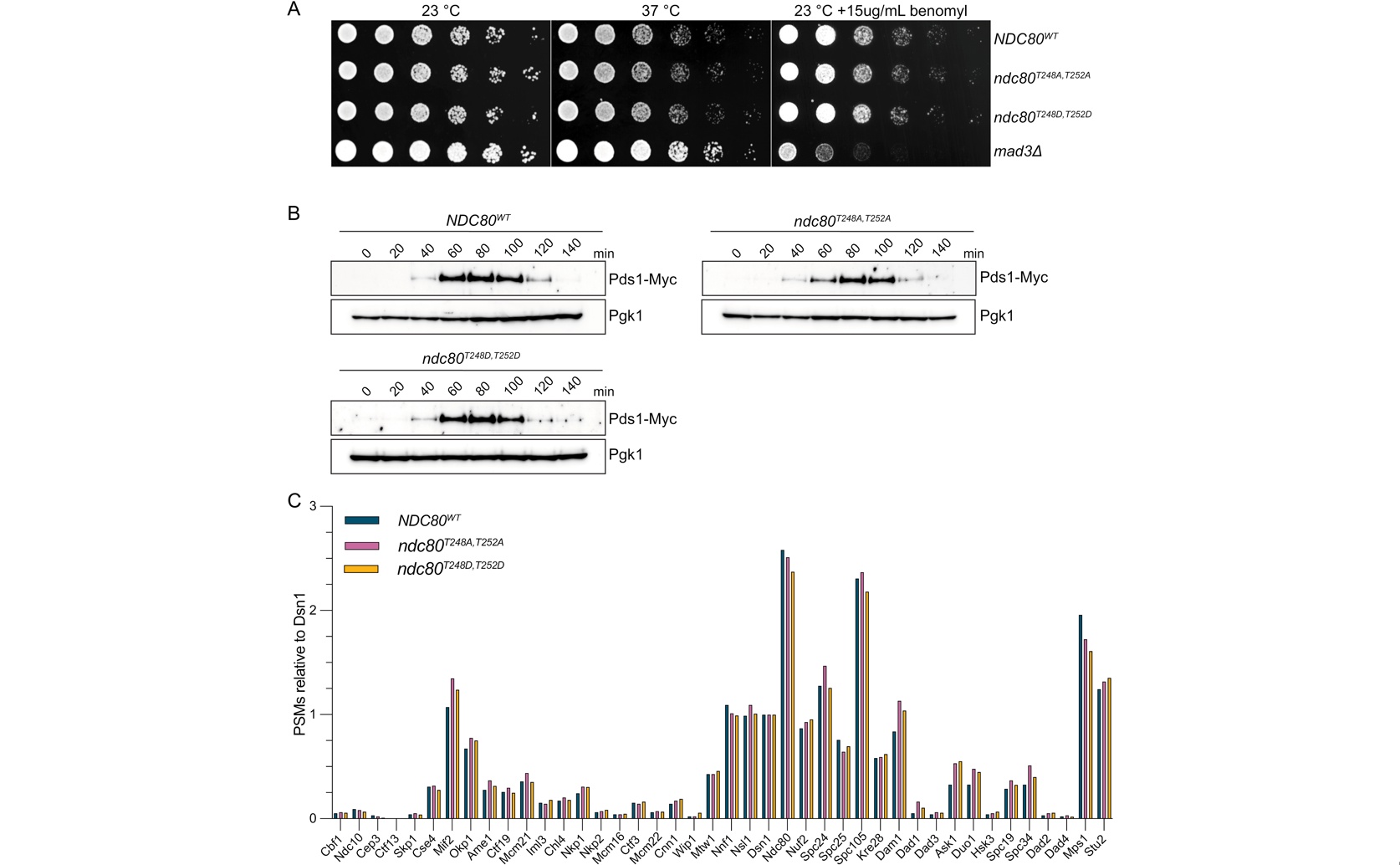
Mutating the Ndc80 phosphorylation sites has no significant effect on yeast cell viability (a), the timing of cell division (b), or the protein composition of the kinetochore (c), demonstrating that this regulatory event is dispensable for fundamental kinetochore functions and instead controls mitotic spindle integrity.

Image adapted from: Nelson et al. / CC BY (Source)

Key Findings

  • Researchers at the University of Washington discovered how two proteins work together to ensure chromosomes are correctly separated during cell division
  • They found that specific modifications on the Ndc80 protein enhance its interaction with Dam1c, helping maintain the structure that divides cells
  • Disrupting this process can lead to errors in chromosome separation, which may contribute to diseases like cancer
Chromosome segregation is a fundamental process ensuring that each daughter cell receives an accurate copy of genetic material during cell division. Central to this process are kinetochores, large protein complexes that attach chromosomes to microtubules, the dynamic structures that facilitate chromosome movement during anaphase, the stage of mitosis where sister chromatids are pulled apart. Understanding the precise mechanisms that regulate kinetochore function is essential for comprehending how cells maintain genetic stability, and disruptions in this process can lead to diseases such as cancer. A recent study conducted by researchers at the University of Washington[1] sheds light on the regulatory events that control kinetochore function, particularly focusing on the interaction between two critical protein complexes: Dam1c and Ndc80c. These complexes work together to ensure that kinetochores remain attached to the growing ends of microtubules, allowing chromosomes to be accurately segregated. Additionally, the Dam1 complex plays a unique role in maintaining the integrity of the mitotic spindle, the structure responsible for separating chromosomes during cell division. However, the precise events that coordinate these diverse functions of Dam1c were previously unclear. To unravel these regulatory mechanisms, the research team employed phosphoproteomics, a technique that identifies phosphorylation events on proteins. Phosphorylation, the addition of a phosphate group to a protein, is a common way cells regulate protein activity and interactions. By analyzing purified kinetochore proteins, the researchers identified several new phosphorylation sites, providing insights into how kinetochore functions are controlled during the cell cycle. One of the key findings of the study is the phosphorylation of the Ndc80 protein at two specific threonine residues, Thr-248 and Thr-252. This modification promotes the interaction between Ndc80 and Dam1c, enhancing their cooperative function in tracking microtubule plus-ends. Interestingly, the phosphorylation of Thr-248 is regulated by the cell cycle and depends on the kinase Mps1, an enzyme known to play critical roles in mitotic checkpoint control. Contrary to initial expectations, the phosphorylation of Ndc80 at these sites does not appear to directly regulate kinetochore function. Instead, it facilitates the localization of Dam1c to the anaphase spindle, thereby contributing to spindle organization and stability. Further investigations using a phospho-deficient mutant of Ndc80, which cannot be phosphorylated at Thr-248 and Thr-252, revealed genetic interactions and changes in spindle morphology when combined with mutations in Dam1. This suggests that the phosphorylation of Ndc80 is crucial for the proper functioning of Dam1c in spindle maintenance during anaphase. These findings build upon earlier research on centromere function in yeast. Previous studies identified the CSE4 gene, essential for proper kinetochore assembly and chromosome segregation[2]. CSE4 encodes a protein similar to the histone H3, indicating its role in forming a specialized nucleosome structure at the centromere, which is critical for kinetochore attachment and function. The current study complements this by detailing how post-translational modifications, specifically phosphorylation, of kinetochore components like Ndc80 are necessary for the dynamic interactions required during chromosome segregation. By elucidating the role of Mps1-dependent phosphorylation in regulating the interaction between Ndc80 and Dam1c, the University of Washington team provides a clearer picture of the molecular choreography that ensures accurate chromosome segregation. This regulatory mechanism likely represents an evolutionarily conserved process, given the similarity of the centromere proteins across different species, as seen in the earlier study[2]. Understanding these interactions not only advances our knowledge of basic cellular processes but also has potential implications for developing therapeutic strategies targeting cell division in diseases characterized by genomic instability. In summary, the study identifies specific phosphorylation events on Ndc80 that are essential for the proper localization and function of Dam1c during anaphase. By uncovering these regulatory steps, the research enhances our understanding of kinetochore-microtubule dynamics and the maintenance of spindle integrity, key factors in ensuring the fidelity of chromosome segregation.

GeneticsBiochem

References

Main Study

1) Spindle integrity is regulated by a phospho-dependent interaction between the Ndc80 and Dam1 kinetochore complexes

Published 4th April, 2025

https://doi.org/10.1371/journal.pgen.1011645


Related Studies

2) A mutation in CSE4, an essential gene encoding a novel chromatin-associated protein in yeast, causes chromosome nondisjunction and cell cycle arrest at mitosis.

Journal: Genes & development, Issue: Vol 9, Issue 5, Mar 1995


Related Articles

An unhandled error has occurred. Reload 🗙